Showing posts with label favourites. Show all posts

Saturday, April 11, 2020

OOTD: Repping my favourite and least favourite films of 2019

In this aesthetic, I'm pairing a Parasite T-shirt (my favourite film of 2019 and one of my favourite movies of all time; I was so buzzing to be proved wrong, and see it win Best Film and Best Director at the Oscars over CoD: WW1!) with a floral headband a la Florence Pugh in Midsommar. I despised Midsommar - it was all kinds of toxic indulgent garbage, but I will concede that floral garlands are a very pretty look.

T-shirt: RedBubble (bought online)
Floral headband: Accessorize
Earcuff: Etsy (bought online)

The result is a casual yet girly and very cine-literate outfit! Of course, a flower headband is only a miniature version of the full-on garland that Dani wore in Midsommar. But I did recently find a larger garland that was truer to the look:

Excuse my gross make-up-less face there. My face without make-up deserves a 15 rating.

It might be harder to square wearing this to work on Dressdown Fridays, though!

Wednesday, December 04, 2019

My 10 favourite films of 2018 [5-3]

Part 1 of the blog was here! As I've written longer mini-reviews for the top five this year, but don't intend on writing a full review of the first-placed film (like I did last year with Dunkirk #twinksonabeach), I'm going to divide coverage of the top 5 as a 3:2 split!

05. The Favourite


Yorgos Lanthimos made my personal top 5 of 2017 for his deliciously wicked take on the Greek tragedy, The Killing of the Sacred Deer, and he does the business again with another amoral morality tale, although of a very different flavour.

Wednesday, September 28, 2016

Dual roles blogathon: Paul Dano in THERE WILL BE BLOOD (2007)


Slight spoilers for TWBB ahead, so, I would recommend you don’t read this piece if you haven’t seen the movie!

--

Paul Thomas Anderson's modern masterpiece, There Will Be Blood, is a fascinating tale of Daniel Plainview (Daniel Day-Lewis)'s journey as an oil tycoon, and the strategic moves he make during his ascent to the top. His rise to power is both facilitated and impeded by two characters, both played by Paul Dano: twins Paul and Eli Sunday.

The decision to cast Dano as both the Sunday brothers (and ergo, making them twins) wasn't originally in director P.T. Anderson's plans. Kel O'Neill was initially pencilled in to play the mild-mannered brother Paul. But the actor was too intimidated by the director, and pulled out at the last minute, causing some creative problem-solving in the form of casting Dano as both the characters, and making them twins.

Dano's role as Paul Sunday consists of a brief appearance, but is crucial to the plot. At the start of the film, he seeks out Plainview to alert him about a lucrative area to drill for oil in. Dano plays Paul Sunday with a meek, child-like quality. It helps that Paul Dano has one of those ageless faces. He is 32 but could pass for a teenager, a helpful trait to have in the ageist world of Hollywood casting, but one Dano capitalises on only to embark on projects that fulfil him, rather than chase the next money train, which he could easily do.

(Incidentally, for the movie nerds out there, Dano playing a character called Paul in this film means that both Daniel Day-Lewis and Dano play characters with the same Christian names as themselves). #Symmetry

With Paul Sunday's tip, Daniel Plainview makes his way to Little Boston, California to scout out this piece of land. It requires buying acres from the Sunday family, where Eli Sunday, an ambitious preacher, drives a hard bargain for his father's land. He wants whatever Daniel’s offering, and $5,000 for Eli's church. 

Plainview takes an instant dislike to Eli Sunday and his sanctimonious ways, finding the way Eli constantly badgers him about his debt to the church infuriating. Eli's compelling sermons also draw workers away from working on Plainview's ranch and towards his church.

But the thing about Eli that Daniel Plainview loathes the most is that he can read Eli like a magazine, and he sees himself in him. Both men are con artists, who will do and say whatever the audience wants to hear to get what they want. They just go about it in different ways. Plainview sees Eli as a low-rent version of himself, and Eli knows that. Eli isn’t buying what Plainview is selling, and vice versa.

There Will Be Blood undoubtedly belongs to Daniel Day-Lewis, who won a well-deserved Best Actor Oscar for his mesmeric, unforgettable performance. It truly is a spectacular, charismatic piece of acting, and what impressed me most about it is that DDL, like other actors who I admire (Saoirse Ronan, Rooney Mara), does 95% of his emoting with his pupils.

But it his scenes with Dano which linger the memory the most, the way the men interact and play off each other, being spurred on by their mutual dislike, makes the power struggle between them in There Will Be Blood so gripping. The fact that the Dano was pretty much ignored come Awards Season 2008, with only BAFTA acknowledging his excellence in TWBB with a nomination, makes me sad.


The baptism scene, where Eli makes a spectacle of exorcising the past from Daniel, humiliating him, shouting at and even slapping at Plainview to exorcise the bad spirits from him. It's a hypnotic and darkly comic scene, and I definitely noticed a rise in Dano's character's spirits, like he was mirroring the mannerisms of the man he was preaching at. The way he goads Plainview about his Achilles Heel - his son - illustrated that, in that scene at least, Eli had the control over him, and he was going to make the most of it.

Because Dano plays both the Sunday brothers, some film-goers have wondered if they were supposed to be the same character pretending to be two people, particularly as you never see both of them on screen at the same time. But I read Paul and Eli Sunday as unambiguously, two different people. Eli's rant at his father about his 'stupid son Paul', as well as the final scene, where Daniel lauds over Eli how he paid Paul off and how is brother is a winner, and he, a loser, pretty much put that to bed.

Nonetheless, having the same actor play two different roles does have an inherent element of confusion and trickery. The kind of odd cinematic game you wouldn’t put past Paul Thomas Anderson, who’s offbeat Punch-Drunk Love teased out a fine serious turn from Adam Sandler, of all people. If anyone can turn the tables and pull the rug from underneath you, it’s P.T. Anderson.

I've got a lot of time for Paul Dano, who constantly surprises me with his off-kilter acting choices. I squeed with delight when I spotted him playing the fictional embodiment of the Tolstoy in the BBC’s War and Peace this year (my brother was watching).

The fact that he's not a conventional Hollywood heartthrob yet has still done very well for himself in a predominantly superficial industry is a testament to his talent (incidentally, this is precisely the reason why I idolise Jonah Hill, even if the two men’s acting styles are quite different), and I like how Dano pursues film roles for the art, rather than the money. I also dig that he doesn’t thirst for awards like some (tho, seriously. Just because he doesn't strive for recognition doesn't excuse him being passed over by the Award bodies for his work in this movie).

There Will Be Blood ranks as one of his finest performances, and certainly the best film he's appeared in. Of Dano’s upcoming projects, I'm most psyched for his writing & directorial debut, where he will direct his Prisoners co-star Jake Gyllenhaal in a tale of a relationship falling apart. I will be first in the queue to see it at the cinemas.

Godspeed, Mr. Dano. Cinema needs more auteurs like you.

--

This post is my entry in Christina Wehner's blogathon about Dual Roles in movies. Head on over to read other fabulous articles from bloggers on actors who have played more than one role in a film!


Tuesday, September 13, 2016

Interesting BBFC Short Insights.

In case you thought I was done talking crap about the BBFC and Jonah Hill with my blog post on Saturday, you were quite mistaken, thank you very much.

Having the BBFC app installed on my phone means I can eat up commutes by entering my favourite film stars’ names into the search box and pedantically spot things that are amiss, such as:


I've never seen a U-rated film with strong language, just saying. Or just being a pedantic cnut. (It's not an 18-rated use of the c-word if you call yourself it).

A few other screenshots from the app I have sitting around on my phone feature short insight that was, for one reason or another, quite eye-watering:
Not everyday you see that in a line of insight!

The insight for Blue Velvet, which turns 30 this year, is a curious artefact because it shows how crucial it is to include an 'and' between the 'sex' and 'violence', else you'll get the first classification issue, something else altogether: sexual violence.

What's interesting about Blue Velvet's 18 certificate is that practically all the 18-rated content is due to Dennis Hopper's nightmarishly scary Frank Booth. He pillages, mutilates, rapes, and also, is the only character in the film to utter the f-word. And he says it a lot, especially when someone asks for an alcoholic beverage he doesn't agree with. (Spoiler alert: he's not a fan of this drink).

Although I despise this pretentious film, (it's in my bottom 10 of all-time), I think Hopper was absolutely magnificent as Frank Booth, giving an iconic performance as one of the most memorable movie villains of all time. 

I mean, you can see why I identify with him: one's a foul-mouthed, perverted psychopath.

The other's a figment of David Lynch's imagination.

Continuing with BBFC short insights of films in my bottom 10 of all time; this Bible-bashing movie be my second most despised film ever, second only to American Hustle

It was bloated and boring A F, and the BBFC aren't wrong with their short insight. It certainly does contain potentially dangerous behaviour: you could potentially fall asleep from boredom and never wake up as a result of watching this snorefest.


On the topic of 'potentially dangerous behaviour' as a classification issue, The Secret World of Alex Mack, which is a kid's show, getting a 15 might seem odd, especially as it has a GP (the olden version of the PG) from the MPAA. I haven't seen this show but given it's about a kid for kids, I'd imagine PG is correct, generally.

But the BBFC have one issue of contention which gets them extremely anxious and trigger-happy to up-rate, that doesn't seem to be shared with other viewing boards across the world, and that's the perilous practice of a child hiding in a tumble dryer, particularly if such an act isn't demonstrated to have negative consequences.

That's precisely why this show's a 15 (I only know this from reading around). Because Alex does exactly that in one of the episodes and the action is not only presented to be dangerous, but fun and whimsical. An impressionable kid watching this might draw the wrong conclusions from watching Alex do so and try it out from themselves.

On several of the BBFC podcasts, they've discussed how every year, some children crawl into tumble driers, their parents don't know they're in there, and the kid dies. It's not a high proportion of children, but still, a life is still a life, and as such, I completely empathise with the BBFC's justification for rating a kid's show with PG content 15. They're just being responsible. If only they exercised such responsibility when rating Sausage Party, isn't it.

There's a line between being being responsible and being a nanny-state, however. 18 for dangerous car stunts? Seems a bit harsh.

This is the extended insight for a movie called, Oliver, Stoned, which is an 18 purely for marijuana use.

This isn't just draconian but also inconsistent, given movies with some pretty graphic depictions of harder drugs have been passed 15 (off the top of my head, I'm thinking  CandyWild, War Dogs, Get Him to the Greek, but there's really loads of 15-rated titles with depictions of heroin or cocaine use).

It's only MJ in this movie and it got an 18! Evidently, the BBFC really don't like glamorisation of drugs, even soft ones.

This 18-rated film, a very good adaptation of my favourite novel, thoroughly earns its 18 certificate. The BBFC insight is detailed, bordering on spoilerish, though, no?


Another insight line that is detailed to the point of giving away the plot...

And again! With Nobody Knows and Cracks, I don't see why they couldn't have just used 'mature themes' in both instances.

Another short insight that is almost too prescriptive.


I'm not sure if this is more of a line of insight, or a value judgement about the quality of the film?! What one man may judge to be 'irresponsible behaviour' might seem like just good fun to a more immature individual like me.

As with Mr Bean's Holiday, this feels closer to a line you'd expect in a review rather than a description of what to expect in terms of content.

'Historical cigarette advertising', lol.


The last issue I'll talk about is a turn of phrase which, thanks to the BBFC's employment in short insights, I absolutely adore: 'emotional intensity'. I'm a fairly emotional person (I cried from beginning to end at Kubo and the Two Strings), so my default setting is 'mild emotional' intensity'...

.... although when I'm on the blob, this line is more accurate.

Not to be confused with Martin Scorsese's upcoming film, this is one extremely detailed and specific PG classification issue, eh?

'Drawings of explicit sex'. 😳


I started with a bit of BBFC bantz about one of my favourite actors, so, only fair I end with some banter about one of my least favourite actresses (if you can call her that).


This is at the Covent Garden Odeon, and suggests that some opportunist under-15 year old kids are trying to sneak in, or try their luck with fake IDs in order to see Suicide Squad.

They'd do well to pay heed to the BBFC rating for Suicide Squad, tbh. Film was traumatising.

Cara Delevingne's twerking still gives me nightmares.

Sunday, September 04, 2016

Film review: AU REVOIR LES ENFANTS (Louis Malle, 1987)

This post is in conjunction with Pop Culture Reverie's Back to School blogathon. Head on over there to check out other fabulous posts about movies set in schools!

---


Au revoir les enfants, a semi-autobiographical film by Louis Malle, tells the story of the tentative friendship that forms between Julien Quentin (Gaspard Manesse) and Jean Bonnet (Raphael Fejtö), a new, enigmatic boy who joins the Catholic boarding school at which Julien stays. 

Julien suspects that Jean is harbouring a secret of some kind, and as the plot transpires, it turns out that Jean is Jewish, and he and two others are given covert asylum from the Nazis by Père Jean, the kind headmaster of the school. The time period being the Second World War, when France is occupied by Nazis, Jean’s secret hangs over their friendship, and the film.

Malle’s movie dextrously examines the nature of French guilt with regards to their collusion with the Germans during the War, recognising that for many, it was an act of survival. Despite the fact that German soldiers all the inhabitants of the town, a resentment and dislike of the Nazi regime is definitely brewing.  In one scene, a Jewish diner at a restaurant is threatened with ejection by the Nazi soldiers, but it is the Nazi soldiers who are chased out of the restaurant by other diners, sick of their fascism and anti-Semitism.

Having witnessed some the events depicted film firsthand, Malle understands the conflicting duality of the French people in terms of doing what is right, and what won’t get them into trouble. To quote Edmund Burke, 'The only thing necessary for the triumph of evil is for good men to do nothing' and Malle captures this essence in the faces and actions of French citizens in the film who want to protect the Jews, yet at the same time, view self-preservation as the most important item, and thus, did not stand up to the Nazis.

The film follows Julien and Jean as their bond strengthens amidst this historical backdrop. Jean, a smart, quiet lad who’s adept at mathematics and the piano, helps Julien improve his playing. Another scene in the film that lingers with me is when the two boys duet together; it’s a joy to see the smiles on their faces as they do so, and the way something as simple as music can bring people together and provide momentary displacement for life-threatening concerns on Jean's part, is profound and affecting.


Despite the grim historical setting, Au revoir les enfants doesn’t allow itself to get bogged down and even affords the audience some moments of levity, such as back-and-forth-banter between the boarding school boys about things like bed-wetting, naughty literature and masturbation, as well as the inclusion of Julien’s older brother, another boarder at the school, who should be looking out for his younger brother but instead getting distracted by his constant pursuit of skirt. By including moments of comedy amongst the drama, Malle makes the experience more frank and captures the innocence of youth.

The chemistry between Manesse and Fejtö, two untrained young actors, is organic and lovely. The transitioning of their relationship: from the start, where Julien envies Jean’s academic prowess and thus feels slight hostility towards him, towards their friendship slowly blooming and Jean letting him in on his secret, every step feels real. You’re rooting for these two boys to stay friends and for Jean to stay safe, even if, historical evidence points to the opposite occurring. 

The last scene in the film, where the movie’s title is spoken, is heart-wrenchingly sad, more so because it is directed in such a matter-of-fact, unfussy style. World War II did happen, and atrocities were committed against the Jews. By not sensationalising events and honing in on how it affected one impressionable young boy, we view the story through Julien’s prism, and it is no less harrowing. The look in Julien’s eyes in the last shot still lingers with me; he says nothing, but a picture says a thousand words.

French cinema captures the essence of adolescence in a manner that really speaks to me. Blue is the Warmest Colour was one of the most honest depictions of sexual awakening and the rollercoaster of experiencing your first love, and Les 400 coups, my fourth favourite film, excellently depicted what it's like to feel misunderstood.

Au revoir les enfants is another fine addition to this list. Through subtly made and lovingly-crafted scenes, it is one of the most powerful films about friendship between kids I've seen, and an unforgettable reminder that even in the darkest of times, something beautiful can be formed.

9/10

Friday, August 12, 2016

Film review: SORRY, WRONG NUMBER (Anatole Litvak, 1948)


This post is as part of Midnite Drive-In’s Film-noir blogathon. Movie bloggers all over the internet are coming together to discuss a wide range of film noirs, both well-known and less established, so do head on over to that fabulous blogathon and enrich your film knowledge!

-- 

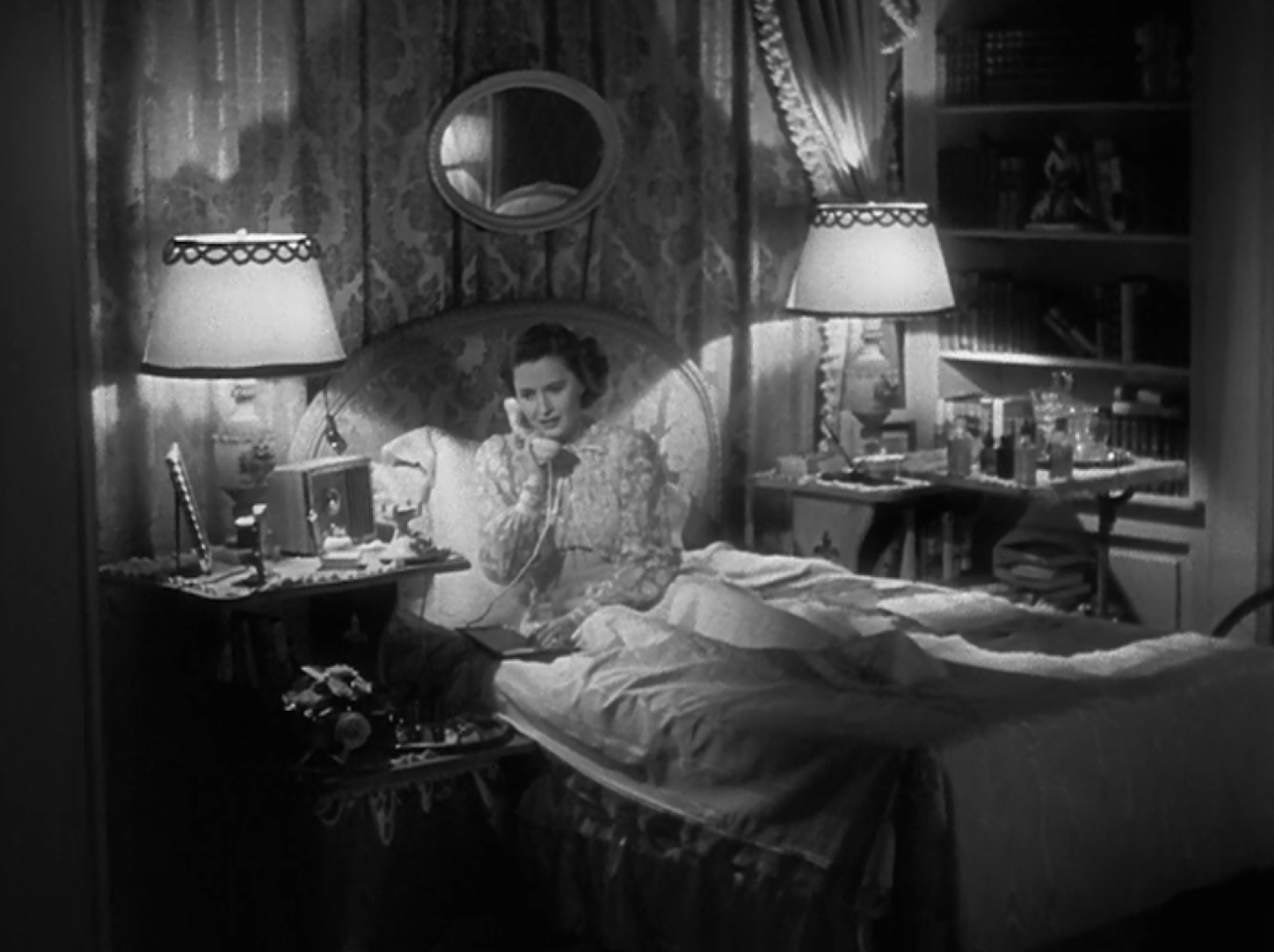
Leona Stevenson is the rich only daughter of a pharmaceutical magnate. She is also invalid, and in NYC from Chicago to consult with a doctor about her health issues. At the start of the fil m, it is apparent that her husband is avoiding her, screening her calls. His absence is even more gaping by the empty chair he leaves, which Leona addresses plaintively. In a stroke of (mis)fortune, she overhears two men’s plots to murder a woman at 11:15pm, with the time meticulously chosen so that the sound of the crime will be masked by a passing train. 

She reports it to the police and then her father, but both efforts fall on deaf ears. As she becomes increasingly agitated alone in the Manhattan apartment, she tries to locate her errant husband, only to inadvertently piece together the context of the phone call she overheard, which she involves her more than she’d care for.

One of Barbara Stanwyck’s four Oscar nominations for Best Actress, Sorry Wrong Number came out four years after her iconic turn as conniving seductress in Double Indemnity. Both are film noirs with a heavy sense of foreboding, but playing a bedridden character, her physical repertoire is limited here. Whilst she slinked around (who can forget that anklet and the way she shimmies down the stairs to show it off?) in Double Indemnity, she spends the majority of Sorry, Wrong Number fretting in bed. It’s a difficult role that only someone with the screen presence and acting guile Stanwyck is blessed with could pull off.

Graciously for her, she does get to stand up at some point in the film: a good proportion of the 
story is told via flashback. We discover how she and her husband (Burt Lancaster) met: he was actually at a dance with a girl called Sally Hunt, who plays an integral part in helping Leona piece together the clues. Leona, never having been deprived anything she wanted in her life, boldly makes a play for Henry. He’s initially put off by her entitled attitude, but, nonetheless, his head is turned by her wealth. Stanwyck conveys her character’s bratty attitude wonderfully: in one scene, she regards her husband with a contemptuous glance in that signature way Barbara Stanwyck looks people up and down. You mirror Lancaster's character's feeling of belittlement when it occurs.

Lucille Fletcher penned the script for Sorry, Wrong Number, which was originally a radio play by her. The translation is effective: few sets are required in Sorry, Wrong Number, and the art decoration of Leona’s grand but stuffy bedroom is conveyed excellently: she has expensive trinkets and bottles, but her loneliness is clear. The moral that money can’t buy happiness is an age-old one in cinema, but this message is conflated with another: money being the root of all evil, which motivates some shady actions by certain characters. Thus, the script, ahead of its time in this sense, touches on an almost Kafkian problem: the more Leona feels her husband pulling away, the more she tries to throw money in the problem, which in turn, makes him increasingly more detached towards her.

The cinematography dextrously plays with light and shade, true to the genre, to create ambiance and dread throughout the film. Also, in the vein of film noirs, there are few truly "good" characters (I would argue only Sally, Leona's former classmate who's love she stole in such a cavalier manner, is), and plenty of murky ones. Even our protagonist, who finds herself in increasing danger, is somewhat hard to take and completely root for, her arriviste persona accentuated by her plush wardrobe, multitude of expensive rings, and Stanwyck's virtuoso performance as a woman who refuses to see what's going on right under her nose, causing the audience to fear the moment the House of Cards will crumble.


The employment of flashbacks and the film being played in real time give Sorry, Wrong Number a real sense of urgency, and the protagonist being confined to their room gives them a powerless sense that makes this film a worthy predecessor to the more polished Rear Window. The beating heart of the film is Barbara Stanwyck; I can’t believe she never won a proper Oscar during her lifetime especially when frauds like Jennifer Lawrence and Natalie Portman have them! As mentioned, Leona is not likeable at all, treating other characters in the film as below her and talking down to everyone. Yet Stanwyck is able to inject sympathy into even an upstart like this! By the end of the picture, she has you rooting for Leona, warts and all.

The Academy gave her an honorary award in 1982, whilst she was still alive, though, for “For superlative creativity and unique contribution to the art of screen acting”, and that is exactly what she has, in spades, here. Without her, Sorry, Wrong Number would have been a fairly exciting film. With her, it’s a complete and utter thriller.

Saturday, August 13, 2011

Obligatory list is bloody obligatory.

It’s a yearly thing that I do – list my top 100 songs, and then see how much the list has changed. So, here we go for the 2011 edition!

(side note – unlike my taste in films and rather more like my taste in footballers, my taste in music is atrocious. Shitty R&B and girlband choons lamenting love are pretty much my life’s calling. But I like what I like, and I ain’t gonna front about it! So learn to deal.jpg :p)

01. Homecoming (Kanye West ft. Chris Martin)
02. Son of a Preacher Man (Dusty Springfield)
03. Angie Baby (Helen Reddy)
04. Rocky Raccoon (The Beatles)
05. Hallelujah (Rufus Wainwright)
06. Alison (Elvis Costello)
07. Sinnerman (Nina Simone)
08. Sexy! No No No… (Girls Aloud)
09. Clam, Crab, Cockle, Cowrie (Joanna Newsom)
10. Paper Planes (M.I.A.)
11. November Has Come (Gorillaz)
12. Samson (Regina Spektor)
13. Adia (Sarah McLachlan)
14. Run this Town (Rihanna, Jay-Z and Kanye West)
15. Power (Kanye West)
16. Untouchable (Girls Aloud)
17. Talk Show Host (Radiohead)
18. Lullaby (Dixie Chicks)
19. All These Things that I've Done (The Killers)
20. Love the Way You Lie Part II (Rihanna ft. Eminem)
21. Romeo and Juliet (Dire Straits)
22. Head over Heels (Tears for Fears)
23. Boys Don't Cry (The Cure)
24. Good Old Fashioned Lover Boy (Queen)
25. Defying Gravity (Idina Menzel)


26. Glory Box (Portishead)
27. Hey Stephen (Taylor Swift)
28. Empire State of Mind: Broken Down (Alicia Keys)
29. 2am (The Saturdays)
30. Fix Up Look Sharp (Dizzee Rascal)
31. Tiny Dancer (Elton John)
32. Baba O'Riley (The Who)
33. Wildwood Flower (June Carter Cash)
34. My Love (Sia)
35. The Loving Kind (Girls Aloud)
36. California Dreamin' (The Mamas and the Papas)
37. Chelsea Dagger (The Fratellis)
38. My Father's Gun (Elton John)
39. Seasons of Love (Idina Menzel)
40. What’s My Name? (Rihanna)
41. Hey Jude (The Beatles)
42. Brandy Alexander (Feist)
43. Don't Stop Believin' (Journey)
44. Love Affair (Regina Spektor)
45. I Don't Want to Go to Chelsea (Elvis Costello)
46. Dragon Queen (Yeah Yeah Yeahs)
47. Under Pressure (Queen ft David Bowie)
48. Brown Eyes (Lady Gaga)
49. It Wouldn’t Have Made Any Difference (Todd Rundgren)
50. Clothes Off! (Gym Class Heroes)

51. Everybody Wants to Rule the World (Tears for Fears)
52. Underneath Your Clothes (Shakira)
53. Breathe (Taylor Swift)
54. Travelin' Soldier (Dixie Chicks)
55. Jesus Walks (Kanye West)
56. Numb Encore (Jay Z ft. Linkin Park)
57. Lovely Head (Goldfrapp)
58. I Wish I Knew How it Feels to Be Free (Nina Simone)
59. Shout (Tears for Fears)
60. She (Elvis Costello)
61. Clint Eastwood (Gorillaz)
62. Vincent (Don McLean)
63. Love will Tear us Apart (Joy Division)
64. Lullaby (The Cure)
65. While My Guitar Gently Weeps (The Beatles)
66. Sunshowers (M.I.A.)
67. Pennies in my Pocket (Emilio Estefan)
68. Jackson (Johnny and June Carter Cash)
69. Dream on (Aerosmith)
70. Wonderwall (Oasis)
71. Make You Feel My Love (Adele)
72. Airplanes part 2 (B.o.B, Hayley Williams & Eminem)
73. The Killing Moon (Echo and the Bunnymen)
74. Teenage Dream (Katy Perry)
75. Momentum (Aimee Mann)

76. The River (Joni Mitchell)
77. Golden Slumbers (K.D. Lang)
78. Hey Mama (Kanye West)
79. Braille (Regina Spektor)
80. Back to Black (Amy Winehouse)
81. O Saya (A.R. Rahman ft. M.I.A)
82. Bossy (Kelis)
83. Chillin' (WALE ft Lady Gaga)
84. Take a Bow (Rihanna)
85. Lean on Me (Bill Withers)
86. Ignition (Remix) (R. Kelly)
87. The Call (Regina Spektor)
88. Machine Gun (Portishead)
89. Twentyfourseven (Artful Dodger)
90. Strict Machine (Goldfrapp)
91. Motivation (Kelly Rowland ft. Lil’ Wayne)
92. Too Young (Phoenix)
93. The Next Messiah (Jenny Lewis)
94. You've got the Dirtee Love (Florence and the Machine ft Dizzee Rascal)
95. No More (3LW)
96. Feel Good inc (Gorillaz)
97. We Will Rock You (Queen)
98. Like I Love You (Justin Timberlake)
99. Call the Shots (Girls Aloud)
100. Forget You (Cee Lo Green)

By artist:
Kanye: 6
Girls Aloud: 4
Rihanna: 4
The Beatles: 3
Queen: 3
Gorillaz: 3
Elvis Costello: 3

Sunday, January 09, 2011

We are family.

Photobucket
Just three this week, a terrible film, a terrific film, and a film that I liked a lot more than I expected to; all three films are about family.

You Again (Andy Fickman, 2010)
Photobucket
Kristen Bell plays Marni, a girl who was a “loser” in high school with her big glasses, dodgy haircut and constant clumsiness, and thus a massively easy target for the school’s lead cheerleader Joanna. Eight years later, she is a successful VP at an advertising company, and goes back home for her brother’s wedding. So imagine her horror to discover that the woman her brother’s marrying is the bullying bitch herself. Of course, it’s years later, and she’s seemingly turned over a new leaf, but Marni, having endured her bullying for years, is less than convinced that this leopard has changed her spots.

I was not won over by this film, to be honest. The problems I had with it were the exact same faults I found with Bride Wars, that being that the characters were too sketchy, their motives and actions too exaggerated and unbelievable, and the conclusion far, far too part. The directors and producers have clearly tried the whole “bung some talented stars in in the hope that no-one notices how awful the writing is” formula by throwing a subplot with a similar rivalry between Jamie Lee Curtis and Sigourney Weaver in, and Victor Garber is good fun as ever, but even they can turn shit to gold. I was not impressed. Never again.

Paper Moon (Peter Bogdanovich, 1973)
Photobucket
After watching Sofia Coppola’s “Somewhere” last weekend, I got a huge craving to re-watching one of my favourite films, Paper Moon, which I’d noticed shades of in Coppola’s film. In it, real life father-and-daughter pairing Ryan and Tatum O’Neal play con man and tagalong and the funny, weird and sneaky little road trip they make together. I absolutely adore Tatum O’Neal in this film, it’s one of my favourite child performances of all time, and Addie Logins is such an adorable girl; she smokes and steals, but has a heart with it—she has no qualms about stealing from the old lady with more money than sense, but can’t bring herself or her (possible) dad to steal from the single mum with a huge family to look after. Madeleine Kahn offers some comic relief and there are some amusing supporting turns, but this film is all about the chemistry between the O’Neals. One of the sweetest and cutest films of all time, Paper Moon came out in between Daddy Coppola’s two Godfather movies, but I love it more than both of them put together.

Conviction (Tony Goldwyn, 2010)


Hilary Swank plays Betty Anne Waters, born from a dodgy family and flailing single mother, whose brother, Kenny Waters (played by Sam Rockwell) is wrongfully sent to prison for a murder he didn’t commit. Everything is against Kenny: DNA, his troubled background and history of breaking & entering, not to mention an entire array of witnesses who swear in court that he bragged about killing the woman. 

Betty Anne, being the only person who seems to believe her brother’s innocence, decides to put herself through Law School in the hope that she can get him out.

I liked Conviction a whole lot more than I thought it would. Despite the hugely hillbilly vibes the film exuded, it was still a thoroughly entertaining and gripping drama with an understated turn from Swank (I do hope she gets nominated for an Oscar, I preferred her over Natalie Portman in Black Swan to be honest), and an equally good turn from Sam Rockwell. 

Juliette Lewis absolutely steals the show in an ultra de-glam cameo too. Furthermore, anyone who knows me ought to know how much I love my redemptive dramas wherein the misunderstood guy, after years of tribulation, finally gets his atonement, and indeed, it was the shades of Shawshank (the 'earn your happy ending' trope is a favourite of mine!) that rendered the film a big win for me. One of the finer films of 2010.

Saturday, May 15, 2010

Soundtrack to 2009.

Original, non-original, movie songs… all the tunes from films that I loved.

Almost There, The Princess and the Frog (Randy Newman)
Un Amico, Inglourious Basterds (Ennio Morricone)
Blue Jeans, Confessions of a Shopaholic (Jessie James)
Californian Dreamin’, Fish Tank (Bobby Womack)
Carl’s Maiden Voyage, Up (Michael Giacchino)
Photobucket
Cat People/Putting Out Fire with Gasoline, Inglourious Basterds (David Bowie)
Discombobulate, Sherlock Holmes (Hans Zimmer)
Dopo La Condanna, Inglourious Basterds (Ennio Morricone)
Down in New Orleans, The Princess and the Frog
Drop, 17 Again (Ying Yang Twins)
Girls Just Want to Have Fun, Confessions of a Shopaholic (Greg Laswell)
The Green Leaves of Summer, Inglourious Basterds (Nick Perito)
Fashion, Confessions of a Shopaholic (Lady Gaga)
Hero, (500) Days of Summer (Regina Spektor)
L.E.S. Artistes, 17 Again (Santogold)
Married Life, Up (Michael Giacchino)
Mushaboom, (500) Days of Summer (Feist)
Naïve, 17 Again (The Kooks)
Please, Please, Please, Let me Get what I want, (500) Days of Summer (The Smiths)
Rabbio e Tarantella, Inglourious Basterds (Ennio Morricone)
Sugar Town, (500) Days of Summer (Zooey Deschanel)
There is a Light that Never Goes Out, (500) Days of Summer (The Smiths)
Us, (500) Days of Summer (Regina Spektor)
Photobucket

Tuesday, February 23, 2010

Film review: UP (Pete Docter, 2009)

My 11-year-old brother Tom has a lol of a MSN profile, wherein he lists his favourite films as the likes of The Pink Panther II and Fantastic Mr Fox. However, a film choice he has there that I actually approve of is Up, the animation of 2009 that until today, I’d not actually seen. But you know what they say, good things come to those who wait. I’d waited long enough for Up, and it sure as hell was good enough.


Thursday, February 18, 2010

8. He ni zai yi qi (Chen Kaige, 2002)

Together tells the story about Liu Xiaochun, a thirteen year old boy with a prodigal talent at the violin. His father, Liu Peiqi enters him for a musical competition in Beijing, and although his son finishes fifth, his residence not in Beijing renders him invalid. His dad persuades a music professor to take his son on whilst he goes back home, thus leaving Liu Xiaochun away from his dad for the first time in his life.


Appropriately, for a film about the violin, the music in this film is stunning. This humble story is also written by the director, telling the story with stirring emotive force. Liu Xiaochun proves to be the kind of sensitive soul that far few 13-year-olds are. In its own little way, Together makes me appreciate my parents much more and evoke tears whenever I think about how much they’ve sacrificed for me. The supporting actors are all good, showing the subtle ways in which the people young Xiaochun meets shape his development and life. 

It’s refreshing to witness the friendships and platonic loves that the protagonist meets throughout the film. Xiaochun has two music teachers throughout the film, and each is at a dead end in his life about something, and these themes are investigated with sensitivity. Far be it from being a film about just the violin, themes of friendship, determination, courage, and love are all in here. The film is not without its melodramatic moments, but that only heightened my enjoyment of it. And, whilst it has been criticized by some for being too saccharine, to that I say, what’s so bad about sugary once in a while? As Chen Kaige himself said, "being Chinese isn't all misery”.

Tang Yun, a real-life violinist, was selected for the role when director Chen Kaige saw him at a concert, and his performance is genuine as it is heartfelt. Liu Peiqi is incredible as the father who makes sacrifice upon sacrifice because he wants the best for his son – a gesture that is shown to be even more affecting when the flashback shows how the father came to find his son (few films scenes have had me crying so much, and for so long). 

In fact, despite his violin skills being the catalyst and plot driving force in the film, I see Together more as a universal tale of the love between a father and son. The father isn’t perfect; he’s poor and struggling to make ends meet, but this is something that makes his devotion to his son easier to relate to.

Photobucket

There are two things about Together that resonated with me: the fact that I’m Chinese and the fact that I play violin. And it’s true; watching Together did make me appreciate the violin more, as well feel nostalgia for my homeland. But my appreciation for the film came from far more than just those similarities. 

Cinema is an art form that transcends mere entertainment. It can inspire debate, conversation, raise pertinent topics. It can make an everyday story more exciting and interesting with the aid of music, cinematography and beautiful art direction. But the main reason I watch films is to feel. Human emotion can be felt by anybody, anywhere. And in getting me to feel pathos, bathos and the spectrum of emotions in between, Together achieves that aim perfectly.