Showing posts with label 80s. Show all posts

Sunday, September 04, 2016

Film review: AU REVOIR LES ENFANTS (Louis Malle, 1987)

This post is in conjunction with Pop Culture Reverie's Back to School blogathon. Head on over there to check out other fabulous posts about movies set in schools!

---


Au revoir les enfants, a semi-autobiographical film by Louis Malle, tells the story of the tentative friendship that forms between Julien Quentin (Gaspard Manesse) and Jean Bonnet (Raphael Fejtö), a new, enigmatic boy who joins the Catholic boarding school at which Julien stays. 

Julien suspects that Jean is harbouring a secret of some kind, and as the plot transpires, it turns out that Jean is Jewish, and he and two others are given covert asylum from the Nazis by Père Jean, the kind headmaster of the school. The time period being the Second World War, when France is occupied by Nazis, Jean’s secret hangs over their friendship, and the film.

Malle’s movie dextrously examines the nature of French guilt with regards to their collusion with the Germans during the War, recognising that for many, it was an act of survival. Despite the fact that German soldiers all the inhabitants of the town, a resentment and dislike of the Nazi regime is definitely brewing.  In one scene, a Jewish diner at a restaurant is threatened with ejection by the Nazi soldiers, but it is the Nazi soldiers who are chased out of the restaurant by other diners, sick of their fascism and anti-Semitism.

Having witnessed some the events depicted film firsthand, Malle understands the conflicting duality of the French people in terms of doing what is right, and what won’t get them into trouble. To quote Edmund Burke, 'The only thing necessary for the triumph of evil is for good men to do nothing' and Malle captures this essence in the faces and actions of French citizens in the film who want to protect the Jews, yet at the same time, view self-preservation as the most important item, and thus, did not stand up to the Nazis.

The film follows Julien and Jean as their bond strengthens amidst this historical backdrop. Jean, a smart, quiet lad who’s adept at mathematics and the piano, helps Julien improve his playing. Another scene in the film that lingers with me is when the two boys duet together; it’s a joy to see the smiles on their faces as they do so, and the way something as simple as music can bring people together and provide momentary displacement for life-threatening concerns on Jean's part, is profound and affecting.


Despite the grim historical setting, Au revoir les enfants doesn’t allow itself to get bogged down and even affords the audience some moments of levity, such as back-and-forth-banter between the boarding school boys about things like bed-wetting, naughty literature and masturbation, as well as the inclusion of Julien’s older brother, another boarder at the school, who should be looking out for his younger brother but instead getting distracted by his constant pursuit of skirt. By including moments of comedy amongst the drama, Malle makes the experience more frank and captures the innocence of youth.

The chemistry between Manesse and Fejtö, two untrained young actors, is organic and lovely. The transitioning of their relationship: from the start, where Julien envies Jean’s academic prowess and thus feels slight hostility towards him, towards their friendship slowly blooming and Jean letting him in on his secret, every step feels real. You’re rooting for these two boys to stay friends and for Jean to stay safe, even if, historical evidence points to the opposite occurring. 

The last scene in the film, where the movie’s title is spoken, is heart-wrenchingly sad, more so because it is directed in such a matter-of-fact, unfussy style. World War II did happen, and atrocities were committed against the Jews. By not sensationalising events and honing in on how it affected one impressionable young boy, we view the story through Julien’s prism, and it is no less harrowing. The look in Julien’s eyes in the last shot still lingers with me; he says nothing, but a picture says a thousand words.

French cinema captures the essence of adolescence in a manner that really speaks to me. Blue is the Warmest Colour was one of the most honest depictions of sexual awakening and the rollercoaster of experiencing your first love, and Les 400 coups, my fourth favourite film, excellently depicted what it's like to feel misunderstood.

Au revoir les enfants is another fine addition to this list. Through subtly made and lovingly-crafted scenes, it is one of the most powerful films about friendship between kids I've seen, and an unforgettable reminder that even in the darkest of times, something beautiful can be formed.

9/10

Tuesday, May 18, 2010

Girl, you'll be a woman soon.

So, on a whim, I rented Ronald F. Maxwell's Little Darlings, purely because the DVD cover looked extremely Parent Trap-esque and I was having a random bout of nostalgia for that film. Little did I know that Little Darlings was a fair bit more adult; whilst it, like The Parent Trap centres around two girls who look quite similar in a Summer camp who initially don't get on, the two girls (15 years of age) soon find themselves in a race to see who can lose their virginities first. Grown up stuff!

Photobucket

Both girls are initially shunned by all the others in their camp. Tatum O'Neal's rich girl is laughed at for her posh attire and bad-ass Kristy McNichol's devil-may-care attitude doesn't sit well with the ringleader of the camp girls, a bit-part model and self-professed woman; she is the only girl in the camp who has had sex, though every other girl there aside from the two protagonists make (not very convincing) claims that they've done the dirty. For Tatum O'Neal's Ferris, she's doing it to fit in, and for Kristy McNichol, it's to show that she can.

Both girls pick their prey. Ferris has found hers in the form of their dishy swimming instructor Gary (Armand Assante) and Angel plays closer to her age bracket with Matt Dillon's motorbike-riding Randy. As both girls get closer to achieving their aim, both become more emotionally invested in the men they've marked out, hence complicating matters.

Although dated, Little Darlings nonetheless has many messages that still hold true to this day and age; the dangers of rushing into sex, and how one must be true to their heart, etc. The latter implies the film has a bit of a "Disney" feel to it, and whilst it is extremely tame compared to modern days teenage flicks where the protagonists swear, smoke and shag blindly, the heavy emphasis placed on the loss of virginity here rendered the film extremely endearing in my eyes. Tatum O Neal and Kristy McNichol are both excellent in their roles - the former making her "rich girl" role suprisingly sweet and likeable, and the latter giving a terrifically convincing portrayal of a young girl who gives a tough exterior to hide her less strong inner self, and Matt Dillon, too, gives one of his softest performances. The banter and misdemeanors that the girls in the camp get up to are hilarious - one sketch involving them trying to procure condoms had me in stitches. All in all, although the film was not at all what I was expecting, it turned out to be much, much better. It's a film about sex, but it is sweet and romantic about it, which, one guesses, is what Ronald F. Maxwell feels losing one's virginity should be like.

Tuesday, February 16, 2010

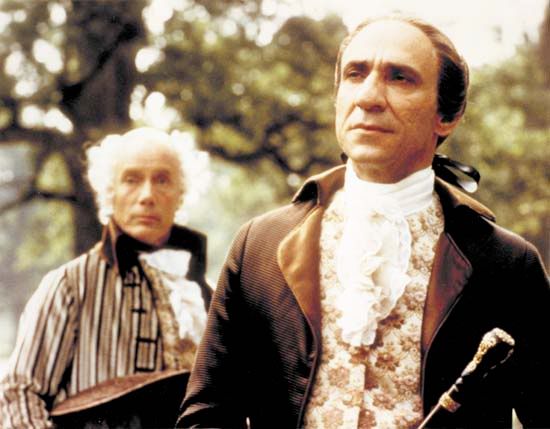
9. Amadeus (Milos Forman, 1984)


Hands up who hasn’t felt jealous of someone else’s talent at some point in the past? Jealousy, is, after all, innate. One poor sod who’s life was driven by his jealousy is Antonio Salieri, who, for all his mediocre, even semi-decent musical talent, never matched the level of genius attained by Mozart. And, whilst Salieri slaved away, devoting all his time to form his passable scores, Mozart’s came naturally. In fact, considering Mozart’s hedonistic and general sloppy living, his musical talent came to him in spite of, rather than because of his lifestyle. This fact drove Salieri crazy, letting this take over his life, as he devoted all his energy into somehow evening out the score.

F. Murray Abraham plays the lead in a beautifully controlled depiction of jealousy, resentment and rage, all hidden under a façade of that carefully forced smile. Tom Hulce is terrifically annoying as Mozart; his crazy high-pitched laugh rang in my ears long after the credits rolled. Amadeus was the last movie to bung two actors in the Best Leading Actor category at the Oscars. Had Hulce been pushed for supporting, he very probably would have won. As it was, he went up against his co-lead Abraham, who won the Oscar, perhaps the first time Salieri has done one over on Mozart.

The film is gorgeous to look at and listen to. Many of Mozart’s most sumptuous pieces are used throughout. The film carries a tone of underlying sadness throughout, but that doesn’t mean our eyes and ears aren’t deprived of a treat throughout. The costumes, so intricately designed, evoke the feel of 18th century Europe, and the sets, so cleverly architectured, succeed in capturing the grand scale of the opera houses.

Adapted from Peter Schaffer’s play, the script modulates from moment of great comedy to desperate sadness. The story is told in flashback by Salieri, who now resides in a mental asylum and has just had a failed suicide attempt. As a sympathetic priest listens to his tale, Salieri recounts his traumatic and disturbing tale. The direction of F. Murray Abraham is wonderful, both restrained and indulgent, it captures the many sides of the composing industry as well depicting the sadness of the human condition.

The fact that the film is so historically inaccurate does not matter a jot. Rather than attempt to paint a vivid picture of Mozart’s life, Forman instead goes for a painting of jealousy, and in doing so, he has achieved his masterpiece. The title, Mozart’s middle name, “Amadeus”, translates to “Loved by God”, and Salieri spends the whole film opining as to why it is Mozart who chooses to be loved, not him. Mozart, who seemingly has no appreciation of his massive talent, and chooses to piss and debauch his life away rather than making the most of it. And this is the central message of Amadeus: hard as it is to accept, sometimes it is those that deserve it the least are blessed the most.

Saturday, August 04, 2007

81. Stand By Me (Rob Reiner, 1986).

Love the movie and the song.

R.I.P., River. What a talent. What a waste of a life. :(