Showing posts with label top 100 countdown. Show all posts

Wednesday, February 09, 2011

04. Les quatre cent coups (François Truffaut, 1959)

lol, yeah, I really need to train with this countdown of my top 100. My last review for #5 was almost seven months ago. Blimey. So here we are! Number 4.

12-year-old Antoine Doinel just can’t seem to get it right. At home, his mother and father neglect him. At school, all he ever seems to does is get himself into trouble (the French translation of faire les quatre cent coups means to raise hell), and he’s happiest when he’s bunking school, just roaming the streets. He’s not a bad egg by any means, just one who seems to be the unfortunate one who gets caught doing something even though everyone else is (case in point—his classmates pass around a picture of a nude lady, but when the teacher walks in it is he holding it). The film follows his misdemeanours during a few days, which involve his hilariously poor attempts to come up with an alibi for why he doesn’t come into school, as well as well-intentioned plans that result in bigger mistakes—such as starting a small fire, as well as downright plagiarism for a homework task.

The 400 Blows is a touching, witty, but very heartbreaking portrayal of a young lad who is by no means bad or evil-spirited, simply, misunderstood. I found it very easy to sympathize with him, his parents show him very little real affection or love in the film, and any kindness they show him usually have ulterior motives (his mother buys him an extravagant ice cream, but only because she knows he has seen her cavorting with another man and wants to buy her son’s silence). It’s hardly surprising that, with the upbringing (or lack thereof) that he has been given, that he’s prone to doing the odd silly thing.

Jean-Pierre Léaud is insanely good as Antoine, and he would go on to collaborate with Truffaut in four other films about the trouble-attracting protagonist as well as the delightful Day for Night setting off one of the greatest director-actor combos in history. He’s very natural, often it doesn’t even feel like he’s acting, but in the blank, empty look in his eyes is a whole load of unsaid sadness and disillusion of a person wise beyond their years. Similarly, the odd cheeky looks he has in his moments of mischief make for some brilliant comic relief. Here is what is easily one of the child performances in cinema. The transcendent finale features my fourth favourite film scene of all-time wherein he’s been sent to a reform school but he finds the opportunity to escape during a football game, he runs and runs and runs, and comes to the sea. The final scene is Antoine turning and looking into the camera. For that moment, he is free, yet he can go no further.

Often hailed as one of the most prominent pieces to come out of of the French New Wave, The 400 Blows is realism at its gritty, grainy best. Whereas previous films were all about their happy endings and conventional story-telling, Truffaut ventures into new ground with his pseudo-documentary-style here. It was revolutionary at the time, but even now, more than 50 years on, The 400 Blows makes for compelling view, and anyone who’s ever felt disjointed or misunderstood would surely connect with it. There are sequences of utmost hilarity juxtaposed with sadness that hints at the disturbing malaise of truth. I think I first saw The 400 Blows when I was about 15 and I saw myself in the lead character straight away. Almost 6 years on, I still recognize myself in them. There’s really not a lot of films I could say that about, now. A true masterpiece.

Wednesday, June 16, 2010

5. Brief Encounter (David Lean, 1945)

To most, having to have grit removed from one's eyes is not the best circumstance under which to make an acquaintance. But for Celia Johnson's Laura, this is how, on a railway station, she meets dashing doctor Alec Harvey (Trevor Howard). The two form a friendship that soon becomes more than platonic. Despite their love for each other, their relationship is never consummated. Caught in such a bad romance, they realise that due to social rules and their commitments to their family, the tempting option of running away together is simply impossible.
Photobucket
Cinematography goes a long way in telling the story. The camera shots are so close-up that they frame just Laura and Alec, suggesting that, for the time being at least, they are in their own perfectly formed world.

Photobucket

The fact that the title gives away the fact that Laura and Alec's romance is short lived does not detract from the poignancy and power of their brief time spent with each other. Although the two do not sleep together, there is no doubt of their desire to do so, making their restrain even more admirable (the scene in which they are interrupted by a prying friend was extremely frustrating when I first watched the film but now I see that it fits perfectly with the themes of social decorum and doing what is right rather than what we want).
Photobucket
Many things make Brief Encounter the gem it is, but two things stand out. The first is the usage of Rachmaninov's Second Piano Concerto . There have been films which have been ruined by the terrible music in them, and others wherein the music is either so good or so bombastic that it deflects attention away from the film. In Brief Encounter, the elegaic piano tune complements the film perfectly. Used throughout, it evokes the emotions that Laura is feeling in us. And the second? Why, that would be Celia Johnson's exquisitely beautiful performance as the housewife who looks for an exciting, new thing in her life, only to realise that when all is said and done, however exciting, however much it thrills her, she cannot throw away what she already has. As Alec places his hand over Laura's shoulder as they say their goodbyes, tears never fail to come to my eyes. Brief Encounter is as deep and British a film as they come.

Saturday, March 06, 2010

7. The Apartment (Billy Wilder, 1960)

I love to laugh. Whether it be at some lame inside joke with my mates, laughing at silly lines in old episodes of Friends or laughing uproariously at stand-up comedy, I believe that laughter is terrific for the soul. Sadly, it isn’t all fun and games in my top 10, where there are 9 drama/romances and just the one comedy. And even the comedy, by the director and star’s standards, are surprisingly somber at times. The movie in question? The Apartment.

Photobucket

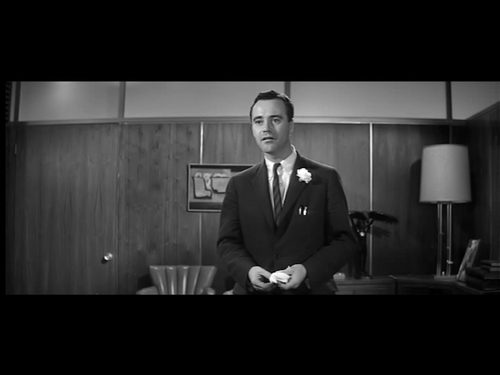
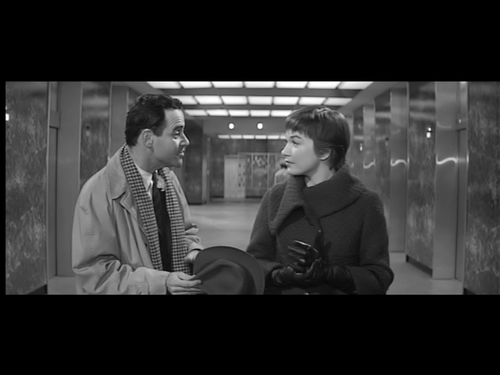
It’s 60s New York City and the protagonist, the kookily named C. C. Baxter (Jack Lemmon) has a dead end job and an even more lamentable love life. He has an apartment on the Upper West Side (there’s your Sex and the City-style location referencing), which he lends the key out to four of his managers, so that they can take their mistresses there and bung without their wives finding out. It’s not a position C.C. particularly enjoys being in, but he’s not one for confrontation so he expresses his displeasure by purposely mixing up his workmates’ liaisons. Meanwhile, C.C. finds his eye caught by Fran Kubelik, the elevator operator from where he works. C. C.’s apartment earns him glowing reports from all four
managers and following that a promotion, though his director Mr Sheldrake suspects something. He allows for the promotion, only on the condition that he can also use the apartment, to which Baxter, delighted with his promotion, acquiesces. It probably won’t surprise you to hear that Sheldrake arranged the apartment to use with Fran Kubelik, thus making for a very dysfunctional love triangle.

At the time of its release, the themes of infidelity depicted in The Apartment meant it made for uncomfortable watching amongst American audiences, who until then had led a sheltered cinema-going experience where all is well and the only bad things in a marriage is when the wife undercooks the breakfast. As such, the film received pretty bad reviews. By today’s standards, however, the film is an extremely smart satire on the working world and the so-called “sanctities” of marriage, and one only needs to look in a local workplace or an ailing marriage and a husband with a wandering eye to know how this cynical film hits the nail on the head.

The wonderful thing about C.C. Baxter and Fran Kubelik is that they’re both far from perfect, getting themselves into some sticky situations, but the joy of it all is that they can get themselves out of it. Jack Lemmon, in one of his best roles, is wonderful as the mild-mannered, exploited Baxter, who’s sense of moral values leave him with precious little. But the star of the show is easily Shirley MacLaine, who shows the world that she’s more than just a pretty face. Her acting skills are truly tested as the complex Fran; smart and together at the start, a complete wreck in her confrontation with Mr Sheldrake, but sharp and getting some of her swagger back by the end. It’s a glowing and multi-layered performance that cemented MacLaine’s place as a true auteur. Fran likes C.C., for his kindness and warmness, but her feelings aren’t quite as ardent as his towards her, and it is both refreshing to see a film wherein it is the woman who is the more disinterested party, yet equally frustrating, because C.C. is a much better match for her than Mr Sheldrake ever could.

As you’d expect from a Billy Wilder film, the screenplay is flawless, taking us from one genre to another. The dialogue feels unforced and natural (C.C. Baxter could be the guy in the supermarket who you’ve known for ages), at the same time holding some wonderful repartee and sparring. Shirley MacLaine once revealed in an interview that much of The Apartment was improvised by the actors as they went along. It’s these little touches – along with the strong plot based on the script – that elevate this film out of “standard romantic comedy” territory, such as Jack Lemmon humming as he prepares the meatball sauce. There are moments in the film when things turn extremely sour and the tone is almost desperate, but Billy Wilder, being the expect director that he is, knows how to balance these emotions perfectly and make light of even the deepest sadnesses.

Like many of the films in my top 10, The Apartment is a romance. Unlike the other nine, it is a comedy. But within the comedy, there is also tragedy. We see good people compromising their principles in order to get a step up in the working world, as well as how love can lift you up, then, just as you’re feeling nothing can bring you down, give you a gigantic kick in the bollocks. In this love story there is duplicity, infidelity, depression, loneliness and despair aplenty. The Apartment doesn’t sugarcoat things like plenty of other films from that era did, and its honesty – and cynicism is invigorating. Because, at the end of the day, love ain’t all a bed of flowers, but Fran’s ambiguous closing line hints that she may or may not be willing to give it another chance.

Thursday, February 18, 2010

8. He ni zai yi qi (Chen Kaige, 2002)

Together tells the story about Liu Xiaochun, a thirteen year old boy with a prodigal talent at the violin. His father, Liu Peiqi enters him for a musical competition in Beijing, and although his son finishes fifth, his residence not in Beijing renders him invalid. His dad persuades a music professor to take his son on whilst he goes back home, thus leaving Liu Xiaochun away from his dad for the first time in his life.


Appropriately, for a film about the violin, the music in this film is stunning. This humble story is also written by the director, telling the story with stirring emotive force. Liu Xiaochun proves to be the kind of sensitive soul that far few 13-year-olds are. In its own little way, Together makes me appreciate my parents much more and evoke tears whenever I think about how much they’ve sacrificed for me. The supporting actors are all good, showing the subtle ways in which the people young Xiaochun meets shape his development and life. 

It’s refreshing to witness the friendships and platonic loves that the protagonist meets throughout the film. Xiaochun has two music teachers throughout the film, and each is at a dead end in his life about something, and these themes are investigated with sensitivity. Far be it from being a film about just the violin, themes of friendship, determination, courage, and love are all in here. The film is not without its melodramatic moments, but that only heightened my enjoyment of it. And, whilst it has been criticized by some for being too saccharine, to that I say, what’s so bad about sugary once in a while? As Chen Kaige himself said, "being Chinese isn't all misery”.

Tang Yun, a real-life violinist, was selected for the role when director Chen Kaige saw him at a concert, and his performance is genuine as it is heartfelt. Liu Peiqi is incredible as the father who makes sacrifice upon sacrifice because he wants the best for his son – a gesture that is shown to be even more affecting when the flashback shows how the father came to find his son (few films scenes have had me crying so much, and for so long). 

In fact, despite his violin skills being the catalyst and plot driving force in the film, I see Together more as a universal tale of the love between a father and son. The father isn’t perfect; he’s poor and struggling to make ends meet, but this is something that makes his devotion to his son easier to relate to.

Photobucket

There are two things about Together that resonated with me: the fact that I’m Chinese and the fact that I play violin. And it’s true; watching Together did make me appreciate the violin more, as well feel nostalgia for my homeland. But my appreciation for the film came from far more than just those similarities. 

Cinema is an art form that transcends mere entertainment. It can inspire debate, conversation, raise pertinent topics. It can make an everyday story more exciting and interesting with the aid of music, cinematography and beautiful art direction. But the main reason I watch films is to feel. Human emotion can be felt by anybody, anywhere. And in getting me to feel pathos, bathos and the spectrum of emotions in between, Together achieves that aim perfectly.

Tuesday, February 16, 2010

9. Amadeus (Milos Forman, 1984)


Hands up who hasn’t felt jealous of someone else’s talent at some point in the past? Jealousy, is, after all, innate. One poor sod who’s life was driven by his jealousy is Antonio Salieri, who, for all his mediocre, even semi-decent musical talent, never matched the level of genius attained by Mozart. And, whilst Salieri slaved away, devoting all his time to form his passable scores, Mozart’s came naturally. In fact, considering Mozart’s hedonistic and general sloppy living, his musical talent came to him in spite of, rather than because of his lifestyle. This fact drove Salieri crazy, letting this take over his life, as he devoted all his energy into somehow evening out the score.

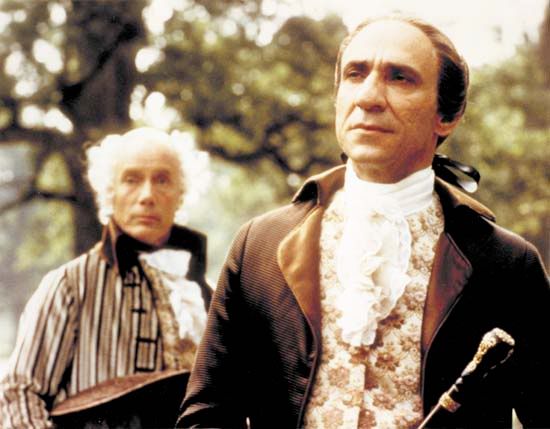
F. Murray Abraham plays the lead in a beautifully controlled depiction of jealousy, resentment and rage, all hidden under a façade of that carefully forced smile. Tom Hulce is terrifically annoying as Mozart; his crazy high-pitched laugh rang in my ears long after the credits rolled. Amadeus was the last movie to bung two actors in the Best Leading Actor category at the Oscars. Had Hulce been pushed for supporting, he very probably would have won. As it was, he went up against his co-lead Abraham, who won the Oscar, perhaps the first time Salieri has done one over on Mozart.

The film is gorgeous to look at and listen to. Many of Mozart’s most sumptuous pieces are used throughout. The film carries a tone of underlying sadness throughout, but that doesn’t mean our eyes and ears aren’t deprived of a treat throughout. The costumes, so intricately designed, evoke the feel of 18th century Europe, and the sets, so cleverly architectured, succeed in capturing the grand scale of the opera houses.

Adapted from Peter Schaffer’s play, the script modulates from moment of great comedy to desperate sadness. The story is told in flashback by Salieri, who now resides in a mental asylum and has just had a failed suicide attempt. As a sympathetic priest listens to his tale, Salieri recounts his traumatic and disturbing tale. The direction of F. Murray Abraham is wonderful, both restrained and indulgent, it captures the many sides of the composing industry as well depicting the sadness of the human condition.

The fact that the film is so historically inaccurate does not matter a jot. Rather than attempt to paint a vivid picture of Mozart’s life, Forman instead goes for a painting of jealousy, and in doing so, he has achieved his masterpiece. The title, Mozart’s middle name, “Amadeus”, translates to “Loved by God”, and Salieri spends the whole film opining as to why it is Mozart who chooses to be loved, not him. Mozart, who seemingly has no appreciation of his massive talent, and chooses to piss and debauch his life away rather than making the most of it. And this is the central message of Amadeus: hard as it is to accept, sometimes it is those that deserve it the least are blessed the most.
Monday, October 20, 2008

15. Le Placard (The Closet) (Francis Veber, 2001)


Life’s not looking too good for bland Joe-everybody François Pignon, long-time employee of a condom factory. He’s been without his ex-wife for two years, and his teenage son won’t have anything to do with him. He’s teetering on the verge of suicide when he discovers that his company are making downsizes, and he’ll soon be made redundant. However, his kind old neighbour (Aumont) comes up with a plan that will possibly save Auteuil's job – for Auteuil to come out of the “closet” so that his sacking will seem like an act of homophobia, so keeping a hold of his job. As a result of their lie, further misunderstandings and confusions arise, chiefly involving the company’s alpha male (Depardieu) and Auteuil's boss Laroque, that lead the protagonist to learn things about the people around him, and find out about himself too.

Photobucket

The cast are a total treat. Daniel Auteuil is great in the loser role that has been so well perfected by William H. Macy, transforming a character of, at the start, no interesting qualities, dull and foolishs into a spirited and amusing hero. Depardieu goes to town with his caricatured character, a homophobic, self-proclaimed macho man who fears/resents Auteuil initially after his claims of being gay. Michelle Laroque, from Ma Vie en Rose, makes an appropriately pretty love interest. The plot may be gossamer thin, but the cast give some of their best performances and deliver comedy gold to maintain a lively tone throughout.

There are those who immediately disregard foreign films for being too hard to understand, too prim, too stuffy. And indeed some of them are. But Le Placard is the complete antithesis of one of those type of movies; it refuses to take itself seriously, and has great fun in the process. There are countless laugh-out-loud moments (the process of fabricating the “gay” photos, all the interchanges between Auitiel and Depardieu, etc) in Le Placard, but my favourite of them all is probably the gay rights march, where Auitiel is sat on the top of an open top bus wearing a condom on his head. This amiable and amusing film is delightful as it plays around with themes of homophobia, political correctness and work politics, and whilst it never delves into the layers of these topics, it remains entertainingly satirical. Unassuming and witty, Le Placard is one of my favourite films to watch when I’m down, because it never fails in cheering me up.

Saturday, October 04, 2008

16. Roman Holiday (William Wyler, 1953)

As is you may have noticed, I’m a huge Audrey Hepburn fan. I love how she brings elegance and beauty to everything that she does, whether it be play cockney flower girl Eliza Dolittle or Holly Golightly, Truman Capote’s famous country girl turned call girl. But perhaps her most winning performance was her lead debut in Roman Holiday, wherein she plays an overprotected royal princess who one day, escapes from her world of dire duties to explore Rome, and in doing so, explore herself.

After a while or so, she falls asleep on a local bench, and passing by is newspaper reporter Joe Bradley (Greg Peck), who fails to recognise her. Being gentlemanly and chivalrous, he lets her stay the night in his apartment, even giving the royal highness his bed, whilst he settles for the less-than-comfortable surroundings of his couch. His next day at work, Joe hears that the princess has gone missing and puts two and two together and, in want of rescuing his ailing position at his job, makes a bet that her can obtain an exclusive on the Princess.
Such is the overall charm of Roman Holiday, that the scene where Hepburn and Peck dart around the streets of Italy on a Vespa scooter have been frequently copied, but never bettered. (The worst attempt to echo it was in the Lizzie McGuire Movie when Hilary [is] Duff rode around on one in Italy. Bitch.) The black-and-white cinematography is simple and pretty, and, whilst there’s never anything flashy being done, the backdrop of Rome itself is magic on screen.

Photobucket

Some girls are won over by the Cinderella Story, but Roman Holiday works kinda like the polar opposite of Cinderella, and I love it for that. There’s something poignant about the idea of “changing into someone else”, even if it is just for a day, especially when we’re not sure who it is that we’re meant to be in the first place. It seems that Roman Holiday is about a princess who disguises herself as an everyday person. But maybe Anya is equally confused about how to be a princess. It’s only when she sacrifices her amazing holiday and experiences, not to mention the love she’s found with Joe Bradley – that she finally becomes a true princess.

Audrey Hepburn IS this princess, from head to toe. Arguably one of the best actresses of all time, certainly one of the most beautiful, and by far my favourite, she plays Princess Anya to perfection. Hepburn depicts the Princess’ frustrations and boredom of her everyday life as well as the pure joy she finds in escaping it with such a winning charm and a gorgeous smile that you feel completely sucked into her experience. The film has, littered about it, various entertaining moments, but my favourite is when Joe and Anya visit the marble statue for the Moment of Truth, and Joe frightens Anya by pretending to get his hand stuck in it. The innocence and fear shown in Anya’s eyes by Hepburn is just so winning and sweet and the chemistry between Peck and Hepburn is brilliant; and I think it sums up the movie pretty well.

Funny, romantic, adorable and entertaining, Roman Holiday is everything that Lost in Translation never was. It’s a beautiful and touching look at what should have been but couldn’t have been, and in doing so, has great fun.

Sunday, August 31, 2008

17. Pan’s Labyrinth (Guillermo del Toro, 2006)


My top 100 has so far seen it all: guilty pleasures, romantic comedies, thought-provoking dramas, animated films, etc. But the one genre that is massively under presented is fantasy. Part of the reason for this is because I don’t see all that many. Another is that the ones I have seen just don’t do it for me, sadly. Whilst Pan’s Labyrinth is not strictly just a fantasy, Guillermo del Toro does incorporate a lot of elements of fantasy in it, and it stands proudly as the only film of its type on my list.

Pre-adolescent Ofelia is a wide-eyed wanderer who immerses herself in a world of books. Along with her heavily pregnant mum, she is propelled to an unfamiliar lifestyle into living with her stepdad in the midst of Franco-era Spain, Ofelia lives in a world of fantasy to avoid facing the stark grittiness of real life.

One day at night she is led into a labyrinth, wherein she meets a faun who promises to make her a princess if she can carry out three tasks. Sounds simple, no? Well, not if the tasks involve placing stones in a giant toad’s stomach and evading the terrifying Pale Man…

Ofelia’s stepdad, El Capitan, is a cruel and sadistic bastard with very little consideration for anything apart from getting things done his way, and producing an heir (seeing his wife as little other as a womb for his son to grow in). In one unforgettable scene, he attacks two rabbit poachers (who he imagines to be trespassers) in the most brutal and disturbing way imaginable, only to discover that they were indeed hunting rabbits. He’s no nonsense, no morality, no soul, and he is feared by all around him.

However, there are those who are brave enough to rebel, albeit quietly and behind his back. Mercedes, his servant, is secretly supplying food and ointments to the rebelling soldiers, and the town doctor is doing the best he can to keep the sinking hoard alive. But one feels that El Capitan, with his bullish resolve, is a force to be reckoned with, and any things going on behind his back, he soon cottons on to.

Meanwhile, Ofelia is pursuing her adventure in her quest to become princess. What starts out as exciting and whimsical for her, soon escalates into something much, much darker. The Toad tasks was scary and a bit minging, and Ofelia gets into trouble because she ruins her new dress. But that is nothing compared to her second task, where she must steal a dagger from the chambers of the Pale Man, an eyeless, boney monster that sits still, until food from his chamber is consumed. When he doesn’t sit still, he’s out for the kill. And finally, she must use the dagger as the faun tells her to, in the biggest challenge, and sacrifice, of them all.

Pan’s Labyrinth is like nothing I’ve ever seen before. There are elements of war movie scattered about, with the grainy battle scenes and focus on the casualties of war. It is also a fairy tale; a twisted one at that, but a fairy tell, about a girl and her quest. And then there’s the drama, with the dark story of a girl who suspects she is losing her mother to a pregnancy that isn’t good for her, and her being left, alone, in a place she hates and a stepdad she hates more.


The two worlds of real and imagery come together the ingenious art direction of Eugenio Cabellero, and Guillermo Navarro's lush cinematography. The musical score by Javier Navarrete is also excellent in how it uses the theme of a hummed lullaby and presents this theme in many different forms – aided with a thick orchestral palatte – to modulate the tone from daydream, to nightmare, and back again. And Guillermo del Toro, who knows how to direct a fantasy like no-one you’ve ever seen (this year’s Hellboy 2 was rollicking good fun) ties everything together masterfully, expertly paralleling Ofelia's own terrible reality with an equally terrifying and terrible fantasy.

And, of course, there’s the cast. Sergi López has created one of the most despised villains of all time. I personally feel that his character in Dirty Pretty Things was even more despicable, but El Capitan certainly comes close. The audience feels a heavy sense of grim satisfaction when he finally gets his comeuppance. Maribel Verdu also gives a good supporting turn, as the put-upon servant who loathes her employer, but has to live everyday without showing it.

But the film absolutely belongs to Barça-born Ivana Baquero, whose big eyes and dulcet Spanish tones carry the film. As Ofelia, she is smart but slightly naïve, tough externally but fragile inside, and, through her endless reading, has become eternally curious about the world around her. In entering the fantasy world, she encounters creatures and events that are as horrifying as those in the world she is trying so hard to escape. But most of all, she is a good, kind, person. Ofelia’s bravery and dedication to her task put her through some appalling ordeals, and in the end, I wanted her to succeed and find redemption more than anything else in the world.

Monday, April 07, 2008

18. Finding Nemo (Andrew Stanton, 2003)


Pixar may have walked away with the Oscar (rather undeservedly, I felt) again this year for and gotten countless superlative praises for their work on Ratatouille, but I far, far prefer Monster’s Inc, Toy Story, The Incredibles and A Bug’s Life. And I love Finding Nemo even more than them.

I watch a lot of films and TV programmes with my little brother Tom, and Finding Nemo is our favourite to watch together. It's a movie that we both love for the same reasons, and never gets old. The plot – weak-finned Nemo is the only remaining family of neurotic clownfish Marlin following an accident that kills his mum and all his other brothers and sisters. One day, sick of his dad’s constant fretting, Nemo goes against his dad’s instructions, and gets caught by a passing diver in the process. Marlin must then gather his wits in order to get his son back, and in the adventure, both father and son discover the beauty and grandeur of the Great Barrier Reef, as well as finding out just how important family is to them.

Finding Nemo is feast for the eyes, ears and soul alike. The detail and intricacy at which the underwater fishes are created are nothing short of breathtaking. Each frame glows with beauty. The score, from Thomas Newman, is my favourite of all time. His orchestration, whether it be soft strings (Nemo egg), Pizzicati (First Day) or Shawshank Redemption-ness (Wow) fits the movie perfectly. And every character in the film is memorable and adorable in their own little way, whether it be the vegetarian sharks, plucky little Marlin or, best of all, the forgetful but well-intentioned Dory, possibly one of the cutest film characters of all time. The script is so, so good, it never gets over schmaltzy like some Disney films have in the past, yet it still captivates the audience to deliver a message that can be appreciated universally. Andrew Stanton should have won Original Screenplay at the Oscars over Sofia Coppola. All this cumulates in a very special piece of work that had me weeping with laughter from one minute (the Psycho homage), and wiping away a bittersweet tear of another (Nemo telling his dad he loved him.)

I like me a bit of cartoons, whether it be Studio Ghibli Produkshunz, 40s Disney or The Simpsons. And Finding Nemo, for me, is as good as it gets in animated film. This film is sweet, moving, entertaining and really, really funny. 2003 was a great year for films and Finding Nemo will always have a special place in my heart.


Saturday, March 22, 2008

19. All About Eve (Joseph L. Mankiewicz, 1950)

omgz i wrote something?!!


All About Eve came out in 1950, the same year as Sunset Boulevard, Billy Wilder’s subversive portayal of Hollywood and its actors. Mankiewicz was equally scathing in his look at the world of Broadway stage, portraying the mythical ruthlessness and petulance of stage actors. Both were big hits, and All About Eve was nominated for a record fourteen Oscars, winning six, including Best Picture, Best Director, and Best Writing.

It’s the best film about theatre that I've seen, also happening to say more about the film industry too. Sunset Boulevard might be the film about stars that dwell in the glory days of the past and live in self-delusion, but All About Eve demonstrates how they allowed their egos to get like that.

Like Sunset Boulevard, All About Eve tells its story in the form of a flashback. It all kicks off with the presentation of a prestigious stage-acting award to the eponymous Eve Harrington, accompanied by the commentary of theatre critic Addison DeWitt (George Sanders). He introduces us to the players in the world of Broadway before we go 9 months back in history before Eve was a star.

The film then charts the story Eve and how she has wormed her way into the acting clan. She does so by getting into a circle of theatre friends around an aging (and insecure about it) actress Margo Channing, whom she attempts to be a protégé of, using her a persona of friendliness and self-deprecation to mask a sinister plan of getting to the top.

All About Eve is an absolute treat in terms of acting. The role of the older actress, Margo Channing, was considered for a range of in-form actresses, from Gertrude Lawrence (wanted script changes that the director did not), Susan Hayward (too young), Claudette Colbert (pulled out back injury), Marlene Dietrich (Mankiewicz didn't love her), and Ingrid Bergman (would not leave Italy) before Bette Davis was finally chosen.

It’s the role of her lifetime, playing a character that ran only too true – a brilliant actress, but one who felt her time was running out. Bette Davis knew she was handed a dream role when she was cast as the resolute diva caught up in the throes of mid-life crisis both on- and off-stage, and she’s amazing her in performance. She’s selfish and tough yet at the same time, vulnerable and insecure.

Getting suspicious about her increasingly distrustful follower Eve, Margo lets her friends know that she doesn’t trust her, though they, taken to Eve’s put-on niceness, disagree, mistaking her fear for jealousy and harshness. Not willing to resolve the problem in a dignified way, Margo goes on a rampage and has a go at anyone who comes near her.

Bette Davis was born to play Margo Channing and, in my opinion, is even better than Swanson in Sunset Blvd. She can be a catty cow or a coy pussycat, and Davis loves every scene she gets to tear into. At the same time, however, she evokes real sympathy for Margo. The film may be titled All About Eve, but Margo is and always will be the real star of the movie.

Her supporting cast are to die for. Celeste Holm is excellent as Margo's sensible best friend, who at first is on Eve's side but eventually sees how conniving she can be and how ruthless she is in climbing to the top. When she took on the narration, I just got the feeling that things would turn out alright for Margo. She's the closest character to any of the audience throughout the movie, as, she is pretty much a spectator herself.

Gary Merrill and Hugh Marlowe are a joy in their respective roles as Margo’s boyfriend and playwright. George Sanders plays his trademark role as the cad with such cynicism and unfriendliness that it’s no wonder he bagged the Oscar. As the diabolical theatre critic, he has some of the best lines of the movie.

Thelma Ritter again proves why she is the best supporting player in the biz - as coarse but loyal Birdie Coonan, a member of Margo's "drone". Anne Baxter is pretty good as the sneaky Eve, though obviously my opinion of her performance is tainted by the fact that I despise her character (realistic as it was). There’s even space for a Marylin Monroe cameo, in which she steals the show in the ditzy-blonde trope that she would carry for the rest of her acting life.

All About Eve's screenplay is another one of its assets. Written by director Joseph L. Mankiewicz from the Mary Orr play "The Wisdom of Eve," it features strong characters and great dialogue that is witty, bitching and biting. Despite its running time, at nearly 2 and a half hours, it never drags on. Each of the characters are so perfectly drawn, you could imagine them doing things just like that in the 50s.

Femininity, aging, betrayal, manipulation and ambition are just a few of the themes touched upon in All About Eve. It's funny, but it's also a lot cleverer than it looks. It's got melodrama, yet somehow never goes over the top. All About Eve takes the age-old story of a young performer buttering up an old one, with the intention of usurping them, but makes it into something new, something utterly brilliant. Not to be missed.

10/10