I watched Lady Bird yesterday, so I can analyse another Oscar category, woohoo! Read my analysis of Best Original Score here. Due to time constraints, this is probably the final category I’m gonna analyse before the ceremony, but, at least I discussed two fields this year, an improvement from last year by one.
Showing posts with label growing up. Show all posts
Sunday, February 25, 2018
Sunday, September 04, 2016
Film review: AU REVOIR LES ENFANTS (Louis Malle, 1987)
This post is in conjunction with Pop Culture Reverie's Back to School blogathon. Head on over there to check out other fabulous posts about movies set in schools!
---
Au revoir les enfants, a semi-autobiographical film by Louis Malle, tells the story of the tentative friendship that forms between Julien Quentin (Gaspard Manesse) and Jean Bonnet (Raphael Fejtö), a new, enigmatic boy who joins the Catholic boarding school at which Julien stays.
Julien suspects that Jean is harbouring a secret of some kind, and as the plot transpires, it turns out that Jean is Jewish, and he and two others are given covert asylum from the Nazis by Père Jean, the kind headmaster of the school. The time period being the Second World War, when France is occupied by Nazis, Jean’s secret hangs over their friendship, and the film.
Malle’s movie dextrously examines the nature of French guilt with regards to their collusion with the Germans during the War, recognising that for many, it was an act of survival. Despite the fact that German soldiers all the inhabitants of the town, a resentment and dislike of the Nazi regime is definitely brewing. In one scene, a Jewish diner at a restaurant is threatened with ejection by the Nazi soldiers, but it is the Nazi soldiers who are chased out of the restaurant by other diners, sick of their fascism and anti-Semitism.
Having witnessed some the events depicted film firsthand, Malle understands the conflicting duality of the French people in terms of doing what is right, and what won’t get them into trouble. To quote Edmund Burke, 'The only thing necessary for the triumph of evil is for good men to do nothing' and Malle captures this essence in the faces and actions of French citizens in the film who want to protect the Jews, yet at the same time, view self-preservation as the most important item, and thus, did not stand up to the Nazis.
The film follows Julien and Jean as their bond strengthens amidst this historical backdrop. Jean, a smart, quiet lad who’s adept at mathematics and the piano, helps Julien improve his playing. Another scene in the film that lingers with me is when the two boys duet together; it’s a joy to see the smiles on their faces as they do so, and the way something as simple as music can bring people together and provide momentary displacement for life-threatening concerns on Jean's part, is profound and affecting.
Despite the grim historical setting, Au revoir les enfants doesn’t allow itself to get bogged down and even affords the audience some moments of levity, such as back-and-forth-banter between the boarding school boys about things like bed-wetting, naughty literature and masturbation, as well as the inclusion of Julien’s older brother, another boarder at the school, who should be looking out for his younger brother but instead getting distracted by his constant pursuit of skirt. By including moments of comedy amongst the drama, Malle makes the experience more frank and captures the innocence of youth.
The chemistry between Manesse and Fejtö, two untrained young actors, is organic and lovely. The transitioning of their relationship: from the start, where Julien envies Jean’s academic prowess and thus feels slight hostility towards him, towards their friendship slowly blooming and Jean letting him in on his secret, every step feels real. You’re rooting for these two boys to stay friends and for Jean to stay safe, even if, historical evidence points to the opposite occurring.
The last scene in the film, where the movie’s title is spoken, is heart-wrenchingly sad, more so because it is directed in such a matter-of-fact, unfussy style. World War II did happen, and atrocities were committed against the Jews. By not sensationalising events and honing in on how it affected one impressionable young boy, we view the story through Julien’s prism, and it is no less harrowing. The look in Julien’s eyes in the last shot still lingers with me; he says nothing, but a picture says a thousand words.
French cinema captures the essence of adolescence in a manner that really speaks to me. Blue is the Warmest Colour was one of the most honest depictions of sexual awakening and the rollercoaster of experiencing your first love, and Les 400 coups, my fourth favourite film, excellently depicted what it's like to feel misunderstood.
Au revoir les enfants is another fine addition to this list. Through subtly made and lovingly-crafted scenes, it is one of the most powerful films about friendship between kids I've seen, and an unforgettable reminder that even in the darkest of times, something beautiful can be formed.
Saturday, August 11, 2012
Book Review: Fever Pitch (Nick Hornby)
This year marks the twentieth anniversary of Nick Hornby’s ode to Arsenal Football Club, Fever Pitch. I watched the film a good three years ago and remarked favourably upon it, having enjoyed the dramedy as well as the way the character’s passion for the beautiful game was translated onto the screen, so thought now would be as good a time as any to read the seminal book from which it came from.
I was hooked from the off. The book is an autobiographical account of how Hornby, a Maidenhead boy, came to fall so violently in love with a team 30 miles away from him. It stemmed from his parents divorcing, and his father, desperate to find ways to bond with his somewhat estranged son, speculatively taking him to an Arsenal game in the hope that Nick would enjoy it. The game he first attended, as it transpired, was a non-too-sexy grinded out 1-0 win due to a rebound from a missed penalty, but the young Nicky Hornby fell in love with Arsenal football club there and then, a love that would run the course of the rest of his life.
The book is consisted of essays and anecdotes, of which football matches which Hornby attended form the fulcrum. There are accounts of violence during the games (in one match, the schoolkid Hornby is beaten up and his scarf stolen from him; too scared to admit to his mother the harsh realities of the game, he invents some cover story), as well as how the game, on several occasions, interferes with his social life, and the Sophie’s Choiceesque decisions he has to make. His love life and football conflate on various occasions, and when Hornby writes movingly about the pangs of losing a cherished girlfriend feeling oddly similar to seeing one of your favourite players leaving, he is exactly right.
Indeed, that’s what makes Fever Pitch such a fantastic read, each and every word, every experience, will ring true to the more passionate football fans, having gone through the emotions yourself. Furthermore, the best scene in the movie Fever Pitch – when lots of Arsenal fans celebrate their winning the league by dancing along the streets in North London – is even better on paper, having read Hornby’s 200-page build-up to such a momentous occasion. I might not like Arsenal, but it’s a wonderfully cathartic moment when you are over the moon for the long-suffering narrator.
By turns uproariously funny (Hornby goes to a Reading game and tries to blag that he's a Londoner to sound like a more legitimate Arsenal fan, but gets caught out, with hilariously awkward consequences), bang on the money (Hornby at one point has potential for success with a TV script he has written, but says he would happily forgo personal glory to see Arsenal win the Cup; a sentiment I more than share, having devoted endless hours this year watching Chelsea’s CL final game over and over again instead of revising for my Microeconomics and Accounting exams) and depressingly solemn (there are plenty of those moments, he supports Arsenal after all :-p), Fever Pitch encapsulates everything that is involved in the heady rollercoaster ride of being a football fan. I’m far from an Arsenal fan, and, indeed, some of the older players which Hornby repeatedly mentions are like white noise to me, but that didn’t detract in any way from my enjoyment of the novel. Hornby might be deprecatingly modest about his degree at Cambridge (in the novel his Uni degree and his jobs but play a third place behind football and women) but truth be told it obviously wasn’t for nothing because he has an ingenious way with words that I can only dream of. Pair that with personal, heartfelt stories as well as football as the leading player, and Fever Pitch, is, twenty years on, one of the finest autobiographies I’ve read, and almost certainly the best book about football.
Grade: A
Labels:
Arsenal,
books,
Cambridge,
football,
growing up,
London,
Nick Hornby,
reviews,
romance
Thursday, February 09, 2012
Martha Marcy May Marlene (Sean Durkin, 2011)
Martha (Elizabeth Olsen) has just escaped from a dangerous, abusive cult, run by evil but charismatic Patrick (John Hawkes). She is rescued by her sister, who is now happily married, and she is all too happy to facilitate her younger sister into her life, feeling guilty for times when she has not fulfilled her siblingly duties in the past. However, it is not as simple as just shaking off the past, and Martha is repeatedly plagued by visions of her past two years spent in the cult, under the name Marcy May.
Director Sean Durkin wanted an unknown actress for the eponymous lead, and held open auditions, before Elizabeth Olsen won the part. And indeed, I have never watched a film with her in, thus marking her introduction into the film world. But naturally, her surname precedes her; she is of course the baby sister of the Olsen twins, who went from twin sensation-come-television producers to notorious for their off-stage antics. Although I grew up with shows such as Two of a Kind and So Little Time and enjoyed the Olsen twins’ charm, I was never that bowled over by their acting style, finding them somewhat gimmicky. Elizabeth Olsen in Martha Marcy May Marlene, however, is no such thing. She is chillingly natural and lifts a difficult role into a sensational performance. Her Martha is an inscrutable character, and drifts from ordeal to ordeal without complaint. You watch as she is drawn into the cult leader Patrick’s beliefs and becomes brainwashed by the cult, hypnotized. Elizabeth Olsen commands every scene she is in, but the mastery is that she does not over or underact, judge or offer empathy towards what is clearly a very damaged character, she just lets the script and Martha’s persona do the talking.
The supporting cast are also very good, Sarah Paulson (who, ironically, made a TV appearance herself as Lynette’s hippy sister in Desperate Housewives) conveying her sisterly warmth, as well as the times when Martha’s infuriating behaviour drive her to want to be the polar opposite, and Hugh Dancy, though not given much to do as Martha’s long-suffering brother-in-law, is perfectly fine. John Hawkes, playing essentially the “villain” of the piece, gives another fantastic turn. Funnily enough, I felt the same vibe from Martha Marcy May Marlene as I did from Winter’s Bone, a film he was in in the previous year. Both are cold viewing appearances, without grand budgets or sets and glued together by the lead female (in Winter’s Bone’s case, Jennifer Lawrence was the star). John Hawkes’ character is threatening and a thoroughly unpleasant guy, but watching the clever way he changes his tune around the girls when he wants something from them, making them feel special, it is easy to see how an impressionable young girl could fall for his ugly charm.
Martha Marcy May Marlene has been billed as a “psychological thriller”, but truth be told, there was nothing terribly psychological or terribly thrilling about it. Director Sean Durkin spends far too long on meandering, pseudo-avant garde scenes of rippling water and characters staring wistfully into space that feel like they’ve been directly lifted out of a “how to make an arthouse film” book. That being said, he deserves credit for certain scenes in the film, which are undoubtedly disturbing, without ever being graphic; the power of the content is in the actors’ facial expressions rather than the violence being inflicted on them. Overall, it isn’t an easy film to like, and that I didn’t, but as a star-making picture for Elizabeth Olsen, it has succeeded resoundingly. Olsen really is a fantastic actress, with a rare quality of holding your attention without even trying. If she stays off the beaten track that her sisters went down, she is surely destined for great things, and an Oscar, before she turns 30.
Grade: C+/B-
Thursday, February 02, 2012
Born to Die (Lana del Rey)
Celebrity. It’s a fickle business. When Lana del Rey’s “Video Games” first made its way onto the airwaves last year, people instantly fell in love with her. The song was beautiful, as was she. She was dubbed the “gangster Nancy Sinatra” and could do no wrong. An unsuccessful appearance on SNL that was torn apart by the twittersphere and the bombshell that she already had a past as failed singer and wealthy New York girl Lizzy Grant, however, contributed to all the haters crawling out of the woodwork and slating her, insulting every aspect of her music as well as speculating over whether or not she had had plastic surgery. Going into the release of her album, Lana del Rey was shrouded in negative publicity.
No publicity is really bad press though, and in the end, the joke was on her detractors but Lizzy/Lana shot to number 1 in eleven countries with “Born to Die”, a 15-track album with some true gems. The title track is a beautiful elegy with haunting vocals and of course, “Video Games” is unforgettable. Looking past these two obvious choices, however, there are some other contenders of gems of the year, “Summertime Sadness” captures the poetic side to the end of a summer fling that Grease can only dream of, and “Blue Jeans” is fantastic satire on the American dream. “National Anthem” is her ode to sex, drugs and rock and roll, and “Carmen” is fantastically sensual (Lana has a rare talent of making even the sleaziest lyric -
"While I'm standing over your body / Hold you like a python / And you can't keep your hands off me / Or your pants on" sound fabulous).
There are two songs on “Born to Die” that absolutely blow all of these out of the water, however. The first is “This is what Makes us Girls”, in which she sings of her past as a bit of a good girl gone bad. Lolita imagery is rife in her tale of sexual awakening and growing up as well as some cliches which she makes gorgeous, "Oh she starts to cry, mascara running down her little Bambi eyes." The icing on the musical cake is when she whispers sultrily “Pabst blue ribbon on ice” – it sounds like a joke (especially as Pabst blue Ribbon is always a beverage I associate with Dennis Hopper in Blue Velvet), but somehow, she pulls it off. Her lines about the hopeful delusion of young love, "We all look for heaven and we put love first" are spot-on.
Even better than that, however, is “Off to the Races”, which yet again features Lolita imagery (interestingly enough, “Lolita” is also a song on her album, but it is probably the weakest one of the fifteen). Indeed, opening lines to Lolita, “light of my life, fire of my loins” are repeated as a bridge throughout the song, which is a bizarre story of a destructive love affair with a man who’s clearly wrong for her and vice versa, but she loves anyway. Musically, it is aurgasmic (the welling strings and RnB beat hit perfect notes), her voice is sensational (especially when it goes falsetto at the “I’m your little Scarlett, Harlot”). The lyrics are much, much cleverer than they initially seem, with allusions to Leaving las Vegas, and various pulp noir in jokes throughout. All that being said, there's just an effortless swagger in her voice and delivery, so much so that even listening to her recite names of wine sounds like poetry to me. I rarely get this excited about a song; one of my top 10 of all time now.
Thus, verily I say, Lana del Rey’s album is an unqualified success. I genuinely couldn’t give two hoots who she was in the past or whether she’s had collagen. To me, she is a sublimely talented singer-songwriter. There are some images that she seems to love and thus re-uses (eg, that of a red dress), but to be honest, I'm hardly one to talk about reptition, now am I? Take a bow, goddess.
Grade: A
No publicity is really bad press though, and in the end, the joke was on her detractors but Lizzy/Lana shot to number 1 in eleven countries with “Born to Die”, a 15-track album with some true gems. The title track is a beautiful elegy with haunting vocals and of course, “Video Games” is unforgettable. Looking past these two obvious choices, however, there are some other contenders of gems of the year, “Summertime Sadness” captures the poetic side to the end of a summer fling that Grease can only dream of, and “Blue Jeans” is fantastic satire on the American dream. “National Anthem” is her ode to sex, drugs and rock and roll, and “Carmen” is fantastically sensual (Lana has a rare talent of making even the sleaziest lyric -
"While I'm standing over your body / Hold you like a python / And you can't keep your hands off me / Or your pants on" sound fabulous).
There are two songs on “Born to Die” that absolutely blow all of these out of the water, however. The first is “This is what Makes us Girls”, in which she sings of her past as a bit of a good girl gone bad. Lolita imagery is rife in her tale of sexual awakening and growing up as well as some cliches which she makes gorgeous, "Oh she starts to cry, mascara running down her little Bambi eyes." The icing on the musical cake is when she whispers sultrily “Pabst blue ribbon on ice” – it sounds like a joke (especially as Pabst blue Ribbon is always a beverage I associate with Dennis Hopper in Blue Velvet), but somehow, she pulls it off. Her lines about the hopeful delusion of young love, "We all look for heaven and we put love first" are spot-on.
Even better than that, however, is “Off to the Races”, which yet again features Lolita imagery (interestingly enough, “Lolita” is also a song on her album, but it is probably the weakest one of the fifteen). Indeed, opening lines to Lolita, “light of my life, fire of my loins” are repeated as a bridge throughout the song, which is a bizarre story of a destructive love affair with a man who’s clearly wrong for her and vice versa, but she loves anyway. Musically, it is aurgasmic (the welling strings and RnB beat hit perfect notes), her voice is sensational (especially when it goes falsetto at the “I’m your little Scarlett, Harlot”). The lyrics are much, much cleverer than they initially seem, with allusions to Leaving las Vegas, and various pulp noir in jokes throughout. All that being said, there's just an effortless swagger in her voice and delivery, so much so that even listening to her recite names of wine sounds like poetry to me. I rarely get this excited about a song; one of my top 10 of all time now.
Thus, verily I say, Lana del Rey’s album is an unqualified success. I genuinely couldn’t give two hoots who she was in the past or whether she’s had collagen. To me, she is a sublimely talented singer-songwriter. There are some images that she seems to love and thus re-uses (eg, that of a red dress), but to be honest, I'm hardly one to talk about reptition, now am I? Take a bow, goddess.
Grade: A
Labels:
2012,
doomed love,
growing up,
Lana del Rey,
Lolita,
love,
music,
Sex
Friday, October 07, 2011
Album review: CINDERELLA EYES (Nicola Roberts)
It’s always going to be hard establishing yourself in a band that features four other band members who are all considered to be much more glamorous than you, what with Nadine Coyle and her bold, fearless voice, and Cheryl Cole’s undeserved status as the ~Nation’s Sweetheart~.
And, indeed, after Girls Aloud went on a break – much to the heartbreak of their fans, yours truly included, the solo efforts from Madams Coyle and Cole haven’t exactly blown the world away, proving to be nothing more than catchy, if forgettable, pop ditties.
So it was fair to say then, that Nicola Roberts, always maligned as “the ginger, unsmiling one”, didn’t exactly have a hard act to follow, and could almost be forgiven for allowing her album to plunge into the same depths of mediocrities that the other two did. If anything, many probably expected as much from Nicola, for, as mentioned, she was often outshone by other members of Girls Aloud, for whatever reason. In fact, her solo album, Cinderella Eyes is comfortably, comfortably better than anything released by Nadine or Cheryl – put together.
With the sound much more reliant on electronic synths rather than the everyday poppy sound that Nadine and Cheryl chose, Nicola also pens her own lyrics, and it is the combination of the fresh sound and her unflinchingly honest words that make for a winning combination.
Whilst the first single from the album, Beat of My Drum, was a catchy dance track with just the hint of bite, there are tracks on the album that are loaded with even more spice and emotional layers. Gladiator is a cheeky, hyper dance track with an intro to rival even that of Girls Aloud’s Biology - check out her swagger as she hollers “We love you faking cos you make the effort to pretend,” a line that blows anything from Close to Love out of the park in terms of innuendo.
Unlike Cheryl Cole, who has the vocal range of about one octave, Roberts is much more vocally diverse, and even then, is not afraid to push her vocal boundaries- on this album, she raps, sings, hollers, sometimes all in the space of one song. This is epitomized in Cinderella Eyes, which features her speaking lyrics, as well as a striking falsetto on the “Cinderella, are you happy?” part.
The standout track on the album for me, though, is Sticks and Stones, which could not be more autobiographical. The gentle piano chords are a perfect complement to Roberts’ inner soliloquy “couldn't you tell lies to me? Couldn't you say I'm pretty?”. In a four-minute track, years of inner turmoil come out. The issues of feeling ugly, self-loathing, wanting to fit in will sit well with all of Roberts’ target audience, but the fact that she has genuinely experienced everything that she has written about gives the song a raw, authentic edge. It moved me to tears.
One of the things I loved most about Girls Aloud was that I could always connect to their song lyrics, particularly the ones about the tribulations of being in love, and Nicola Roberts stays true to this with her song Yo-Yo, “don’t want to be the last to know, will it be a yes or no?”, about women and the men who lead us on for their own wants. In every sense, this is an album from a woman who has a lot to sing about, whether it be about feeling insecure, being wrapped around the finger of someone who’s just using us, or simply growing up.
What’s more, Nicola Roberts isn’t afraid to drop the odd expletive. I loved it when Girls Aloud swore, infrequent as it was – “shut your mouth because your shit might show” on No Good Advice was one of my all-time guilty pleasure song lyrics, and hearing the sweet, angel-faced Liverpudlian lass open her potty mouth is as much of a joy, as exhibited on Take a Bite and I. The combination of her life experiences, surprising amount of spunk and the ingenious electro-beats behind all her sings makes for a totally winning combination.
Those of us who thoroughly know our Girls Aloud inside and out out, have always known what a joy Nicola voice is – check out her embodying sexy sassiness on Sexy! No No No… in her “from top to bottom I’m a woman, sunshine” part, and the sweet melancholia in her voice during The Loving Kind’s gorgeous “I’ll do anything, sing songs that lovers sing” refrain. So it isn’t the quality of her voice that is so much the big surprise of Cinderella’s Eyes. But, rather, that she has stepped out and produced a genuinely fantastic solo album, which, in isolation, could well grace my top 20 albums of all times list. It has an entire rollercoaster of emotions, from joy, heartbreak, despair and lyrics that exhibit a real wisdom beyond her years.
Not a word of lie, I could, quite comfortably, compile a list of top 20 favourite lyrics from this album and they would all be poetry to rival that of Blake or Keats.
These are not tentative, baby steps into the world of solo-dom. This is a bold, in-your-face, I’m-here-deal-with-it album from Miss Roberts, and all the better for it. It is the best thing I have heard all year, and could well be one of the best albums of the new millennium.
Grade: A
Labels:
2011,
beautiful,
Cheryl Cole,
girl power,
Girls Aloud,
growing up,
music,
Nadine Coyle,
Nicola Roberts,
poetry
Friday, August 19, 2011
Film review: THE INBETWEENERS MOVIE (Ben Palmer, 2011)
Anyone who watches the show knows the set up of the inbetweener boys: Will McKenzie, bespectacled, well-mannered but massively irritating, his best friend Simon, the most attractive of the clan but let down by his gelled-up hair and his relentless thirst for pricktease Carli D’Amato, who clearly doesn’t feel a fraction of the intensity he does to her, dim and slow-witted Neil, and Jay, chronically bullshitting about women he’s shagged, things he’s done, and er, women he’s shagged.
The four boys’ ridiculously embarrassing travails through life made for three hugely entertaining series on Channel 4, albeit with the third series being discernibly less funny than the previous two, series three feeling a lot like a re-hash of the jokes they used before, but turned up to an eleven. Well, in the boys’ big-screen outing, they hit Greece on summer holiday, and now they have a brand new country to bring their individual brand of gross-out comedy to.
Perverse as it is, throughout the film, I was actually reminded a bit of the Sex and the City movies, except for four boys rather than women. Now, hear me out. Lots of people felt disappointed with Sex and the City the Movie, feeling it was just one drawn out episode, but that’s pretty much the same with the Inbetweeners Movie, and in both movies, I had a terrific time.
Further more, as with Sex and the City, despite all the women being well into their forties (and Samantha considerably older), they all have their journeys to make, lessons to learn throughout the course of the film, whether that be about courage, sacrifice, fidelity, or love. The lessons in The Inbetweeners Movie, suffice to say, are a little less meaty, but there is a surprisingly uplifting feel to the way the four boys find redemption in their sweet/sick ways.
Leggy blonde Laura Haddock, who is no stranger to lads’ mags across the UK, leads the quartet of attractive girls who catch the four boys’ eyes. Each girl is pretty in her own way, particularly Laura Haddock (Will’s love interest Alison) with her astoundingly definded cheekbones and babydoll eyes and Tamla Kari, the pretty brunette who clearly likes Simon, despite the fact that he is still blindly going on about Carli, who, incidentally, is also at Malia.
The way the four boys eff it up with their respective female counterparts is exactly like in an episode of the show, except, this being the big-screen, the writers Damon Beesley and Iain Morris were a little more generous to their four long-suffering leads. Nonetheless, all four boys make more than their share of horrendously cringe-inducing gaffes along the way.
This being The Inbetweeners, you can pretty much make a mental ticklist of things you’re going to hear jokes about: masturbation, anal sex, other weird sex practices, poo, the list is endless. The characters also get involved in embarrassing situations not involving bodily functions or fluids; witness Jay as he tries to drown a well-meaning-but-slightly-annoying-boy on holiday, or Will, King of putting his foot in it, when he argues with a handicapped girl’s dad over rights to a lounge chair.
But the funniest scene in the entire film was, for me, the cringefest that was Neil, Will and Simon trying to get the girls’ attentions by dancing up to them. If you can call it dancing. I call it “sides splitting with laughter.”
Critics have hailed The Inbetweeners Movie prurient, juvenile, and relentlessly crude. They are right. Some of the jokes do fall flat, but the ones that are good are great, and coupled with a cheesy-cool soundtrack, some genuine drama (Simon and Jay fall out, like, omgz!!!!) and an arsenal of one-liners that will have you hiding behind your hands with embarrassment, The Inbetweeners Movie pretty much does what it says it would on the tin, with an added bonus of the unexpected but genuine satisfaction the viewer gets from seeing our four boys become men – sort of.
Grade: B+
Labels:
2011,
embarrassing,
growing up,
holiday,
lol-inducing,
Sex and the City,
teenage,
The Inbetweeners,
TV
Wednesday, July 13, 2011
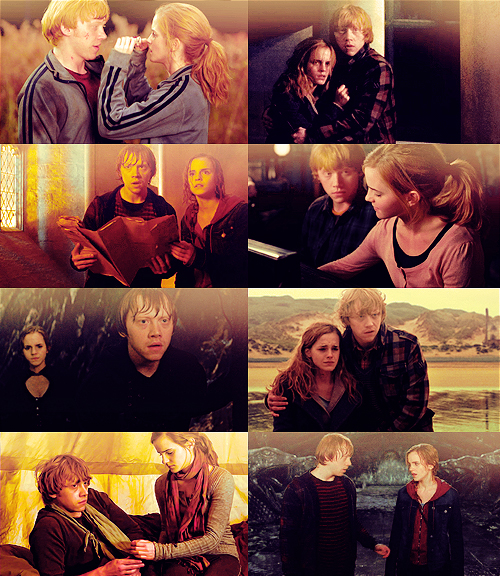
Favourite Ron & Hermione moments.
By the way, this is my hand touching Grint's from the premiere last Thursday in Leicester Square:
10. Can You Keep a Secret?
Hermione’s super-human knowledge and diligence is well-documented throughout the seven books and indeed, her intelligence has come to Harry’s aid on countless occasions. But she possesses so much more than simply book smarts; she is sensitive and a very good reader of people – Ginny’s schoolgirl crush on Harry is apparent to all in Chamber of Secrets, but she being the 11-year-old, impressionable lil’ sis of his best friend, he sensibly pretends not to notice, leaving the crush to evaporate. In Half-Blood Prince, however, it is he who develops feelings for her, and the fact that she has them, quite literally, lined up, and isn’t afraid to face her brother Ron about it when he scolds her – only exacerbates his feelings for her. At the end of the book, after he has gotten her, he has to let go, and it is revealed that it was Hermione to advise Ginny to go with some other boys, not particularly with the aim of forgetting about Harry entirely or to make him jealous, but because she deserved to experience teenage love in her own right. Deep down though, Hermione knew that Ginny only had eyes for Harry and the her flings – however troubling to Harry (and Ron) – would do her no harm. Whilst this is not explicitly a Hermione/Ron moment, simply the fact that Hermione knew how much her crush & best friend’s younger sister fancied her other famous best friend but diplomatically chose not to tell either shows that whilst she is smart like the best of them, Hermione’s best quality is not her brain, but her heart.
09. Well Jell
In Half-Blood Prince, Harry and Hermione both turn the head of Potions Master Professor Slughorn, who invites them to come to his exclusive Slug Club, of which the other members are either well-connected students with distinguished bloodlines (Blaise Zabini’s mum was a heartbreaker of a witch who frequently married and divorced), or students who Professor Slughorn sees a light in, like Ginny and Hermione. Ron, who reacts with a red-hot temper that would do his hair proud at seeing his sister and two best friends invited but not him, and much of his anger is directed at Hermione, who by now he is growing increasingly confused by his feelings towards. Hermione rarely dabbles in underhand tactics, but Ron becomes so snarky towards her simply for being noticed for her excellence that she allows the horny-but-hot Cormac McLuggen to bring her as his date for the Christmas Slug Club party, knowing full well how much it will make Ron jealous. The little on-running feud between Ron and Hermione is as amusing as it is entertaining and acts as an accurate portrayal of teenagers and the petty things we do to get the attention of the ones we like.
08. For you, there’ll be no more crying.
In Philosopher’s Stone, the first few times we are introduced to Hermione Granger, it is difficult to warm to her. Bossy, a know-it-all and almost unbearably stuffy, Harry is a little bemused by her. Ron, however, never one to mince his words, voices his displeasure towards Hermione. Naturally, Hermione would overhear, and despite the brave face she has sustained so far, her butter-wouldn’t-melt demeanour comes crumbling down and her hurt locker shows. She runs into a toilet to cry, unaware that a gigantic troll is also there. Harry and Ron come to her rescue and in a brilliant display of teamwork, the three defeat it. With that, the quintessential OT3 of friendship is borne. If I really wanted to overanalyse, we could say that Hermione’s obnoxious behaviour to Harry and Ron had just been her defensive mechanism for speaking to “famous Harry Potter” and his cute ginger friend who she quite liked the look of. But that would probably be overanalysing it; they were only in year seven.
07. “I love you, Hermione”.
Harry and Ron have – as they have a knack of doing – got themselves in trouble, and now have homework assignments on top of that to worry about. Hermione senses their plight and offers to help with their work. Ron, so grateful, utters weakly “I love you, Hermione,” and it is said that Hermione “turns pink”. Ron’s comment was a throwaway one, but Hermione’s embarrassed reaction tells me that it was she who fell for Ron first, but he was too bull-headed and dull to realise.
06. Lust and delirious
Harry Potter and the Half-Blood Prince is, in a way, a tennis match of sexual politics between Ron Weasley and Hermione Granger. He should be so lucky as to get her – beautiful, smart, loyal girl that she is, but his own insecurity is so crippling that it leads him to mistreat her. His path in getting with sentimental and fairly annoying but well-intentioned Lavender Brown arose from a fight with his younger sister. Unhappy at being berated by Ron for making out with his friends, Ginny cries, in defence, that Ron is simply being a prude because Harry has had experience of snogging (Cho), and “even Hermione kissed Viktor.” This proves to be the catalyst for Ron and Lavender getting together, Lavender herself unaware to the fact that she’s being used as a pawn in the two’s warfare. After Ron suffers a near-death accident, however, and he is recovering, he’s so doped up that he’s unable to get his agenda right and says the name of the girl who he’s really thinking about: Hermione.
05. Oh, Krums.
Harry and Ron leave it a bit late in finding dates for the Yule Ball, meaning that the girls they go with – attractive twins Parvati and Padma Patel are perfectly fine, but not the ones they wished to have gone with. Harry’s choice had been asked sooner – Cho Chang, and Ron’s preferred date is more obscure. When it became hard to find someone he thought Hermione would be available as a last-ditch resort, but on seeing her – by far the most beautiful she’s been – at the Yule Ball, in the arms of Viktor Krum, a famous Quidditch player who up until this point he’d been in awe of, brings up all kinds of envy in him. As a result, he pays Padma no attention, loses all the idolatry he’d had thus far for his Quidditch hero, and seeks Hermione out to have a go. She isn’t having any of it, crying, “Next time there's a ball, ask me before someone else does, and not as a last resort!". Ron splutters his indignations, but judging from Hermione’s tears and Harry’s tactical reticence, he’s only kidding himself.
04. Knight with cruddy armour
Draco Malfoy comes from an affluent family. This is unceremoniously shoved in the Gryffindors’ faces when his father kits the entire Slytherin Quidditch team out with Nimbus 2001. Taking the opportunity to sneer at Harry and Ron, Hermione replies sharply – but accurately that at least Harry earnt his place on the team, rather than buying it like Draco. Malfoy doesn’t like being told by a Muggle, and calls her a terrible word – Mudblood. This infuriates many of the passers by, but only Ron does something about it, pulling out his wand to defend his friend. Unfortunately for him, his wand is crooked and his own hex backfires, but that he would defend his mate’s honour with such fierce loyalty shows the beautiful, unadulterated spirit behind Ron and Hermione relationship.
03. Paying the penalty
Always in the shadow of ~Famous Harry Potter~ and his astounding Quidditch skills, Ron has a chance to shine in the sixth book when Harry, as captain of the Quidditch team, is holding tryouts. Cormac McLuggen probably has more natural talent, and in a Quidditch penalty shoot out, he is flying, saving four of four penalties. As the fifth is taken however, he does a bizarre dance-in-the-sky that results in him letting one in, and Ron getting the role of goalkeeper. As it transpires, it was Hermione who performed the jinx on Cormac to make him under-perform, as retribution for some throwaway comments he’d made about Ron and Ginny. A little action of a good friend, perhaps, but for by-the-book Hermione to play so dirty shows that she truly cared about the person she was doing it for. If only Ron knew.
02. Come together, over me
Albus Dumbledore’s death in Harry Potter and the Half-Blood Prince was one of the most arresting, surprising and depressing deaths in literature for me, not least because it seemed to signal an uprising of Voldemort’s clan. At the end of the book, the entire school (bar a few evil-minded Slytherins) is in mourning. Ron and Hermione have set aside all the drama they have incurred in the book (in a fit of rage, Hermione had sent a bunch of canaries after Ron after seeing the two all over each other), and it is fair to say that Ron has entered that tentative transition between lad and full-fledged young man. Many of the inhabitants of Hogwarts cry, including Hermione, who, we are told, weeps into her ginger friend’s shoulder. It is a rare moment of beauty amidst a sea of heartbreak.
01. Kiss Me
There was a clatter as the basilisk fangs cascaded out of Hermione’s arms. Running at Ron, she flung them around his neck and kissed him full on the mouth. Ron threw away the fangs and broomstick he was holding and responded with such enthusiasm that he lifted Hermione off her feet.
Corny, yes. Out of place (it’s in the Battle of Hogwarts), yes. But oh my lord, it was so bloody overdue. Seven years of adventure, of being there of each other, laughter and tears, mindgames and game playing, all culminating in these few, such rewarding lines. As you may have noticed, I'm quite into my films where there's all this strife and tribulation, and it ends with a grandstanding act of redemption, and Ron and Hermione's kiss is redemption for a lot of the casualties incurred in the series. I don’t care for Emma Watson a jot but I love Rupert Grint and Harry Potter, and thinking over all these precious Ron/Hermione moments has thoroughly piqued my thirst for the final film coming out this Friday!
10. Can You Keep a Secret?
Hermione’s super-human knowledge and diligence is well-documented throughout the seven books and indeed, her intelligence has come to Harry’s aid on countless occasions. But she possesses so much more than simply book smarts; she is sensitive and a very good reader of people – Ginny’s schoolgirl crush on Harry is apparent to all in Chamber of Secrets, but she being the 11-year-old, impressionable lil’ sis of his best friend, he sensibly pretends not to notice, leaving the crush to evaporate. In Half-Blood Prince, however, it is he who develops feelings for her, and the fact that she has them, quite literally, lined up, and isn’t afraid to face her brother Ron about it when he scolds her – only exacerbates his feelings for her. At the end of the book, after he has gotten her, he has to let go, and it is revealed that it was Hermione to advise Ginny to go with some other boys, not particularly with the aim of forgetting about Harry entirely or to make him jealous, but because she deserved to experience teenage love in her own right. Deep down though, Hermione knew that Ginny only had eyes for Harry and the her flings – however troubling to Harry (and Ron) – would do her no harm. Whilst this is not explicitly a Hermione/Ron moment, simply the fact that Hermione knew how much her crush & best friend’s younger sister fancied her other famous best friend but diplomatically chose not to tell either shows that whilst she is smart like the best of them, Hermione’s best quality is not her brain, but her heart.
09. Well Jell
In Half-Blood Prince, Harry and Hermione both turn the head of Potions Master Professor Slughorn, who invites them to come to his exclusive Slug Club, of which the other members are either well-connected students with distinguished bloodlines (Blaise Zabini’s mum was a heartbreaker of a witch who frequently married and divorced), or students who Professor Slughorn sees a light in, like Ginny and Hermione. Ron, who reacts with a red-hot temper that would do his hair proud at seeing his sister and two best friends invited but not him, and much of his anger is directed at Hermione, who by now he is growing increasingly confused by his feelings towards. Hermione rarely dabbles in underhand tactics, but Ron becomes so snarky towards her simply for being noticed for her excellence that she allows the horny-but-hot Cormac McLuggen to bring her as his date for the Christmas Slug Club party, knowing full well how much it will make Ron jealous. The little on-running feud between Ron and Hermione is as amusing as it is entertaining and acts as an accurate portrayal of teenagers and the petty things we do to get the attention of the ones we like.08. For you, there’ll be no more crying.
In Philosopher’s Stone, the first few times we are introduced to Hermione Granger, it is difficult to warm to her. Bossy, a know-it-all and almost unbearably stuffy, Harry is a little bemused by her. Ron, however, never one to mince his words, voices his displeasure towards Hermione. Naturally, Hermione would overhear, and despite the brave face she has sustained so far, her butter-wouldn’t-melt demeanour comes crumbling down and her hurt locker shows. She runs into a toilet to cry, unaware that a gigantic troll is also there. Harry and Ron come to her rescue and in a brilliant display of teamwork, the three defeat it. With that, the quintessential OT3 of friendship is borne. If I really wanted to overanalyse, we could say that Hermione’s obnoxious behaviour to Harry and Ron had just been her defensive mechanism for speaking to “famous Harry Potter” and his cute ginger friend who she quite liked the look of. But that would probably be overanalysing it; they were only in year seven.
07. “I love you, Hermione”.
Harry and Ron have – as they have a knack of doing – got themselves in trouble, and now have homework assignments on top of that to worry about. Hermione senses their plight and offers to help with their work. Ron, so grateful, utters weakly “I love you, Hermione,” and it is said that Hermione “turns pink”. Ron’s comment was a throwaway one, but Hermione’s embarrassed reaction tells me that it was she who fell for Ron first, but he was too bull-headed and dull to realise.
06. Lust and delirious
Harry Potter and the Half-Blood Prince is, in a way, a tennis match of sexual politics between Ron Weasley and Hermione Granger. He should be so lucky as to get her – beautiful, smart, loyal girl that she is, but his own insecurity is so crippling that it leads him to mistreat her. His path in getting with sentimental and fairly annoying but well-intentioned Lavender Brown arose from a fight with his younger sister. Unhappy at being berated by Ron for making out with his friends, Ginny cries, in defence, that Ron is simply being a prude because Harry has had experience of snogging (Cho), and “even Hermione kissed Viktor.” This proves to be the catalyst for Ron and Lavender getting together, Lavender herself unaware to the fact that she’s being used as a pawn in the two’s warfare. After Ron suffers a near-death accident, however, and he is recovering, he’s so doped up that he’s unable to get his agenda right and says the name of the girl who he’s really thinking about: Hermione.
05. Oh, Krums.
Harry and Ron leave it a bit late in finding dates for the Yule Ball, meaning that the girls they go with – attractive twins Parvati and Padma Patel are perfectly fine, but not the ones they wished to have gone with. Harry’s choice had been asked sooner – Cho Chang, and Ron’s preferred date is more obscure. When it became hard to find someone he thought Hermione would be available as a last-ditch resort, but on seeing her – by far the most beautiful she’s been – at the Yule Ball, in the arms of Viktor Krum, a famous Quidditch player who up until this point he’d been in awe of, brings up all kinds of envy in him. As a result, he pays Padma no attention, loses all the idolatry he’d had thus far for his Quidditch hero, and seeks Hermione out to have a go. She isn’t having any of it, crying, “Next time there's a ball, ask me before someone else does, and not as a last resort!". Ron splutters his indignations, but judging from Hermione’s tears and Harry’s tactical reticence, he’s only kidding himself.
04. Knight with cruddy armour
Draco Malfoy comes from an affluent family. This is unceremoniously shoved in the Gryffindors’ faces when his father kits the entire Slytherin Quidditch team out with Nimbus 2001. Taking the opportunity to sneer at Harry and Ron, Hermione replies sharply – but accurately that at least Harry earnt his place on the team, rather than buying it like Draco. Malfoy doesn’t like being told by a Muggle, and calls her a terrible word – Mudblood. This infuriates many of the passers by, but only Ron does something about it, pulling out his wand to defend his friend. Unfortunately for him, his wand is crooked and his own hex backfires, but that he would defend his mate’s honour with such fierce loyalty shows the beautiful, unadulterated spirit behind Ron and Hermione relationship.
03. Paying the penalty
Always in the shadow of ~Famous Harry Potter~ and his astounding Quidditch skills, Ron has a chance to shine in the sixth book when Harry, as captain of the Quidditch team, is holding tryouts. Cormac McLuggen probably has more natural talent, and in a Quidditch penalty shoot out, he is flying, saving four of four penalties. As the fifth is taken however, he does a bizarre dance-in-the-sky that results in him letting one in, and Ron getting the role of goalkeeper. As it transpires, it was Hermione who performed the jinx on Cormac to make him under-perform, as retribution for some throwaway comments he’d made about Ron and Ginny. A little action of a good friend, perhaps, but for by-the-book Hermione to play so dirty shows that she truly cared about the person she was doing it for. If only Ron knew.
02. Come together, over me
Albus Dumbledore’s death in Harry Potter and the Half-Blood Prince was one of the most arresting, surprising and depressing deaths in literature for me, not least because it seemed to signal an uprising of Voldemort’s clan. At the end of the book, the entire school (bar a few evil-minded Slytherins) is in mourning. Ron and Hermione have set aside all the drama they have incurred in the book (in a fit of rage, Hermione had sent a bunch of canaries after Ron after seeing the two all over each other), and it is fair to say that Ron has entered that tentative transition between lad and full-fledged young man. Many of the inhabitants of Hogwarts cry, including Hermione, who, we are told, weeps into her ginger friend’s shoulder. It is a rare moment of beauty amidst a sea of heartbreak.
01. Kiss Me
There was a clatter as the basilisk fangs cascaded out of Hermione’s arms. Running at Ron, she flung them around his neck and kissed him full on the mouth. Ron threw away the fangs and broomstick he was holding and responded with such enthusiasm that he lifted Hermione off her feet.
Corny, yes. Out of place (it’s in the Battle of Hogwarts), yes. But oh my lord, it was so bloody overdue. Seven years of adventure, of being there of each other, laughter and tears, mindgames and game playing, all culminating in these few, such rewarding lines. As you may have noticed, I'm quite into my films where there's all this strife and tribulation, and it ends with a grandstanding act of redemption, and Ron and Hermione's kiss is redemption for a lot of the casualties incurred in the series. I don’t care for Emma Watson a jot but I love Rupert Grint and Harry Potter, and thinking over all these precious Ron/Hermione moments has thoroughly piqued my thirst for the final film coming out this Friday!
Labels:
books,
Emma Watson,
growing up,
Harry Potter,
lol-inducing,
London,
photos,
romance,
Rupert Grint,
teenage
Sunday, January 02, 2011
Like father, like daughter.
I can’t tell a lie, I went into Somewhere not totally expecting to like it. All I’d known about it before watching was that it won the Golden Lion at the Venice film festival and was generally applauded around the States, but was less-than-warmly received in the UK. And, from some reviews I’d seen which had said the film’s biggest shortcoming was that it tried too hard to emulate Coppola’s 2003 film Lost in Translation (a film, by the way, that I don’t exactly care for). With things like that on its side, it’s no wonder that I approached Somewhere with a level of trepidation. However, films can sometimes prove you wrong. Last year, I watched Bright Star not expecting a whole lot, and adored it. Similarly, Somewhere proved to be a pleasant surprise.
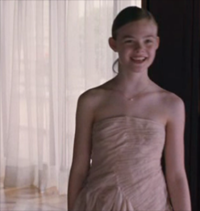
Stephen Dorff plays Johnny Marco, a Hollywood hunk who fills the emptiness that he finds increasingly present in his life with random parties and random women. One day, his 11-year-old daughter Cleo (played by Elle “Dakota’s sister” Fanning”) bungs up and the two are thrown together in a journey of finding out more about each other, and essentially, themselves. It’s a fairly simple premise that has been covered in several films before, but there’s a gentle chemistry between Dorff and Fanning that elevates the film from smug-satire-on-the-privileged that it could so easily slip into. It hardly feels like Stephen Dorff is acting at all, he fits his role so well, and Fanning has none of the precocious know-it-allness that rendered her sister so irksome to me. Furthermore, she plays Cleo with some sweet little mannerisms – the odd hair toss, a bit of thumb twiddling – that indicates the uneasiness and vulnerability of a girl caught in that awkward phase of pre-teenhood, yo-yoed about between two worlds and never feeling like she fits in. It’s a subtle, smart performance that probably deserves more plaudits than it has received.
As with Lost in Translation, there are some indulgent elements to the film that one can’t help feeling Coppola put in the film for herself more than her viewers (a semi-pointless and totally awkward lift scene with Benicio del Toro, far too lingering scenes of pole-dancers entertaining Marco in his hotel room, etc), but these are juxtaposed with scenes that, whilst indulgent, fit in with the film perfectly; shots of Cleo cooking for her and her dad, tracking shots of Johnny Marco’s celebrity being spotted everywhere he goes, as well Cleo describing the plot of Twilight to Johnny. As Cleo fills in Johnny’s days with her favourite activities, his life (perhaps unsurprisingly) sheds its emptiness. But it is a surprising joy to see them on their journey. Apparently much of the film was based around Coppola's own experiences of following her dad around, which would explain the scenes set in Italy, featuring amusing skits on language and culture barriers between Hollywood and the Europeans.
Essentially, what the film could have done with the most was perhaps having the audience care about the leads a little more; whilst I liked them just fine, I never felt I totally fell in love with them like I have done with various other film characters of the noughties (for example, Inglourious Basterd’s Shoshanna, Brokeback Mountain’s Jack Twist, Finding Nemo’s Dory, etc), but nonetheless, Coppola sure knows how to deliver a film. The soundtrack is kooky and fresh (I particularly enjoyed the part Gwen Stefani’s “Cool” played in the film; a song that could perhaps sum up the theme of the film quite well) and Sarah Flack’s editing, with her collaborations with Coppola in Marie-Antoinette and Lost in Translation, cannot be faulted. Ultimately, I didn’t entirely get where the film was headed, but, perhaps like the dad and the daughter in the film, the joy is knowing that they will get, somewhere.
Sunday, October 10, 2010
10.10.10.
4.3.2.1 (Noel Clarke, 2010)
4.3.2.1 tells the story of four female friends in inner-city London who inadvertently get embroiled in a diamond heist. At the start of the film, they meet up in a café, then part ways for their own mini-adventures, not knowing that, over the next 48 hours, their paths will cross in more unorthodox ways. The film follows directly after they have parted ways, channelling the misdemeanours of each girl for the next few days. So far, so Tarantino. Except that, whilst I may find QT a little irksome in his continual self-advertising and self-love, at least he had something to be smug about. Noel Clarke, not so much. There’s split screen and samurai swords (as well as a tacky lesbian sex scene so that the lads are entertained) aplenty, but this film is a heavy case of style over substance. There are plotholes amongst plot holes in the film, and by fragmenting the foursome, it is difficult to find a single one who I cared about; Ophelia Lovibond is the self-harmer who is still bruised from an abortion she once had, Shanika Warren-Marland is a lesbian and wants everyone to know it, Tamsin Egerton a spoilt piano prodigy who swans about in New York spending her parents’ money and losing her virginity, and Emma Roberts a long-suffering checkout worker who pines for better days. None of the four leads give any kind of acting that’s worth a damn, Emma Roberts is and continues to have the kind of face that I feel needs a slap, though I will give credit where credit is due – whilst she can’t act for toffee, Miss Egerton does have astounding legs. The performances all uniformly below-par (bar perhaps Eastenders’ Michelle Ryan, who’s turn as a psycho bitch is at least entertaining), the dialogue is superficial and at times, cringe-inducing (Warren-Marland’s Kerrys sports a T-shirt saying Vagetarian, and the film’s shallow treatment of abortion leaves a lot to be desired) and despite the promising premise, ultra-cool settings in London and New York (my two favourite cities in the world) and soundtrack that hits more than it misses, this film is nonetheless an awful attempt to be with it. As a result, there is no story, no characters, and no quality. When you're an even worse British film of 2010 than Shank, you know you've got problems, blud.
Made in Dagenham (Nigel Cole, 2010)
From an unspeakably poor British film, to a much, much better one. Nigel Cole’s film tells of the Dagenham Ford strike in 1968. Led by feisty but down-to-earth Rita (Sally Hawkins, always lovely), the car-seat makers of the Ford plant decide that they deserve better, and, guided by Bob Hoskins, they take matters in their own hand. An unashamedly pro-women film, this delight does girl power far better than 4.3.2.1 ever could. As with 4.3.2.1, it’s anything but subtle (many characters have monologues and soliloquies talking about the strifes of being a woman) but such is the quality of Billy Ivory’s screenplay, that the film never feels manipulative, or force. And, unlike 4.3.2.1, the acting is stellar. Sally Hawkins is wonderfully natural and sweet, Bob Hoskins is amusing, Geraldine James is very very moving, and Rosamund Pike, though underused, illustrates the film’s key point that one should never skim the surface and automatically disregard a woman as just a pretty face. The costumes captured the earthy Essex chic wonderfully and overall, I walked out of the cinema with a big smile on my face.
The Prestige (Christopher Nolan, 2006)
Now, as you know, I wasn't the biggest fan of Inception. OK, that’s an understatement; I detested it and wanted my money back. But, I know that Chris Nolan is a mighty talented film director, and I wanted to reinforce this point by revisiting one of his more underrated films – The Prestige. Christian Bale and Hugh Jackman play magicians who’s friendship turns sour when a magic trick gone wrong has the latter’s wife dying. From then on, friends turn to enemy as the two continually look for ways to jeopardize each others’ magic acts. A wonderful study of obsession, The Prestige also boasts a clever look into the world of magic performance, as well as some REAL magic, which still turns my head. For once, Scarlett Johansson didn’t bug the crap out of me in her performance, and dual casting of her and Rebecca Hall had me cracking a smile at the Vicky Cristina Barcelona link. Michael Caine is as Michael Caine always is, awesome, and the cinematography, score and editing are all accomplished. Much, much, much more magical than Inception can ever hope to be.
The River (Jean Renoir, 1951)
In short, one of my favourite films of all time.
Sideways (Alexander Payne, 2004)
Paul Giamatti stars as Miles Raymond is a divorce, a jaded middle school teacher, aspiring writer and wine lover, on a road trip with his friend, bit-part actor Jack (Thomas Haden Church), the week before Jack’s wedding. Miles wants to play golf, taste wine and wind down, Jack would prefer to chase women and bonk about a bit before getting wed. Such is the set-up for Alexander Payne’s bittersweet and highly intelligent film, the ultimate “anti road trip movie”. Though I’m perhaps a bit young to appreciate the full genius of this film (certain scenes dragged on for me and it veered dangerously close to just the wrong side of pretentious), one thing I cannot fault about it is Paul Giamatti’s performance, the epitome of mensch. He turns Sideways into a mediocre comedy into a strong comedy-drama with his perfect comedy timing and emotional depth in the more controlled scenes. Furthermore, his romance with Virginia Madsen’s (also divorced) smart and sexy waitress Maya is awkward, initially somewhat embarrassing and unsure, as a believable romance should be. I don’t often care whether or not 40-somethings get the women of their dreams, but such is the power of Giamatti’s performance, that, for him, I did.
Out of the Past (Jacques Tourneur, 1947)
Film noir with Robert Mitchum, Kirk Douglas and Jane Greer, the former of which whom irked me in her irritating performance as the femme fatale who does nothing but cause trouble for men. Jacques Tourneur gets the best out of the rest of his cast, though, and thanks to that, his measured direction and the clever camerawork, this can be ranked as one of the finer film noirs of the 40s. Indeed, the impending sense of doom had me in a dread throughout, even though I knew it was just a film.
Labels:
1947,
2004,
2006,
2010,
40s,
British,
Christian Bale,
cool,
crap,
Essex,
growing up,
Hugh Jackman,
London,
mini-reviews,
New York,
noir,
overrated,
romance,
Tarantino,
teenage
Wednesday, August 04, 2010
I Need a Gun, 'Cos all I Do is Dance.
I know, I know, I've been a bit of a no-show with this blog for the past month or so, and it's really, really not on. Unfortunately, that isn't going to change any time soon, as I'm jetting off to Italy with my family this Friday for a few days. But, for now, have four mini-reviews of the films I've watched recently.

Step Up (Anne Fletcher, 2006)
Channing Tatum plays Tyler, your token disillusioned youth from the wrong side of the tracks who wastes his days being a juvenile delinquent with his two friends, brothers Mac and Skinny. One evening, they are caught vandalising a hall in the Maryland School of Arts. Mac and Skinny escape, but Tyler is punished with community service as a janitor at said school. In doing his duties, he crosses paths with pretty and talented but uppity teenager Nora (Jenna Dewan), who's dream it has always been to be a dancer. When her dance partner for the upcoming danceshow injures himself, it (predictably) sets Tyler up for a chance to show that he's more than just a troublemaker. Despite the background differences between the two, when they dance, sparks fly, and the two protagonists find themselves drawn towards each other as more than just dance partners.
As you'd expext, a film like this is fairly low on plot and dialogue, and puts all of the weight on the dance scenes, which are indeed sublime. The finale in particular, is spectacular, as a group of 20+ dancers, led by Tatum and Dewan, fuse streetdance, hip-hop and ballet to the intrumental track of Yung Joc's "Bout it". It's forgettable fodder for the most part, but the dance scenes really are worth a re-watch.
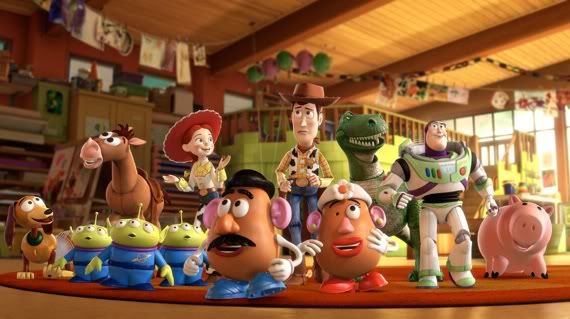
Toy Story 3 (Lee Unkrich, 2010)
Needless to say, Woody and Buzz's owner, Andy, can't be eight forever, and there must be a time when he goes to college. The time has arrived in Toy Story 3, and each of his toys - even his favourite, Woody, knows that they are living on borrowed time. However, they under-estimate their worth to Andy, for, whilst he only wishes to bring Woody with him to college, he still plans to keep the rest of his toys in the attic. But due to a stream of misunderstandings, the remaining toys get tossed out and end up in a day care centre. Whilst this new surrounding initially seems promising - plenty of eager children wanting to play with the toys in ways that Andy no longer does - the debutante toys soon realise that it is only children in the butterfly room who actually know how to play with toys. The kids in the caterpillar room - the room they've been shoved in - is occupied by toddlers, toddlers who don't treat the toys well. At all.
I had a bit of a love/hate relationship with Toy Story 2. I disliked it for aaaages, until one day, I had sudden craving to give it a re-appraisal, and I immediately fell back in love with it. My relationship with the first film is more straightforward: it was the first film I saw in the cinema in England, and loved it. It is a similar case with this film, which was choc-a-bloc full with joy, humour and banter between the toys. I'm not ashamed to admit I tore up twice, and was moved throughout by the loyalty and fraternity between the toys. The ending was one of the most bittersweet in film, but I adored it. And the cameo of a Totoro doll pretty much epitomized the film's awesomeness.
The Karate Kid (Harold Zwart, 2010)
Will Smith's kid plays Dre, a 12-year-old boy who's single mother has relocated them to China. He hates it there, he neither speaks the language, nor gets on with anybody around (except a pretty Chinese girl of his age who is similarly drawn to him). His interest in said girl is what gets him off on a bad foot with the resident bully. Dre, a feisty boy, is never one to take abuse lying down, yet, in their first fight, Dre easily comes off worse, sporting a brutal black eye which he proceeds to try to - and fail - to hide from his mother (played by Taraji P. Henson with the touch of maternal warmth she exhibited in The Curious Case of Benjamin Button). After one particularly bruising encounter with the group of bullies, the grouchy janitor (played by Jackie Chan) steps in, quietly opens a can of whoopass, and becomes Dre's mentor for the upcoming karate tournament.
I forwent Inception to see this film, as it was on my dad's birthday and he loves Jackie Chan, and to be honest, I'm totally sure that I would have preferred the other film. Though, that said, I still had a relatively good time with The Karate Kid. Jaden Smith, who was cute and cuddly in The Pursuit of Happyness but didn't convince me he was capable of much past that, more than carries the film here, both in his natural acting as well as his dedication to the fight scenes. Jackie Chan, who's fight moves I adore but I'd never rated very highly as an actor, also surprises here, particularly in the scene with the car, a scene which actually moved me to tears. Like Step Up, it's a fairly predictable, forgettable set-up, but thanks to a fun soundtrack and brilliant chemistry between the two leads, good fun whilst it lasts.
Diary of a Wimpy Kid (Thor Freudenthal, 2010)
Zachary Gordon stars as Greg Heffley, a boy entering middle school. He's determined to make a name for himself and be as popular as possible, and if this involves re-inventing his loyal but unfashionable best mate Rowley Jefferson (played with affable charm by Robert Capron). The film follows him as his attempts to show how popular and cool he is fall flat each time, with each attempt just landing him further and further away from his aim. It's a simple enough movie with a simple enough message: don't become so preoccupied with the superficial that you forgo the things that really matter, and a cool turn from the ever-lovely Chloe Moretz (MUST watch Kick-Ass!)
Step Up (Anne Fletcher, 2006)
Channing Tatum plays Tyler, your token disillusioned youth from the wrong side of the tracks who wastes his days being a juvenile delinquent with his two friends, brothers Mac and Skinny. One evening, they are caught vandalising a hall in the Maryland School of Arts. Mac and Skinny escape, but Tyler is punished with community service as a janitor at said school. In doing his duties, he crosses paths with pretty and talented but uppity teenager Nora (Jenna Dewan), who's dream it has always been to be a dancer. When her dance partner for the upcoming danceshow injures himself, it (predictably) sets Tyler up for a chance to show that he's more than just a troublemaker. Despite the background differences between the two, when they dance, sparks fly, and the two protagonists find themselves drawn towards each other as more than just dance partners.
As you'd expext, a film like this is fairly low on plot and dialogue, and puts all of the weight on the dance scenes, which are indeed sublime. The finale in particular, is spectacular, as a group of 20+ dancers, led by Tatum and Dewan, fuse streetdance, hip-hop and ballet to the intrumental track of Yung Joc's "Bout it". It's forgettable fodder for the most part, but the dance scenes really are worth a re-watch.
Toy Story 3 (Lee Unkrich, 2010)
Needless to say, Woody and Buzz's owner, Andy, can't be eight forever, and there must be a time when he goes to college. The time has arrived in Toy Story 3, and each of his toys - even his favourite, Woody, knows that they are living on borrowed time. However, they under-estimate their worth to Andy, for, whilst he only wishes to bring Woody with him to college, he still plans to keep the rest of his toys in the attic. But due to a stream of misunderstandings, the remaining toys get tossed out and end up in a day care centre. Whilst this new surrounding initially seems promising - plenty of eager children wanting to play with the toys in ways that Andy no longer does - the debutante toys soon realise that it is only children in the butterfly room who actually know how to play with toys. The kids in the caterpillar room - the room they've been shoved in - is occupied by toddlers, toddlers who don't treat the toys well. At all.
I had a bit of a love/hate relationship with Toy Story 2. I disliked it for aaaages, until one day, I had sudden craving to give it a re-appraisal, and I immediately fell back in love with it. My relationship with the first film is more straightforward: it was the first film I saw in the cinema in England, and loved it. It is a similar case with this film, which was choc-a-bloc full with joy, humour and banter between the toys. I'm not ashamed to admit I tore up twice, and was moved throughout by the loyalty and fraternity between the toys. The ending was one of the most bittersweet in film, but I adored it. And the cameo of a Totoro doll pretty much epitomized the film's awesomeness.
The Karate Kid (Harold Zwart, 2010)
Will Smith's kid plays Dre, a 12-year-old boy who's single mother has relocated them to China. He hates it there, he neither speaks the language, nor gets on with anybody around (except a pretty Chinese girl of his age who is similarly drawn to him). His interest in said girl is what gets him off on a bad foot with the resident bully. Dre, a feisty boy, is never one to take abuse lying down, yet, in their first fight, Dre easily comes off worse, sporting a brutal black eye which he proceeds to try to - and fail - to hide from his mother (played by Taraji P. Henson with the touch of maternal warmth she exhibited in The Curious Case of Benjamin Button). After one particularly bruising encounter with the group of bullies, the grouchy janitor (played by Jackie Chan) steps in, quietly opens a can of whoopass, and becomes Dre's mentor for the upcoming karate tournament.
I forwent Inception to see this film, as it was on my dad's birthday and he loves Jackie Chan, and to be honest, I'm totally sure that I would have preferred the other film. Though, that said, I still had a relatively good time with The Karate Kid. Jaden Smith, who was cute and cuddly in The Pursuit of Happyness but didn't convince me he was capable of much past that, more than carries the film here, both in his natural acting as well as his dedication to the fight scenes. Jackie Chan, who's fight moves I adore but I'd never rated very highly as an actor, also surprises here, particularly in the scene with the car, a scene which actually moved me to tears. Like Step Up, it's a fairly predictable, forgettable set-up, but thanks to a fun soundtrack and brilliant chemistry between the two leads, good fun whilst it lasts.
Diary of a Wimpy Kid (Thor Freudenthal, 2010)
Zachary Gordon stars as Greg Heffley, a boy entering middle school. He's determined to make a name for himself and be as popular as possible, and if this involves re-inventing his loyal but unfashionable best mate Rowley Jefferson (played with affable charm by Robert Capron). The film follows him as his attempts to show how popular and cool he is fall flat each time, with each attempt just landing him further and further away from his aim. It's a simple enough movie with a simple enough message: don't become so preoccupied with the superficial that you forgo the things that really matter, and a cool turn from the ever-lovely Chloe Moretz (MUST watch Kick-Ass!)
Labels:
2006,
2010,
blog,
child performances,
China,
dance,
growing up,
Jackie Chan,
mini-reviews,
Pixar,
teenage,
Tom Hanks,
Toy Story,
Will Smith
Sunday, May 23, 2010
Youth in Revolt (Miguel Arteta, 2009)
Nick Twisp (Michael Cera) is a horny teenage youth with a twist - he wishes to be a writer, lives by the songs of Frank Sinatra, appreciates the films of Fellini, wryly observing the lives of his divorced parents - his father, who lives with a much younger, blonder model, and his mother, who takes whatever men/f-buddies she can get. Under all his witticisms, he just wants to fit in. Whilst accompanying his mother and her current lover on a trailer park holiday, he sets his eyes on Sheeni (Portia Doubleday), whom, to him, is perfection. They have a sweet but short-lived Summer fling (a strictly first and second base one, which Twisp's virginity remains intact from), but Nick wants it to last forever. Adopting a double persona as Francois, his badass alter ego, Nick sets to doing all he can in order to get thrown out so he can go live near Sheeni. At the start of the film, Nick had noted "In movies, the good guy gets the girl. In reality, it's usually the prick", and sets about righting this for once. He is, to all intents and purposing, fighting for her love.
Youth in Revolt plays, at times, like a cross between Superbad and Fight Club, what with the plot revolving around a teenager's quest to lose his bunginity, as well as the fact that he (in his mind) constructs another, cooler vision of himself, one who has the balls to do the things that he normally dare not. It is R-rated (15 in the UK), but not terribly explicit or rude, it just doesn't hold back on the cursing and has a few sex jokes that would go beyond what would be allowed at a 12. There are some hilarious comedic sequences- one in particular involving the protagonist's bad attempt to fake his own death, but on the whole, the film is funny in a downbeat, quiet way. The quirky style of the film is complemented with performances by indie stars Steve Buscemi and Ray Liotta, both who own the camera for the brief moments they are in.
My main concern with Youth in Revolt was that I was simply never convinced that Sheeni reciprocated Nick's (admittedly extremely strong) feelings. It doesn't help, of course, that Portia Doubleday isn't a very good performer, but on the whole, I found her character cold, confused and a little annoying. Part of the joy of Youth in Revolt is enjoying all the escapades to Nick's climb to his destination, and not necessarily the destination, but I couldn't help but feel throughout the film that Sheeni wasn't a worthwhile one. (Though perhaps that doesn't matter, and what matters is that Nick thinks it is). All that said, I did very much enjoy the adorable animated sequence that played through the credits involving the two.
Michael Cera, who warmed hearts in Juno and Superbad, is completely at home in the role of dorky teenage boy, and once again, he steals the show - and my heart - here. His Nick Twisp certainly has a warped, bordering on psychotic idea of what it means to fight for someone's love but there's an everyday quality to Cera's acting and looks that renders him totally likeable, no matter what the creepy scenario he finds himself in. If it weren't for Cera, I may have found the film annoying and not all that funny, but thanks to him, it mostly manages to be bright, sweet and engaging. Cera is definitely one to keep an eye on; mark my words, that lad'll go far.
Labels:
2009,
Cheryl Cole,
comedy,
film ratings,
growing up,
Juno,
Michael Cera,
Ray Liotta,
romance,
Sex,
Steve Buscemi,
teenage
Sunday, March 07, 2010
It could have been you and me before you broke my heart, and now I'm standing here.
I only watched three films this week, which is a bit poor, but in my defence, I did have tonnes of work as well as an increase in my TV-watching (Damages, Cambridge Spies, The Simpsons, The Wire, Desperate Housewives and Gavin & Stacey). Phew!
Up in the Air (Jason Reitman, 2009)
I wasn’t keen on this film from all the clips I’d seen (and the petty fact that I don’t like George Clooney), but it was a genuine surprise. Clooney, whilst playing a smug character, wasn’t actually as unbearably smug as he has been in the past, and was actually semi-likeable as he began to acquire an epiphany toward the end. Vera Farmiga was underused for the most part, but Anna Kendrick was utterly lovely and hilarious. The script was sharp enough, and I love the cameo from the guy that played Juno’s dad. On the whole, I would say I enjoyed the movie less than Juno, but it was much better-rounded as a piece of filmmaking.
Saving Face (Alice Wu, 2004)
I loved this film! It tells the story of Hwei-lang Gao, a 48-year-old Chinese woman living in America who, on getting pregnant, is sent into exile by her ultra-conservative father. She goes to live with her lesbian daughter Wilhelmina, who, from her sexuality, has enough problems of her own. What I loved so much about this film was that it expertly judged the dynamics of the Chinese community in a western society, both embracing its good points, and criticising its shortcomings. The main character, smart surgeon Wilhelmina who’s still struggling to come to terms with her sexuality, was likeable and I genuinely cared for her plight. A bit schmaltzy at the end, but nothing wrong with a bit of feel good. I felt proud to be Chinese after this movie.
Afterschool (Antonio Campos, 2008)
Um. This film was not good. A lad in a restrictive, internet-obsessed boarding school films the death of two cokeheads in his school and shows everyone the video, and afterwards, life just spirals out of control. An extremely pretentious movie, with a lot of long pausing, and one of the most awkward virginity-losing scenes in cinema. Not recommended at all.
a
Labels:
2004,
2008,
2009,
Anna Kendrick,
China,
crap,
George Clooney,
growing up,
independent film,
Juno,
lol-inducing,
mini-reviews
Thursday, February 18, 2010
8. He ni zai yi qi (Chen Kaige, 2002)
Together tells the story about Liu Xiaochun, a thirteen year old boy with a prodigal talent at the violin. His father, Liu Peiqi enters him for a musical competition in Beijing, and although his son finishes fifth, his residence not in Beijing renders him invalid. His dad persuades a music professor to take his son on whilst he goes back home, thus leaving Liu Xiaochun away from his dad for the first time in his life.
Appropriately, for a film about the violin, the music in this film is stunning. This humble story is also written by the director, telling the story with stirring emotive force. Liu Xiaochun proves to be the kind of sensitive soul that far few 13-year-olds are. In its own little way, Together makes me appreciate my parents much more and evoke tears whenever I think about how much they’ve sacrificed for me. The supporting actors are all good, showing the subtle ways in which the people young Xiaochun meets shape his development and life.
It’s refreshing to witness the friendships and platonic loves that the protagonist meets throughout the film. Xiaochun has two music teachers throughout the film, and each is at a dead end in his life about something, and these themes are investigated with sensitivity. Far be it from being a film about just the violin, themes of friendship, determination, courage, and love are all in here. The film is not without its melodramatic moments, but that only heightened my enjoyment of it. And, whilst it has been criticized by some for being too saccharine, to that I say, what’s so bad about sugary once in a while? As Chen Kaige himself said, "being Chinese isn't all misery”.
Tang Yun, a real-life violinist, was selected for the role when director Chen Kaige saw him at a concert, and his performance is genuine as it is heartfelt. Liu Peiqi is incredible as the father who makes sacrifice upon sacrifice because he wants the best for his son – a gesture that is shown to be even more affecting when the flashback shows how the father came to find his son (few films scenes have had me crying so much, and for so long).
In fact, despite his violin skills being the catalyst and plot driving force in the film, I see Together more as a universal tale of the love between a father and son. The father isn’t perfect; he’s poor and struggling to make ends meet, but this is something that makes his devotion to his son easier to relate to.
There are two things about Together that resonated with me: the fact that I’m Chinese and the fact that I play violin. And it’s true; watching Together did make me appreciate the violin more, as well feel nostalgia for my homeland. But my appreciation for the film came from far more than just those similarities.
Cinema is an art form that transcends mere entertainment. It can inspire debate, conversation, raise pertinent topics. It can make an everyday story more exciting and interesting with the aid of music, cinematography and beautiful art direction. But the main reason I watch films is to feel. Human emotion can be felt by anybody, anywhere. And in getting me to feel pathos, bathos and the spectrum of emotions in between, Together achieves that aim perfectly.
Labels:
2002,
China,
classical music,
family,
favourites,
growing up,
parenthood,
teenage,
top 100 countdown,
violin
Friday, April 24, 2009
8 Days of Buñuel - The Young One (Luis Buñuel, 1960)
The film begins with Traver, a man on the run from the law due to allegations that he's raped a woman, rowing to the shore, set to the spiritual song Sinner Man, sung by Leon Bibb. This being the 60s in the American South, him being a black man and the person crying rape being a white woman, the truth, that he in fact is innocent, therefore has little importance.
He reaches an Island which has only two inhabitants - thirteen year old Evvie, an uneducated and unruly child who is a bit too dim for her own good regarding the motives of the other inhabitant - gruff and "manly" beekeeper Miller, who used to work with her grandad before he dies at the start of the film.
On noticing that she can look quite pretty when she tidies herself up, Miller suddenly realises he wants to bung the young girl, developing boobs and all. And hence, we enter the murky territory of Luis Buñuel's film about racism and child abuse, adapted from Peter Matthiessen's short story "Travellin' Man".
He reaches an Island which has only two inhabitants - thirteen year old Evvie, an uneducated and unruly child who is a bit too dim for her own good regarding the motives of the other inhabitant - gruff and "manly" beekeeper Miller, who used to work with her grandad before he dies at the start of the film.
On noticing that she can look quite pretty when she tidies herself up, Miller suddenly realises he wants to bung the young girl, developing boobs and all. And hence, we enter the murky territory of Luis Buñuel's film about racism and child abuse, adapted from Peter Matthiessen's short story "Travellin' Man".
The Young One is probably the least Buñuelesque film of his that I've seen. The storytelling is linear and straightforward, it's one of his two films set in English, plus the themes - of male animosity, personal grudges, racism et al feel more at home in a John Wayne or Clint Eastwood film. That said, one element prevalent in most of his films and present here is the tendency for at least one of the cast members to over-act hilariously.
Here, it is Key Meersman playing the blossoming girl Evalyn. Evvie herself is a likeable enough character - she, unlike her neighbour, is not racist, and treats Traver with respect and admiration. She is also a lamentably naive character, not putting up much of a fight when the sexually frustrated brute Miller comes to her bedside and takes her bunginity. That said, she is, as Kanye West might describe as be one of those girls who "what I love most she had so much soul", and as such, Evvie deserved a better performance than the bland and plain line-reading one Meersman gives.
The two male leads are significantly stronger, particularly Bernie Hamilton as the afflicted and much-maligned jazz clarinet who has been abused and ridiculed, but refuses to lose his pride.
Here, it is Key Meersman playing the blossoming girl Evalyn. Evvie herself is a likeable enough character - she, unlike her neighbour, is not racist, and treats Traver with respect and admiration. She is also a lamentably naive character, not putting up much of a fight when the sexually frustrated brute Miller comes to her bedside and takes her bunginity. That said, she is, as Kanye West might describe as be one of those girls who "what I love most she had so much soul", and as such, Evvie deserved a better performance than the bland and plain line-reading one Meersman gives.
The two male leads are significantly stronger, particularly Bernie Hamilton as the afflicted and much-maligned jazz clarinet who has been abused and ridiculed, but refuses to lose his pride.
In terms of the two key themes of the film - child abuse and racism, Buñuel does a far better job in his depiction of the latter than the former. People back then really were as single-minded as he shows them to be, and it's no coincidence that the three characters in the film that can see above skin colour - Evvie, the Reverend and Traver himself, are portrayed as the good guys. And, even then, prejudice still runs in the veins of the white people, albeit unwillingly - Evvie refers to the clarinet as a liquorice stick, suggesting that, if bought up in racist surroundings, making such comments might be an intrinsic thing.
The paedophilia issue is dealt with woefully. I fully expect the character of Miller to get his full comeuppance for taking advantage of an unknowing 13-year-old by dying, but I was disappointed. Whilst the "say no to racism" message is clear, the stance against paedophilia is a bit more dubious. "She's a woman," says Miller defensively, suggesting he has no repentance for debasing Evvie.
And for that, more than anything else wrong with the film, the highest grade I can give it, for all its strong dramatic moments and intelligent dialogue, is...
The paedophilia issue is dealt with woefully. I fully expect the character of Miller to get his full comeuppance for taking advantage of an unknowing 13-year-old by dying, but I was disappointed. Whilst the "say no to racism" message is clear, the stance against paedophilia is a bit more dubious. "She's a woman," says Miller defensively, suggesting he has no repentance for debasing Evvie.
And for that, more than anything else wrong with the film, the highest grade I can give it, for all its strong dramatic moments and intelligent dialogue, is...
B+
Labels:
1960,
60s,
child performances,
growing up,
Luis Buñuel,
race relations,
reviews,
teenage
Friday, April 03, 2009
The Inbetweeners is awesome.
Season 2 of Damon Beesley & Iain Morris' The Inbetweeners hit E4 last night, and I'd heard nothing but good things about season 1. S
First Day begins with the uprooting of Will, a posh boy whose father has left his mother and can hence no longer afford the private school fees. Once at the comp his square blazer, the oversized badge pinned to him, and his socially inept ways waste him no time in making him enemies and meaning that people are embarrassed to be seen with him in public. However, when he notices a classmate Simon getting ridiculed in public when he gets an erection, Will tags along after him and such begins an unlikely friendship with misadventure, booze, and many, many embarrassments.
In the gang is also a Russell Howard lookalike Jay, a "borderline sex pest" who has just one thing on his mind - "chasing muff" (he has an arsenal of unoriginal "she can come on my face"-type lines that I hear every day from certain lads at Uni), and a slightly dopey fruit-machine addict named Neil, who's dad may or may not be gay. The four boys try their luck buying alcohol in a pub (to no avail), bunking off school, and going to Thorpe Park, to hilarious consequences. The show reaches painful levels of amusement - such as when Will, drunk off his head, abuses Neil's dad, calling him a "bumder" (amalgamation of "bender" and "bumboy", or when Will accidentally hits a wheelchair bound woman with a frisbee, or when the door of Simon's crap yellow car falls off. If Skins is about the lot that get into nightclubs and get stoned, The Inbetweeners captures the lives of those who wait in the cold outside, trying to get in. The hip soundtrack (Kate Nash's Foundations, 1234 by Feist, Chelsea Dagger etc) adds to the authentic feel of the show and Greg Davis is on fire as the psychotic Head of Sixth Mr Gilbert, evoking all too familiar memories of the trouble I used to get into with my Head of Sixth. It's terrifically astute and biting British comedy that encapsulates, in every cringey detail, the full hardship of growing up. Can't wait for more!
Labels:
2008,
2009,
comedy,
growing up,
lol-inducing,
Skins,
teenage,
The Inbetweeners,
TV
Friday, November 14, 2008
Film review: HIGH SCHOOL MUSICAL 3 [sarcasm alert haha]
At the time of writing this, High School Musical 3: Senior Year has an extremely lowly rating of 3.3/10 on IMDb. This saddens me greatly. My friend Luke and I watched HSM3 this Wednesday, due to it being 3.30 and W. not starting until 5.30, and HSM3 starting at 3.45pm. I’m delighted that we made this choice, because it proved to be everything that cinema isn’t these days – intelligent, moving, witty, and so, so, well acted.
Troy and Gabriella are now in their final year of high school, and they still haven’t bunged. In fact, it takes them 90 whole minutes of celluloid to even have a kiss. And even then it’s not a proper kiss. Anyway, it’s time to go to college. Troy’s dad wants him to pursue his basketball, and Gabriella’s doing Law somewhere far away. Naturally, they have preoccupations over whether or not their oh-so-deep relationship will stand this trying test, but it’s nothing the odd song or two can’t sing. In fact, Gabriella even decides it would be a cool thing to – on top of all the exams they have – put on one last school musical.
Meanwhile, Sharpay’s gotten herself a Machiavellian British little manservant, her camp brother Ryan’s trying to prove to the world that he’s not really gay by winking at the girl that plays the piano, and Troy’s basketball buddy Chad is gonna miss his mate. Oh the woes.
Despite the achingly fresh and original storyline, HSM3 still stays true to its bubblegum roots, wherein all the characters will be break into song whenever they damn well please – whether that be in asking a girl to prom, in the middle of a basketball game, or, best of all – in a deserted garage, where the scene between Troy and Chad is bromancetastic.
Vanessa Hudgens deserves an Oscar for her heart-wrenching performance of the teenage girl who is torn between her loves – her education, and her stunning, not at all impotent boyfriend, although this really is a group effort, with the entire cast not putting a foot wrong throughout the entire film.
If you do not cry at the scene in which Troy finds Gabriella and they have their private prom moment, then I tell you, you have no heart. Everything in HSM3 has been building up to this moment, which is in itself a terrifically post-modern homage to Shakespearean courtly scenes. Everything about this film is perfect, and I so wish that I could sing like Ashley Tisdale.
(Nah, seriously, I liked it quite a bit – 7/10. It was totally shit of course, but ya know, in a good way. It was much funnier than Burn After Reading, at any rate. The gospel version of “We’re All in this Together” was good fun.)
Troy and Gabriella are now in their final year of high school, and they still haven’t bunged. In fact, it takes them 90 whole minutes of celluloid to even have a kiss. And even then it’s not a proper kiss. Anyway, it’s time to go to college. Troy’s dad wants him to pursue his basketball, and Gabriella’s doing Law somewhere far away. Naturally, they have preoccupations over whether or not their oh-so-deep relationship will stand this trying test, but it’s nothing the odd song or two can’t sing. In fact, Gabriella even decides it would be a cool thing to – on top of all the exams they have – put on one last school musical.
Meanwhile, Sharpay’s gotten herself a Machiavellian British little manservant, her camp brother Ryan’s trying to prove to the world that he’s not really gay by winking at the girl that plays the piano, and Troy’s basketball buddy Chad is gonna miss his mate. Oh the woes.
Despite the achingly fresh and original storyline, HSM3 still stays true to its bubblegum roots, wherein all the characters will be break into song whenever they damn well please – whether that be in asking a girl to prom, in the middle of a basketball game, or, best of all – in a deserted garage, where the scene between Troy and Chad is bromancetastic.
Vanessa Hudgens deserves an Oscar for her heart-wrenching performance of the teenage girl who is torn between her loves – her education, and her stunning, not at all impotent boyfriend, although this really is a group effort, with the entire cast not putting a foot wrong throughout the entire film.
If you do not cry at the scene in which Troy finds Gabriella and they have their private prom moment, then I tell you, you have no heart. Everything in HSM3 has been building up to this moment, which is in itself a terrifically post-modern homage to Shakespearean courtly scenes. Everything about this film is perfect, and I so wish that I could sing like Ashley Tisdale.
(Nah, seriously, I liked it quite a bit – 7/10. It was totally shit of course, but ya know, in a good way. It was much funnier than Burn After Reading, at any rate. The gospel version of “We’re All in this Together” was good fun.)
Labels:
2008,
bitchiness,
growing up,
High School Musical,
musicals,
Oscars,
reviews,
romance,
school,
universities,
Zac Efron
Wednesday, June 25, 2008
Sweet (Julie Burchill)
Sweet tells the story of Maria “Sugar” Sweet, who has just been released from prison for grievous bodily harm. At 17, she’s already married and got a daughter –
Anyway, the novel follows Sugar as she tries everything she can do get out of Brighton. Her first job is doing cleaning up for a pair of gay fashion designers, who decide to use her as their muse for their latest “product” (it later turns out that product is a range of clothes inspired by chavs.)
Sugar is a larger-than-life character, completely sure of her Goddessness and more than a bit of a slut, jumping from one guy to the next. Although she thinks she might be lesbian (there are frequent references to Kim, the girl who loved her, and Sugar didn’t realise she loved until it was too late), that doesn’t stop her from bedding her workmate Asif, making plans to shag a Chinese doctor she liked the look of, as well as snogging the face off anyone she meets.
I found it very hard to like Sugar, who is one of the most selfish, mercenary and insensitive people I’ve ever read about. Yet, I was totally drawn into her world (probably because it’s so different from mine.) She comes out with some of the most shocking and crass things – such as asking her 35-year-old pregnant mother, who wants her baby terminated, if she’d like to be pushed down the stairs to save money on an abortion, as well as referring to gays and lesbians in the widest range of derogatory terms I’ve ever heard. Plus, remember, she’s a mother. And she doesn’t care.
But I couldn’t help it, I felt myself giggling wickedly at everything Sugar said, and even empathising with her occasionally. Julie Burchill writes in the most colloquial way, but she does it so well and the book feels more like a chat with Sugar than anything else. Plus, the ghost of Kim hangs about through the entire novel, and you can feel Sugar letting her guar
Riotously good fun, shocking, rude, vulgar, unrealistic, yet utterly compelling, I was completely won over by “Sweet”, and will now be backtracking to read “Sugar Rush.”
Labels:
books,
comedy,
growing up,
literature,
teenage
Subscribe to:
Posts (Atom)