My archives of eye candy lists by year are here, if you want to inspect my taste in guys and gals holistically!
Showing posts with label women. Show all posts
Showing posts with label women. Show all posts
Sunday, May 06, 2018



Monday, April 30, 2018
Film review: FALLEN ANGEL (Otto Preminger, 1945)

Eric Stanton, a penniless, down on his luck conman arrives in a Californian coastal town and instantly falls for Stella, the resident siren. Unfortunately for him, he’s not the only one to have fallen under her spell, as all the men in the town are equally smitten with her.
Friday, January 26, 2018
The 10 Most Attractive Women in a 2017 Film.
For every new year that I do this, I’m going to mention whether there was any movement from the actress on the list in the previous year! I like doing these lists because it means that even when I watch films that ultimately irk me (like the almost unwatchably bad Song to Song), I don't regard it as a complete waste of time, because it all counts as research for the blog :)
I haven’t seen Blade Runner 2049, but had I, Ana de Armas would easily make the list and be a strong contender for first place. Her rosebud lips and big green eyes are out of this world! (I have a thing for green eyes. ohai Tim!)


10. Halle Berry, Kingsman 2: The Golden Circle (new entrant)

Wednesday, December 06, 2017
10 Fittest Women in Film, 2012.
I'm off to New York for five nights later, but before I left, thought I'd give a list of the prettiest women in a 2012 film (that I've seen), as 2012 was a very decent year for female eye candy!
10. Kristen Stewart, Snow White and the Huntsman (new entrant)

10. Kristen Stewart, Snow White and the Huntsman (new entrant)

Thursday, September 14, 2017
Film review: OF HUMAN BONDAGE review (John Cromwell, 1934)
Philip Carey (Leslie Howard), a
man with club foot, embarks on medical school, having been told he has no
aptitude for artistry. One day, when out with friends, he meets a tarty, coarse
waitress named Mildred (Bette Davis). Despite her unattractive personality, her
unusual but not altogether becoming looks, and her barely-disguised contempt
for his physical condition, Philip falls hopefully in love with her, an
attachment which she flagrantly abuses.

Wednesday, August 02, 2017
Film review: JEZEBEL (William Wyler, 1938)

Julie Morrison (Bette Davis), a headstrong young woman from New Orleans enjoys toying with the cloistering conventions of the time and is used to getting her way. So when he fiancée Pres (Henry Fonda) rainchecks a date because he’s held up at work, she decides to teach him a lesson.
Wednesday, April 19, 2017
10 Fittest Ladies in Film, 2013.
I had a lot of fun screencap-and-gif-searching for this blog post! The top four, of which three women are in joint second place, has the highest calibre of beautiful women since I started posting this list!
10. Marine Vacth, Jeune et Jolie 
Wednesday, April 05, 2017
10 Fittest Ladies in Film, 2014.
Happy Hump Day! Here be a previous post in the series. I post male and female lists alternately, every Wednesday.
10. Nina Dobrev, Let’s Be Cops

Tuesday, March 21, 2017
10 Fittest Women in Film, 2015.
I had so much fun doing the 2016 hotties list, I thought I'd do the same, going back each year!
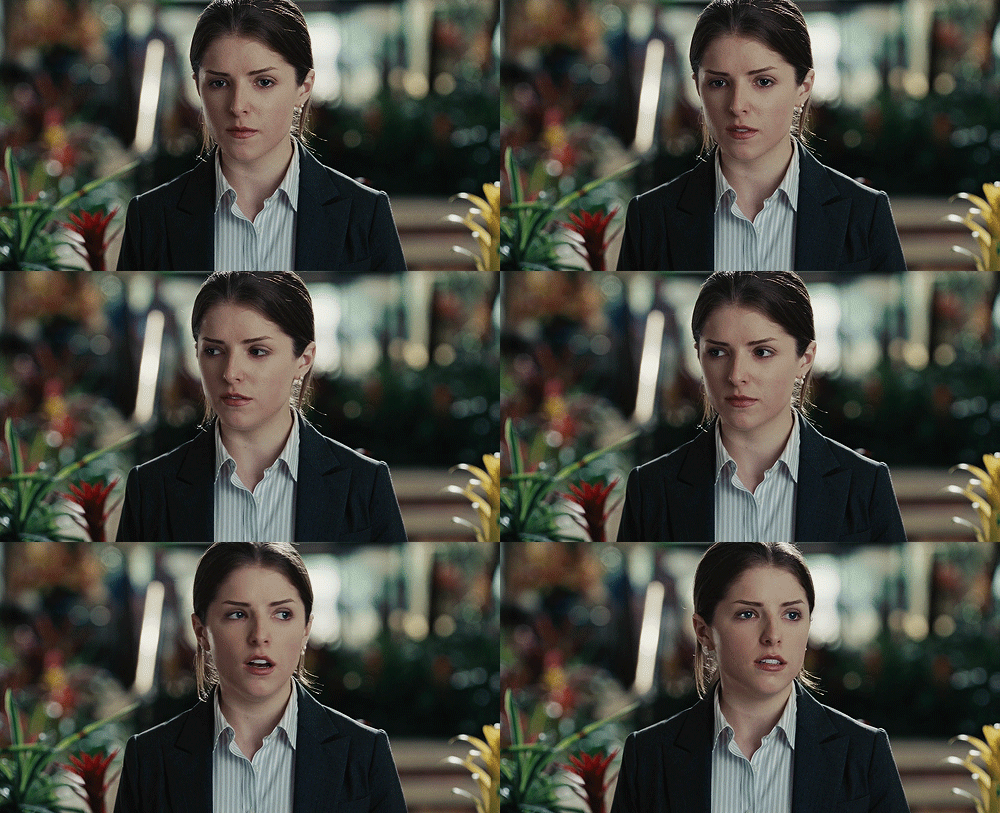
10. Anna Kendrick, Pitch Perfect 2

10. Anna Kendrick, Pitch Perfect 2
Friday, March 10, 2017
10 Fittest Women in Film, 2016
I prefer Margot Robbie not covered in white facepaint and acting like a deranged loon, and Rooney Mara’s character in Lion was pure bleh, so neither of my go-to girlcrushes make it on this year’s list, bizarrely.
Obviously my list might differ slightly from your average bloke's, but I’m rating these ladies’ attractiveness with a female gaze [or so I like to think].
10. Felicity Jones, Rogue One

Thursday, December 15, 2016


Wednesday, December 07, 2016
Film review: CERTAIN WOMEN (Kelly Reichardt, 2016)
Certain Women is a triptych of stories about three women living in Montana, whose lives are peripherally connected. In the first instalment, lawyer Laura (Laura Dern) struggles to get through to a stubborn client, who later takes another character hostage in order to get what he wants. In the middle segment, Gina (Michelle Williams) and her husband try to build a house together, the procurement of sandstone for which betrays some fundamental fissures in their marriage. And in the final story arc, a nameless ranch hand (Lily Gladstone) attends an evening class taught by Beth (Kristen Stewart), and develops a crush on her teacher.


Relative unknown Lily Gladstone, who has been picking up various critics’ awards for her beautiful performance as the rancher, is easily the film’s MVP, and consequently, her section of the film was my favourite. In another universe, where independent films could afford to distribute screeners for the Oscars (and Oscars were actually awarded on merit), she’d be a shoo-in for a nomination for Best Supporting Actress. The majority of her character’s feelings are illustrated through her face rather than words and her big brown eyes convey a lifetime of longing for human company. It's a mesmerizingly moving performance, all the more poignant for its artlessness.


Interestingly, in Maile Meloy's short story collection from which this segment was adapted, the character Gladstone played was a man. But it’s a curiously gender-fluid role, and a sign of cinema graduating with the times, that Reichardt successfully adapted the character to be female in her film. In fact, the besotted way in which Gladstone gazes at Stewart was hauntingly reminiscent of the loving look Jesse Eisenberg gives the same actress in Café Society, as well as the way Emory Cohen looks at Saoirse Ronan in Brooklyn. Both actors gave fine portrayals of men in love, but in witnessing the unguarded yearning in Gladstone's eyes, and knowing that the object doesn't feel the same way, filled me with more pathos than watching the guys did.
Michelle Williams cements her reputation as one of the best actresses of her generation as a hardworking and under-appreciated wife and mother. As with her most powerful scenes in Brokeback Mountain, Williams makes excellent use of body language to convey a mountain of resentment at her slack husband. Michelle Williams, Laura Dern and Kristen Stewart all impressively shed their natural grace and beauty to inhabit far more ordinary characters, without the de-glamorisation process feeling too ‘awards-begging’.


The fact that the actresses so convincingly slip into their run-down roles make the human interactions which they are implicated in the more urgent, even if the register of the film never reaches a dramatic crescendo. In Certain Women, there are 'good' or 'evil' characters, epitomised in the first part, where the disgruntled client who entangles Laura in a hostage situation, it transpires, really was screwed over by his previous company, and feels he has nowhere left to turn. Such scenes are reflective of the real world, where there are no easy answers, and people can only try to make the best of bad situations.
Essentially, Kelly Reichardt's understated, intelligent film makes like that Beyoncé lyric; "Who run the world? Girls." Except in her celebration of the minutiae, she illustrates that while certain women don’t make a song and dance about their actions or their consequences, it doesn’t render them any less profound.
8/10
--
If you enjoyed this review, feel free to check out my other reviews here. Certain Women hits UK cinemas on the 3rd March 2017.
--
If you enjoyed this review, feel free to check out my other reviews here. Certain Women hits UK cinemas on the 3rd March 2017.
Wednesday, November 02, 2016
Film review: LE CHARME DISCRET DE LA BOURGEOISIE (Luis Buñuel, 1972)
6 members of the French upper-middle class find that their best-laid plans to dine together are repeatedly and frustratingly scuppered, whether it be due to misunderstanding over the date, French army officers inviting themselves to their meal or suddenly getting arrested. Some of the most bizarre scenarios are revealed to be dream sequences in Luis Buñuel's Oscar winner of Best foreign film.


From the outset, the characters at the centre of Le Charme discret de la bourgeoisie are an attractive, urbane bunch, who converse on the finer things in life are of good scruples. But the audience's perceptions are quickly shattered. One casually deals drugs whilst bedding his mate's missus. A couple, the Sénéchals, shimmy out of the window to have sex in the garden whilst ignoring their guests.
Buñuel obviously had a rollicking good time exposing the false dichotomy between the bourgeois and the proletariat that they so smugly like to compare themselves to, and for the most part, his film is enthralling to follow. A little more clarity of focus might have rendered this a more complete watch; some of the dream sequences are nested within dreams of other characters, but finding this out merely adds to the confusion rather than answering any narrative questions.
It's highly probable that the many and varied sequences in Le Charme discret de la bourgeoisie wasn't supposed to make sense to the audience, and that the true interpretation of the movie is to be teased out on repeat viewings. If the watcher is to be merely amused and entertained, then, Buñuel has certainly accomplished his goal. He sends the middle class up with far more flair and nuance than he poked fun of Christianity in La Voie lactée, not least because the vignettes in that film depicted characters that felt strawman-ish, whereas in Charme discret the funny parts are generally underscored by truth.
Surreal touches pepper the film. Fernando Rey (Tristana, That Obscure Object of Desire) is a diplomat for a fictional south American country, the Republic of Miranda, but, like the equally fabricated TV towns of Pawnee in Parks and Rec and Agrestic in Weeds, the country is evoked with such detail when characters discuss it, that the audience could easily believe it were a real place. A maid, played by an actress who couldn't be a day over 30, nonchalantly declares she's in her 50s, and no-one bats an eyelid. And, when hearing his wife is in his best friend's bedroom, the culprit coolly tells him to go wait in his car, and his missus will be out later.
In between displays of the director's signature playful dramatic irony, Le Charme discret de la bourgeoisie juxtaposes some disturbing imagery. These arresting scenes of corpses haunting various people now look a tad outdated by 21st century cinema's tendency to depict gore on a hyper-realistic level, but it's because they're so out of the blue and jarring with the rest of the film's comedic tone that they manage to retain power.
Overall, Le Charme discret de la bourgeoisie should be approached with caution; its wacky exposition and unconcern with tying up the plot won't be to everyone's tastes. But if you stick with it, it's a truly surprising movie, that will tickle and unnerve you in equal measure, and as a thesis on the power of dreams, it's a hell of a lot more gripping than Christopher Nolan's overrated Inception.
7.5/10
-----
This review marks my seventh of the eight DVDs in the Luis Buñuel boxset. Read my reviews of the other films I've seen of his here.
Surreal touches pepper the film. Fernando Rey (Tristana, That Obscure Object of Desire) is a diplomat for a fictional south American country, the Republic of Miranda, but, like the equally fabricated TV towns of Pawnee in Parks and Rec and Agrestic in Weeds, the country is evoked with such detail when characters discuss it, that the audience could easily believe it were a real place. A maid, played by an actress who couldn't be a day over 30, nonchalantly declares she's in her 50s, and no-one bats an eyelid. And, when hearing his wife is in his best friend's bedroom, the culprit coolly tells him to go wait in his car, and his missus will be out later.
In between displays of the director's signature playful dramatic irony, Le Charme discret de la bourgeoisie juxtaposes some disturbing imagery. These arresting scenes of corpses haunting various people now look a tad outdated by 21st century cinema's tendency to depict gore on a hyper-realistic level, but it's because they're so out of the blue and jarring with the rest of the film's comedic tone that they manage to retain power.
Overall, Le Charme discret de la bourgeoisie should be approached with caution; its wacky exposition and unconcern with tying up the plot won't be to everyone's tastes. But if you stick with it, it's a truly surprising movie, that will tickle and unnerve you in equal measure, and as a thesis on the power of dreams, it's a hell of a lot more gripping than Christopher Nolan's overrated Inception.
7.5/10
-----
This review marks my seventh of the eight DVDs in the Luis Buñuel boxset. Read my reviews of the other films I've seen of his here.
Thursday, October 20, 2016
Film review: TRISTANA (Luis Buñuel, 1970)
Tristana (Catherine Deneuve), a recently orphaned God-fearing beauty, is given sanctuary by her new legal guardian Don Lope (Fernando Rey), a crusty old womaniser who hates religion, sympathises with the underbelly of society, and likes to backpat himself for being so anti-establishment. Much like the character Rey played in That Obscure Object of Desire, he develops an infatuation with the female lead, and it’s not long before he’s thrown caution to his wind regarding taking Tristana under his wing, choosing to take her under him instead.

From some of the other Buñuel titles I’ve reviewed, it’s evident that the man has got sex on the mind, but his depiction of Don Lope’s carnal instincts and Tristana’s grudging acquiescence to them in this film are surprisingly PG-rated (although, given the mature themes and disturbing imagery in this film, I thought the MPAA awarding this film a PG-13, made more sense) and visually restrained. The unsettling, Woody Allen-esque relationship is portrayed with a few fleeting shots of Tristana impassively getting undressed, before the scene ends. Surprisingly subtle for Buñuel, but it suits the atonal style of the film, and its messages about the double-standards of religious Spanish society.
Deneuve and Rey, two of Brunel’s favourite collaborators, prosper under his direction. As the eponymous lead, Deneuve alchemizes Tristana’s spirit effortlessly. At the beginning, she is a carefree, wide-eyed young girl who just wishes to honour her mother's love of pray. By the end, and not altogether surprisingly given what she has been through, as her character develops, she is a resolute and cold-hearted, and absolutely God-less.
It’s evident that she’s repulsed by her legal guardian’s grabby hands (not the first time a Guardian's been handsy, amirite?), but she grins and bears it in a disquietingly silent manner. As in Belle de Jour, Deneuve portrays her character taking everything just accepting what comes to her under a façade of equanimity, which only leaves the audience more tantalised about what she’s really thinking.
Fernando Rey portrays a monster with more than a small touch of Humbert Humbert. Tristana is an unusual story because it’s not so much a case of Stockholm Syndrome, as the woman coming back to take revenge – revenge by mistreatment – on the man who so impulsively, selfishly, debased her. And her interpretation of the best kind of justice is to simultaneously be with him (in legal union) and not be with him (in emotion and physically).
The central dynamic between Tristana and Don Lope is fascinating. Despite the fact that he defiled her and she rightly resents him for taking her innocence, this is juxtaposed hatred is with her inherent Christian grace towards him, which consists of gratitude for taking her in when she was destitute, as well as a giddy sense of triumph later when he gets older and more pathetic, and she, more beautiful. These emotions come together to create a cocktail of power that she lauds over him.

Buñuel is known for his surrealist elements, but that was the component I liked least about Tristana - Don Lope’s decapitated head swinging from a bell was off-beat but now looks dated. Tristana also lacks the moments of playful levity that The Diary of a Chambermaid and That Obscure Object of Desire had, rendering it a more straightforward piece of storytelling, although in doing so, it doesn't quite reach the peaks of those two titles. Finally, the fact that the film was shot and set in Toledo, Spain, yet the characters speak French, is a tad jarring.
It’s not the best spin on Lolita in a film I’ve seen - that would be Sam Mendes’ incredible American Beauty, but, like That Obscure Object of Desire, survives the test of time well in its astute dissection of gender politics and the blurred, and often confusing, line between love and hate.
Buñuel for all his seedy voyeursim, understands that sex is just as much about emotional control as it is about physical lust, and his detached, capable direction, Deneuve’s suitably frosty performance (quite literally, given the film's aloof coda) and the compelling story make for a bizarre, but thoroughly watchable experience.
Sunday, October 09, 2016
Film review: THE EYES OF MY MOTHER (Nicolas Pesce, 2016)
My second film viewed at the BFI London Film Festival, a surprising choice for me, a horror movie!
--
Francisca lives an unusual but tranquil life with her reticent father and hands-on surgeon mother, who teaches her all about dissection, secluded from the test of the village. One day, her sheltered upbringing is rocked when a man purporting to be a salesman murders her mother, thus triggering and endless sense of longing, as well as morbid curiosity about the human, within her. This fascination with human bodies and a desperate need not to be alone manifests itself in devastating ways.

Horror is not one of my preferred genres (FYI, those would be 1) romance, 2) drama, 3) comedy), and the influx of mindless torture porn titles a la Hostel in recent years has made me even more averse to it. But The Eyes of My Mother is one of those rare things: a horror movie with brains and a beating heart.
--
Francisca lives an unusual but tranquil life with her reticent father and hands-on surgeon mother, who teaches her all about dissection, secluded from the test of the village. One day, her sheltered upbringing is rocked when a man purporting to be a salesman murders her mother, thus triggering and endless sense of longing, as well as morbid curiosity about the human, within her. This fascination with human bodies and a desperate need not to be alone manifests itself in devastating ways.

Horror is not one of my preferred genres (FYI, those would be 1) romance, 2) drama, 3) comedy), and the influx of mindless torture porn titles a la Hostel in recent years has made me even more averse to it. But The Eyes of My Mother is one of those rare things: a horror movie with brains and a beating heart.
In Francisca, you have a beguiling protagonist, whose motivations for her destructive actions are not jammed down your throat with a ham-fisted tale of past tragedy, but instead, hinted at in Kika Magalhães's haunting performance. Throughout the film, and whilst carrying out villainous acts, her character maintains a placid, almost cold facade. Yet the more intimate scenes where she speaks to her dead mother, betray her true vulnerability. The film's ability to make us empathize with such a monstrous character really cannot be applauded enough.
It helps that Magalhães, who was consulted by Pesce throughout his screenwriting process, also got to inject parts of herself into the character she portrays. In a scene where she dances freely to a piece of music, this was one of the actress' mother's favourite pieces. Having this personal touches injects flavour into Magalhães' mesmeric performance, a welcome subversion of how females in horror movies are usually presented.
The black and white cinematography, selected because director Nicolas Pesce wanted to homage the movies of the 1950s that he adored (in a Q&A following the film, he revealed a penchant for Bette Davis and Joan Crawford, good man) suits the stark, bare set, and effectively conveys Francisca's heartbreakingly bleak view on the world. The jarring score adds to the sense of dread and discomfort that builds steadily throughout the film's 76 minute running time.
Nicolas Pesce, like Quentin Tarantino, is a director who loves films. His influences are peppered throughout the film, from the keeping a person barely alive held captive (evoking Takashi Miike's disturbing Audition), to the Alamodovarian underlying theme of the importance our parents play on our formation. Also like Quentin Tarantino, who's dextrous employment of the 'conceal and reveal' in Reservoir Dogs, Pesce fully understands that the best way to unsettle the audience is to not show them the darkest moments, but to leave it to their imagination.


Although Francisca's actions throughout the film are horrifying, the depiction of these are afforded surprising economy of expression; a murder will be indicated with a puddle of blood shown on the floor. The jumping from the serial-killing to the mundane also creates some off-kilter tonal jumps that evoke nervous laughter in the audience. However, there are some arresting images in the film, which impacts on a strongly visceral level.
Overall, The Eyes of My Mother is one of the most intelligent, haunting horror movies created. Pesce (who, depressingly, is only 3 months older than me) deserves a huge amount of credit for subverting the hoary horror movie tropes and put his own organic spins on them. In doing so, he has created Francisca, an enigmatic murderess for the ages.
8/10
8/10
Tuesday, September 20, 2016
The Girl on the Bus

I’m a huge Emmy Blunt fan. She’s gorgeous, talented, and that West London accent does funny things to me. I even stood outside in the rain last year during the Sicario premiere just to get a glimpse of her, which resulted in me having a cold for a week just as I was beginning my thesis, so that was a bit foolish. (To add to the nonsensicalness of that exercise, I still haven’t gotten round to seeing Sicario . It’s just not my genre).
Anyway, I was really excited by The Girl on the Train trailer when I first saw it. The content looked extremely intriguing and dark, invariably evoking memories of Gone Girl. After all, both are big-screen adaptations of best-selling thrillers with a beautiful British actress playing the lead, unreliable narrators and the word ‘Girl’ in the title.
Furthermore, the employment of a remix of Kanye West’s Heartless was dope; it rivalled War Dogs’ using a cover of No Church in the Wild in terms of ‘using a Kanye song to entice the audience’ stakes (although the best use of Kanye West in a film trailer is still, IMO, Power in The Social Network trailer. The conflation of the lyrics [‘No one man should have all that power’] and the plot of that film, especially Jesse Eisenberg’s superb performance as a hubristic megalomaniac, is just so astute).
However, my interest in The Girl on the Train dwindled slightly when I saw it only got rated 15. I was hoping it was going to be the second 2016 film that I’d seen that was 18-rated, the other being the rather unremarkable The Neon Demon. I saw 5 2015 releases that were an 18 (Diary of a Teenage Girl, Fifty Shades of Grey, The Hateful Eight, Legend, Knock Knock), so I’d really be hoping to match that amount of 18s watched this year. But nah, The Girl on the Train is only a 15.
Not only that, it got a 15A in Ireland, who unlike the BBFC, have the 16 rating that they slap on movies that sit in that awkward 15/18 hinterland. But the fact that the Irish film board didn’t even need to get a 16 out tells me it’s not even gonna be a hard 15!

Boring.
So there goes my hopes of this film being 2016’s Gone Girl.
How could they be so heartless?
Monday, June 29, 2015
Film review: KNOCK KNOCK (Eli Roth, 2015)
Even though I turned 25 over two months ago, and thus am now no stranger to watching 18-rated movies in the cinema, for me, it’s something which the novelty of doing doesn’t seem to wear off. Perhaps it evokes nostalgia-filled memories of the first 18-rated film I sneaked into – Martin Scorsese’s The Departed, when I was 16 (under the guise of wanting to watch The Devil Wears Prada, no less), perhaps it’s the feeling of #sophistication it imbues me with, and perhaps it’s the enjoyment of sharing a cinema-going experience with fellow fans without having to deal with bratty teenagers taking Snapchats of the screen throughout the film, but for this seasoned movie geek, watching an 18-rated film at the cinema is something that still makes me feel giddy.
Eli Roth’s Knock Knock is rated 18 for ‘strong sustained and sadistic threat, sex, sex references, nudity’, which is as pithy a summary of the plot as you’re likely to find. Keanu Reeves is Evan Webber, a happily married family man with the quintessential Hollywood family (blonde wife, a son, a daughter and a cute dog), quintessential Hollywood job (high-flying architect who’s CAD-skills are in high demand, meaning he can’t go to the beach with said family one weekend) and quintessential Hollywood house (an urbane bungalow just a few miles from central LA).

When he’s staying at home said weekend, hard at work, he gets a knock on the door. Standing in the pouring rain are two attractive young women, one flaxen, one brunette. They claim to be lost finding a house party they’re meant to attend, and could they dry themselves off whilst he gets an Uber. However, their salacious discussions, casual bending over and stroking of Evan hint at something much more calculated under the randy air stewardess veneer. Evan succumbs to their obvious allure and sleeps with them. And that’s when his problems take a deadly turn.
I’m yet to watch Eli Roth’s Hostel series, and, being one with an aversion for needless torture porn, I doubt I ever will. But I must admit, I was intrigued when I heard the premise of Knock Knock. The idea that the most dangerous thing to us is something that we let into our own house, and that we are the architects of our own downfall, are all themes that pique my interest. Knock Knock is, as expected, not a particularly pleasant viewing experience.
Every scene reeks with amorality and the two girls, Genesis and Bel (played by relative unknowns Lorenza Izzo and Ana de Armas) are on a level of batshit crazy that would make Gone Girl’s Amy seem like the picture of sanity. Watching them torture an affable but hapless guy for one mistake which they essentially entrapped him into, is troubling, to say the least.
Every scene reeks with amorality and the two girls, Genesis and Bel (played by relative unknowns Lorenza Izzo and Ana de Armas) are on a level of batshit crazy that would make Gone Girl’s Amy seem like the picture of sanity. Watching them torture an affable but hapless guy for one mistake which they essentially entrapped him into, is troubling, to say the least.
But what elevates it from standard exploitation-fare is the sharp script, which balances bathos with the darkest of humour. On more than one occasion in the film, I chuckled (whether that be from being tickled by the writing or nerves, who knows). Despite what some reviews have said about Reeves being miscast, I actually completely bought him in this role, and Izzo and Armas were psychotic in their performances, yet magnetically so.
There were moments towards the end of the film as plot twist upon plot twist just got increasingly more ludicrous, but for a 100 minutes of edge-of-your-seat erotic thriller-meets-sarcastic morality tale, Knock Knock just about suffices. I certainly won't be opening the door of my house in a hurry.
There were moments towards the end of the film as plot twist upon plot twist just got increasingly more ludicrous, but for a 100 minutes of edge-of-your-seat erotic thriller-meets-sarcastic morality tale, Knock Knock just about suffices. I certainly won't be opening the door of my house in a hurry.
6.5/10
Sunday, June 01, 2014
My May Playlist
How is it June already? Somehow, 5 months of the year have already passed by. For me, it's been lost in a flurry of deadlines, work, and countless boozing.
Now, I like to mark my #seasonsoflove with songs to associate certain memories with. So, here are some songs I've been listening to religiously in the past month (mostly whilst dithering about with coursework).
Problem (Ariana Grande ft Iggy Azalea)
Most RnB songs have a girl singing the lyrics and a male doing the rapping. In "Problem", we have girls on both. I love the playful spirit and sax loop of this song, and Iggy's Jay-Z reference in her verse makes my life.
Too Much (Spice Girls)
Not my favourite all-time Spice Girls song (that changes between "Say You'll Be There" and "Stop" depending on my mood), but, lyrics-wise, this resonated with me perfectly in the month of May. Much in the same vein as "Problem", it's got the whole I wish I knew how to quit you thing going on. Which I definitely feel for certain fellas.
Can't Remember to Forget You (Shakira ft Rihanna)
I'm not sure as to the veracity of this rumour, but I heard jealous hubby Gerard Pique put a ban on his missus having males in her music videos? As such, we have more girl/girl duets from her, rendering this the third song on my list about wanting to give up a bloke, no mata how difficult (sensing a theme here?) On her album, Shakira also covers this song in Spanish, which I like to listen to to practice my linguistic skills. #multitaskingBITCH
Timber (Pitbull ft Ke$ha)
Hurrah, a song not about men!! I'm not actually too sure what this song is about, mind, but it has an annoyingly infectious beat that makes up for its nonsensical lyrics ("face down, booty up", poetry, that). I also happened to duet on this on my birthday karaoke, singing the Ke$ha bit. I did not do the high notes any justice, really.
Fancy (Iggy Azalea ft Charli XCX)
TUNE. If there's one song I'm going to remember Summer 2014 by, it's going to be this insanely swaggerous, effortlessly cool from Iggy and our very own Charli XCX. The song is an ode to the high life, so whilst it's how the other 5% do live, and thus not something I'd be particularly knowledgeable about, you have a hell of a good time singing along about it. Hertfordshire-born Charli XCX is my new girl crush, she just has Je ne sais quoin, and the Clueless-inspired music video is great fun. The chorus is catchy as hell, and the machine-gun-rapping by Iggy Azalea is too ace. Champagne spilling, you should taste that.
Right, that's five. For June, in the theme of numbers, I shall list the six songs I was obsessed with this month. Plot spoiler: Fancy will probably still be on there.
Now, I like to mark my #seasonsoflove with songs to associate certain memories with. So, here are some songs I've been listening to religiously in the past month (mostly whilst dithering about with coursework).
Problem (Ariana Grande ft Iggy Azalea)
Most RnB songs have a girl singing the lyrics and a male doing the rapping. In "Problem", we have girls on both. I love the playful spirit and sax loop of this song, and Iggy's Jay-Z reference in her verse makes my life.
Too Much (Spice Girls)
Not my favourite all-time Spice Girls song (that changes between "Say You'll Be There" and "Stop" depending on my mood), but, lyrics-wise, this resonated with me perfectly in the month of May. Much in the same vein as "Problem", it's got the whole I wish I knew how to quit you thing going on. Which I definitely feel for certain fellas.
Can't Remember to Forget You (Shakira ft Rihanna)
I'm not sure as to the veracity of this rumour, but I heard jealous hubby Gerard Pique put a ban on his missus having males in her music videos? As such, we have more girl/girl duets from her, rendering this the third song on my list about wanting to give up a bloke, no mata how difficult (sensing a theme here?) On her album, Shakira also covers this song in Spanish, which I like to listen to to practice my linguistic skills. #multitaskingBITCH
Timber (Pitbull ft Ke$ha)
Hurrah, a song not about men!! I'm not actually too sure what this song is about, mind, but it has an annoyingly infectious beat that makes up for its nonsensical lyrics ("face down, booty up", poetry, that). I also happened to duet on this on my birthday karaoke, singing the Ke$ha bit. I did not do the high notes any justice, really.
Fancy (Iggy Azalea ft Charli XCX)
TUNE. If there's one song I'm going to remember Summer 2014 by, it's going to be this insanely swaggerous, effortlessly cool from Iggy and our very own Charli XCX. The song is an ode to the high life, so whilst it's how the other 5% do live, and thus not something I'd be particularly knowledgeable about, you have a hell of a good time singing along about it. Hertfordshire-born Charli XCX is my new girl crush, she just has Je ne sais quoin, and the Clueless-inspired music video is great fun. The chorus is catchy as hell, and the machine-gun-rapping by Iggy Azalea is too ace. Champagne spilling, you should taste that.
Right, that's five. For June, in the theme of numbers, I shall list the six songs I was obsessed with this month. Plot spoiler: Fancy will probably still be on there.
Sunday, July 03, 2011
Film review: BRIDESMAIDS (Paul Feig, 2011)

If you were to ask thirty-something Annie (Kristen Wiig) whether she was happy with how things are going in her life, she probably wouldn’t be totally honest if she answered “yes”. Working in a job she clearly despises as a retail assistant in a jewellery store – a job, we are told, she only got as a favour from the manager to her mum, less-than-satisfied with her relationship – or lack thereof with the hunky but arrogant Ted (Mad Men’s John Hamm) and living with a weird and annoying brother-sister duo, it’s fair to say she’s not exactly firing from all cylinders in her life.
The only aspect she has always been able to count on is her best friend Lillian. The two meet up in the mornings to cheekily scab off free training from a local fitness instructor by hiding behind a tree and exercising to his words. They listen to each others’ relationship woes and offer opinion and advice, but never judgement. And, unlike with so many faux friendships that are rife with ulterior motive, when the two tell each other that they love each other, you know they mean it.
So when Annie learns of Lillian’s upcoming engagement to long-term boyfriend Kevin, her initial feelings of delight for her friend very rapidly turn to fear, isolation and upset when the prospect of losing her childhood friend to a world of upmarket dos, nappies and, even more terrifyingly the annoyingly perfect Helen, Lillain’s fiancée’s boss' wife, who seems intent to usurp Annie’s title as Lillian’s best friend.
In one hilarious scene at the engagement party, Annie gives a brief but heartfelt speech congratulating Lillian. Helen then takes the mic and oh-so-subtly slips in a few words and inside jokes in her speech. Annie, refusing to be outdone, takes the mic back and shares a few friendship histories of her own. Thus triggering off a vicious cycle, culminating in both women singing a terrible song together – but the audience with tears in their eyes.
And that’s the genius of Bridesmaids, in my opinion – it manages to hit so close to the truth. Who hasn’t felt the jealous pang of seeing a friend that you value so dearly slowly, but inextricably falling away from you and closer into the net of the one you perceive as your nemesis? Kristen Wiig, who is no stranger to comedy, being a regular on Saturday Night Live, gives one of the performances of the year. It doesn’t hurt that she co-wrote the script, so is completely comfortable with the material, but her deliveries and deadpan facial expressions make for one of the best comedic performances I’ve seen for a while.
Underneath all the high jinx, however, are the tears of a clown; Annie isn’t happy, and, whether she likes it or not, there are plenty of problems of her’s that can’t purely be pinned down to the fact that her best mate is getting married. Her taste in men speaks for itself; it is clear from the off that good cop Officer Rhodes (our very own Chris O’Dowd off The IT Crowd) has eyes for her, yet she chooses to go back into the welcoming-for-all-of-ten-minutes arms of the chauvinistic Ted. It’s frustrating to watch her make such mistakes, but any and every woman watching Bridesmaids over the age of 15 (as right they should be, it’s a 15 certificate over here after all) knows exactly what it’s like to shun the attentions of a nice guy in favour of one who treats her like shit.

The supporting cast all more than pull their weight in Bridesmaids. Melissa McCarthy is the token chubby-but-good-humoured sister of the groom, who provides much of the visual humour of the film, and Wendi McLendon-Covey, as Lillian’s cousin Becca, gets some of the best lines – involving being married to a horny husband, the nonchalant delivery of “I just want to watch the Daily Show once without being entered.”
The friendship love triangle, of Annie-Lillian-Helen is written perfectly, full of social airs and graces between the former and latter. Rose Byrne as Helen, who I have plenty of fond memories of watching in Damages, is supposed to be the ~bad guy~ here, and some of her actions are deplorable (not least the little prank she pulls on Annie on the airplane), but we don’t end the film completely despising her, as, she is, after all, just another lonely woman.
Chris O’Dowd is completely adorable as Officer Nathan Rhodes, and when he and Annie finally do spend the night together, he not only welcomes her to spend the night (a stark contrast to the friends-with-benefits Ted’s caddish behaviour when he says “I want you to leave but I don’t know how to say it without sounding like a dick”), but he even goes out and buys her some cooking ingredients (Annie used to own a bakery before the recession hit in and ate all her profits – forcing our into redundancy). Annie is so taken aback by this show of kindness that she leaves straight away. It’s a very well directed, surprisingly poignant scene, once again highlighting sometimes often in life, it’s almost as if people go out of their way to stay unhappy.
The balancing act between comedy and drama is a difficult one, and although Bridesmaids is very firmly one of the former (certain scenes – the bridal dress fitting, Annie’s altercation with an uppity young customer, and her drunken daze on the airplane are just some of the many that had me in stitches, and the sex jokes are a bawdy treat), it’s the sensitive, intelligent way that the latter is inflected into the comedy that makes Bridesmaids such a winner. After all, if I wanted to laugh my face off, there’s plenty of dumb YouTube videos I could watch, or, say Borat or something.
But Bridesmaids wasn’t just funny, it was emotionally rewarding. We come to care for Annie and her plight; this film isn’t just about her failings as a bridesmaid-in-chief; they are purely a microcosm of her problems in life as a whole. Yet as the film progresses and she lives and learns a little more, she realises that it is never too late to stop feeling sorry for oneself and turn things around.
Beautifully written, not least the romantic subplot between Annie and Officer Rhodes, you will leave this film with a feeling inside sweeter than any slice of wedding cake.
Wednesday, May 11, 2011
The Apprentice, episode 2.
Second episode in, 15 contestants left. The participants are awoken at the figurative crack of dawn via a recorded message on a laptop. Alan Sugar tells the group of their new challenge – to market and sell a new mobile phone app. I liked this challenge a lot, in this day and age, a huge majority of people are fiddling with apps on their phone when on the tube, and there seems to be an app for almost everything, however weird or wacky, so it would be an interesting thing for the teams to do. Once again, they’re grouped boys vs girls, the ladies have a man advantage.
 When picking Project Managers, Leon puts himself forward, although he has an agenda; in the last episode, Alan Sugar had commented that he wasn’t involved enough, so he wants to prove Sir Alan wrong. Several other men volunteer to be PM as well, but eventually it goes to a vote and Leon gets the role. The boys are moving along at a good pace and before long have decided on their app – Slang-a-tang, an app that gives soundbites of people from all over the UK, as well as over the world.
Things are going considerably less smoothly over at the girls’ team, where Susan gets herself into a bit of a mess when trying to pitch her idea. She says something along the lines of “Imagine I’m here, and you’re there. And I’m me and you’re you-” Needless to say, the team are massively underwhelmed with her idea and Project Manager Edna tells her to pipe down, which Susan refuses to do. When she’s finally silenced, Susan sulks in a fashion dissimilar to a spoilt child. It’s impossible to warm to the woman.
Time’s running out for Edna’s team, and finally they settle for the rather mediocre sounding app which gives out a range of sounds, whether it be annoying, congratulatory, or animal sounds. They call it Ampi-App, which is apparently a play on words, but I’m struggling to think what pun it is. Whilst the women drive off to get their ideas developed, Susan tried a bit of shit-stirring by bad-mouthing Edna, but Melody, who is sat next to her and practically draped in cheap make-up, isn’t having any of it and practically ignores her.

In the boy’s group, four of them, Glen, Jim, Vincent and Alex cast themselves for the app, taking on a range of personas from cockney sparra, Scouser, Welshman, etc. The Wales soundbite is “has anyone seen my sheep?”, and the Liverpudlian one is “How’s your wife and my children?” which I found hilarious, but can see why people would find it offensive. Nick observes the boys indulging in laddish banter, not overly impressed, remarking he finds their product a little on the asinine side, “Unless I’m too old”
Back to the girls, their app is going into development and it really isn’t setting the world alight. Admittedly, the boys’ app isn’t the most inventive thing in the world either, but the girls’ one is dumb for a 13-year-old, let alone busy adults in a rush. “I think we could be heading for a bit of a disaster,” Susan remarks, and she is struggling to keep the glee out of her voice; one senses that she would take her team failing just to see Edna fail and get fired.
 Overnight, the teams sleep whilst the computer boffins do their magic to put the ideas and components into the finished product. In the morning, the two teams work on their pitches. The boys team’s pitch is pithy and witty, albeit with a play on the word “app” too many. Leon, Vince, and Jim, suited and booted, get to the pitches, although there’s a bit of tension because Gavin clearly wanted to help pitch too. In terms of the pitches, they start fairly well, Vince initially taking centre stage, but at one point he fudges it up and Jim, cool as a cucumber, swoops in and rescues the pitch.
Jim is calm and collected in his pitch, and, furthermore, completely unafraid to address the difficult questions, which is that of taste; amusing as the boys team’s product is, it can’t be denied that it isn’t in the best of taste. There’s an awkward turtle moment when one of the men at the Online Magazine considering taking the app queries about the racial stereotypes, Jim denies as such. But what of the Australian man in the funny hat? “That’s just to show he’s Australian!” Jim protests. Er.
Over at the girls, Melody’s pitch is absolutely awful. She tries to butter up the company by giving them some stats about themselves; saying they have a following of 70-something-thousand. It’s actually several million, which the man isn’t at a lack to tell her. Fail. “The pitch is as good as the product,” Melody comments after she’s embarrassed herself, which just smacks of someone who’s getting their excuses in early.
The two teams then go online to see if their product has made it on the websites of the companies they have pitched to, of which there are three in total. The boys make it onto two of them, the girls, the remaining one, however, the website that they made it onto has a substantially bigger following than the other two.
The two teams then head to a technology expo , in which there are 500 bloggers, twitterers and technology experts, eagerly awaiting to hear about the two apps that the teams have on offer. Edna delivers the talk as if she’s selling some groundbreaking product, but from the reaction of the audience as well as the boys, who can scarcely believe their good luck, it isn’t that great. More pertinently, Edna fails to explain to the audience how and where to download the app from, which is, needless to say, quite a big deal.
The boys don’t make such a mistake, and their talk, in which two of the men have dressed up and take to their roles jovially, engages the audience a lot more. One dresses up as a Scouser, the other, a Cockney, and judging from the reaction of the audience, they’re loving it. The boys crank up the charm offensive by offering the audience doughnuts in return for downloading their app, which they show the crowd how to do.
So, all signs would seem to point to a resounding boys team success. However, it’s the figures that do the talking, and, in the boardroom, Karen and Nick are the ones with the figures. And, bombshell of bombshells, because the women come out triumphant winners, with 10,667 downloads, in the face of just 3,951 downloads for the boys. So that horrid, horrid women’s group, headed by the massively unlikable Edna and the two even more infuriating Melody and Susan, are treated to a delicious meal cooked especially for them. “Is that… victory I taste?” Melody asks, smugly. Urgh.
Back in the boardroom, the boys are as shocked as we the audience are to their failing. They had far more team rapport than the women from the start, I personally preferred their product (though an app that rates how smelly your faeces is would be more useful than the piece of crap the women came up with), and their pitches were more intelligent. But, humanity is an odd, odd thing, and the masses went with the women’s monstrosity. In the boardroom, the boys are in a hurry to lay blame with each other. Jim explains that he thinks the failing occurred when they didn’t get the deal with the bigger magazine, but Alan Sugar questions that even if they had gotten it, would their product have been downloaded anyway, as, whilst popular in the UK, it lacked global appeal. The boy’s Achilles heel in this challenge, I think, was their naivety.
Anyway, Leon, as project manager, has two pick two more people to bring into the boardroom with him. He contemplates picking Jim, which I think is an awful idea, and Jim also knows it, and isn’t afraid to defend himself, and that he does, vociferously. So Leon changes his mind, and goes with Alex and Glen. It was Glen’s idea for the project, and he picks Alex because he felt that Alex shirked his responsibilities. In the boardroom, Alex gets bold and bigger than life in fighting his own corner, but the wool isn’t pulled over Sir Alan’s eyes. He figures Alex, rightfully, I feel, meaning that Leon and Glen get to go back to the house, to live another day. App-solutely fabulous!

Things are going considerably less smoothly over at the girls’ team, where Susan gets herself into a bit of a mess when trying to pitch her idea. She says something along the lines of “Imagine I’m here, and you’re there. And I’m me and you’re you-” Needless to say, the team are massively underwhelmed with her idea and Project Manager Edna tells her to pipe down, which Susan refuses to do. When she’s finally silenced, Susan sulks in a fashion dissimilar to a spoilt child. It’s impossible to warm to the woman.
Time’s running out for Edna’s team, and finally they settle for the rather mediocre sounding app which gives out a range of sounds, whether it be annoying, congratulatory, or animal sounds. They call it Ampi-App, which is apparently a play on words, but I’m struggling to think what pun it is. Whilst the women drive off to get their ideas developed, Susan tried a bit of shit-stirring by bad-mouthing Edna, but Melody, who is sat next to her and practically draped in cheap make-up, isn’t having any of it and practically ignores her.

Could she look any more like a five dollar hooker?
In the boy’s group, four of them, Glen, Jim, Vincent and Alex cast themselves for the app, taking on a range of personas from cockney sparra, Scouser, Welshman, etc. The Wales soundbite is “has anyone seen my sheep?”, and the Liverpudlian one is “How’s your wife and my children?” which I found hilarious, but can see why people would find it offensive. Nick observes the boys indulging in laddish banter, not overly impressed, remarking he finds their product a little on the asinine side, “Unless I’m too old”
Back to the girls, their app is going into development and it really isn’t setting the world alight. Admittedly, the boys’ app isn’t the most inventive thing in the world either, but the girls’ one is dumb for a 13-year-old, let alone busy adults in a rush. “I think we could be heading for a bit of a disaster,” Susan remarks, and she is struggling to keep the glee out of her voice; one senses that she would take her team failing just to see Edna fail and get fired.

Jim is calm and collected in his pitch, and, furthermore, completely unafraid to address the difficult questions, which is that of taste; amusing as the boys team’s product is, it can’t be denied that it isn’t in the best of taste. There’s an awkward turtle moment when one of the men at the Online Magazine considering taking the app queries about the racial stereotypes, Jim denies as such. But what of the Australian man in the funny hat? “That’s just to show he’s Australian!” Jim protests. Er.
Over at the girls, Melody’s pitch is absolutely awful. She tries to butter up the company by giving them some stats about themselves; saying they have a following of 70-something-thousand. It’s actually several million, which the man isn’t at a lack to tell her. Fail. “The pitch is as good as the product,” Melody comments after she’s embarrassed herself, which just smacks of someone who’s getting their excuses in early.
The two teams then go online to see if their product has made it on the websites of the companies they have pitched to, of which there are three in total. The boys make it onto two of them, the girls, the remaining one, however, the website that they made it onto has a substantially bigger following than the other two.
The two teams then head to a technology expo , in which there are 500 bloggers, twitterers and technology experts, eagerly awaiting to hear about the two apps that the teams have on offer. Edna delivers the talk as if she’s selling some groundbreaking product, but from the reaction of the audience as well as the boys, who can scarcely believe their good luck, it isn’t that great. More pertinently, Edna fails to explain to the audience how and where to download the app from, which is, needless to say, quite a big deal.
The boys don’t make such a mistake, and their talk, in which two of the men have dressed up and take to their roles jovially, engages the audience a lot more. One dresses up as a Scouser, the other, a Cockney, and judging from the reaction of the audience, they’re loving it. The boys crank up the charm offensive by offering the audience doughnuts in return for downloading their app, which they show the crowd how to do.
So, all signs would seem to point to a resounding boys team success. However, it’s the figures that do the talking, and, in the boardroom, Karen and Nick are the ones with the figures. And, bombshell of bombshells, because the women come out triumphant winners, with 10,667 downloads, in the face of just 3,951 downloads for the boys. So that horrid, horrid women’s group, headed by the massively unlikable Edna and the two even more infuriating Melody and Susan, are treated to a delicious meal cooked especially for them. “Is that… victory I taste?” Melody asks, smugly. Urgh.
Back in the boardroom, the boys are as shocked as we the audience are to their failing. They had far more team rapport than the women from the start, I personally preferred their product (though an app that rates how smelly your faeces is would be more useful than the piece of crap the women came up with), and their pitches were more intelligent. But, humanity is an odd, odd thing, and the masses went with the women’s monstrosity. In the boardroom, the boys are in a hurry to lay blame with each other. Jim explains that he thinks the failing occurred when they didn’t get the deal with the bigger magazine, but Alan Sugar questions that even if they had gotten it, would their product have been downloaded anyway, as, whilst popular in the UK, it lacked global appeal. The boy’s Achilles heel in this challenge, I think, was their naivety.
Anyway, Leon, as project manager, has two pick two more people to bring into the boardroom with him. He contemplates picking Jim, which I think is an awful idea, and Jim also knows it, and isn’t afraid to defend himself, and that he does, vociferously. So Leon changes his mind, and goes with Alex and Glen. It was Glen’s idea for the project, and he picks Alex because he felt that Alex shirked his responsibilities. In the boardroom, Alex gets bold and bigger than life in fighting his own corner, but the wool isn’t pulled over Sir Alan’s eyes. He figures Alex, rightfully, I feel, meaning that Leon and Glen get to go back to the house, to live another day. App-solutely fabulous!
Subscribe to:
Posts (Atom)