Showing posts with label Martin Freeman. Show all posts

Friday, August 19, 2016

Film review: DAVID BRENT: LIFE ON THE ROAD (Ricky Gervais, 2016)

15 years on from the BBC's mockumentary covering Britain's thirstiest boss, Brent is Back. Except, rather than back in the domain of being a Regional Manager, he's now a sales rep for Lavichem, a toiletries distributor. His heart, however, doesn't lie with tampons; he wishes to make it as a rockstar. So, impetuously and not at all financially judiciously, he cleans out his pensions fund to pay four musicians, an aspiring rapper Dom (Doc Brown, aka Ben Bailey Smith aka Zadie Smith's brother) and a sound engineer to go on tour with him as the band 'Foregone Conclusion'. A three week tour around Berkshire, to be precise.


As a big fan of the TV show, I was expecting cringe and situational comedy aplenty in David Brent: Life on the Road, and to that end, the film certainly delivers. Probably a little too much so. Brent's self-funded tour is, not surprisingly, a complete crash and burn. The four musicians can play their instruments and the sound engineer (played by Tom Basden) has experience aplenty, but no amount of aural wizardry could come close to atoning for the sheer egotism of the band's frontman.

Brent's delusions of grandeur, thinking he's singing about matters of substance (from racism, to disabled people, to the plight of the Native Americans) is toe-curdingly embarrassing. The cringe factor is compounded by his complete lack of self-awareness, and the earnest look on Brent's face as he delivers lyrics like 'they fly like an eagle, sit like a pelican' about the Native Americans. As audience numbers dwindle and Brent's sense of isolation kicks in, he actually has to pay his bandmates just to have a pint with him. It's mortifying, and where there should be laughs, we're just feeling unease.

But there's now a glossiness to David Brent: Life on the Road that betrays the films' TV roots. The film looks like a film, what with overhead tracking shots and excellent sound design (which must have been down to Gervais wanting the best possible platform to exhibit his pipes). But in having good production value, the intimate air that the TV show has been lost. And, even more of an issue, because the film uproots Brent to a new company with a new group of colleagues, you're not able to engage with them in the film's 90 or so minute running time.

For example, David Brent's only friend at Lavichem, Nigel (played by Phoneshop's Tom Bennett), admits that nobody really gets him, and hence why he and Brent gravitate towards each other. His social clumsiness make him a sitting duck for the rest of the office. It's not nice watching him get bullied, particularly as he definitely isn't an ill-meaning person, and I feel more character development on his part would have made the movie a more satisfying viewing experience.

The fact that Nigel doesn't get to come into his own and is relegated to the role of a sideshow is because this film, quite clearly, revolves around Ricky Gervais David Brent. Gervais writes, directs, stars, and, much like his cinematic counterpart, he can't stand it when the spotlight isn't on him. The fact that Gervais' most authentic acting in David Brent: Life on the Road was the scene in which  Brent jealously watches Dom, the rapper he 'befriends' (mainly as a get out of jail-free card for his un-PC jokes) rapping to the adulation of a crowd, speaks volumes.

Still, credit to the supporting players who are still able to make an impact despite their paltry screen time. Ben Bailey Smith captures the viewers emotions perfectly in terms of his reaction shots to each of Brent's misguided quips, and his rapping style is understated but incisive; the perfect foil to Brent's bloated singing style. Tom Bennett genuinely moved me as Nigel. His character has a bit of Mackenzie Crook's Gareth's zaniness, a bit of Martin Freeman's Tim's quiet compassion, as well as injecting a third element, of the overgrown schoolboy who sadly never outgrew getting picked on. And finally, Tom Basden, as Foregone Conclusion's Sound Engineer, is a dignified presence throughout the film, his low tolerance for Brent's crap gradually softening as his watches him go through degradation upon degradation. 

These three British talents are good factors that contribute to the quality of David Brent: Life on the Road. But what stops the film from achieving greatness is the sheer, unrelenting narcissism of Gervais. This was never really a film that needed to be made; The Office's co-creator, Stephen Merchant's absence on this film speaks volumes. Like Finding Dory, the superfluous sequel that should never have been made, this film is overkill.

The Office Christmas special was the perfect time to end it, because it balanced tying up story loose ends with long-suffering characters getting some well-earnt redemption. I really cared about Tim and Dawn. By the end, I'd even cared about Gareth. But I didn't care about David Brent a fraction as much as Ricky Gervais wanted me to, and tries to get you to, working overtime, in this film.

Because his affection for a character he created is not mirrored by the audience, after a while, the novelty of watching Gervais play himself wears thin.

There's a sequence in the film where David Brent pays for a photoshoot, where he goes through all the masturbatory notions of gazing into the camera in all manner of provocative poses. Brent really fancies himself a lead singer in a band.

Despite all the humiliation, the awkward silences and the tiny crowds throughout the film, it's quite clear that so does Gervais.

6/10

Tuesday, January 14, 2014

TV review: SHERLOCK series 3 (2014)


Few things have been waited for as eagerly as series 3 of Sherlock. The last time we’d seen the infuriating but brilliant sleuth, he’d hurtled to his death from the top of St. Bart’s hospital. Or had he? Through misdirection and false theories aplenty (including an amusing nod to slash fiction, which no doubt Mark Gatiss was mildly disturbed by when he first discovered, before choosing to use as a force to his advantage), the show’s creators Gatiss and Moffat finally revealed to us how the great detective did it, and it’s fair to say that the reaction of the general audience was that of being underwhelmed. 

Ignoring, for a second, just how muddling and convoluted it was, how many extra players Sherlock’s escape plan entailed, the thing that disappointed the most was the fact that the so-called independent, famously misanthropic man, had to enlist the help of his older brother to get him out of a quagmire.

That little quibble aside, the first episode of this season had a few treats, mainly in the form of Sherlock taking his sweet time revealing to Watson that he was still alive, at the worst possible moment: when Watson was about to propose. It was good to hear Molly had moved on from Sherlock, by getting herself a new boyfriend, though later, when he emerged, we realised we’d spoken too soon; the man looked like a bargain-basement Cumberbatch.

With all the characters being reunited, the plot sat on the back foot somewhat, and when Sherlock realised that the so-called “underground terrorist attack on London” was, quite literally, an UNDERGROUND terrorist attack, you weren’t terribly surprised. Especially when we’d been shown footage of a shifty-looking man wandering on a Tube, and then seemingly disappearing. As far as convoluted plots have gone, this wasn’t Gatiss’ best work.

If the first episode of the series disappointed, then the second episode truly flabbergasted with how poor it was. Every now and then, on a twenty-episodes-a-series show like Family Guy or Friends, the show’s creators will do a “whacky” episode; quirk for quirk’s sake. Due to there being 19 or so other regular episodes, we allow this one-off display of craziness. However, when there’s only three episodes a series of Sherlock, we’re led to expect high quality from ALL the episodes. 

Happily, we got this in series 2, where the three episodes - one introducing Irene Adler, one, a fantastic modern spin on the Hound of the Baskervilles, and the intense final episode with the showdown with Moriarty, both held our attention throughout. In series 3, the second episode’s main plot device was Dr Watson’s wedding, and, although there were flashes of brilliance, the majority of it was just ponderous.

Recently, I’ve been reading Arthur Conan Doyle’s original “The Adventures of Sherlock Holmes”. Bearing in mind that this was long before the era of iPhones, laptops, walkie talkies and the like, it really is enthralling to delve into the mind of such an old-school detective. Hints of Sherlock’s deductive prowess were shown in the first two episodes of series 3 of the TV show (for example, when he immediately susses that a lady’s internet boyfriend has gone missing, that it is the stepfather who was pretending to be him all along, that is based on the short story “A Case of Identity”), but, lamentably, series 3 seems more intent on carving him out better as a person than a sleuth. As such, he’s a more rounded human, but a less interesting character.

Redemption for series 3 came in the season finale, which was back at its finest, and like what we’d been used to in seasons 1 and 2, could work as a stand-alone watch. The storyline centred around a newspaper mogul, Charles Augustus Magnussen, played by the terrifically creepy Lars Mikkelsen, channelling Rupert Murdoch in his performance. We wondered if Sherlock had completed the full transformation into #human when he started dating Janine, a woman he’d met at John & Mary’s wedding in the previous episode. Graciously, it was just the Sherlock we all know and love, the cold, calculated man who tramples over people’s feelings; in this case it was because Janine was Magnussen mogul’s secretary.

There were shocks aplenty in the final episode, although seeing Sherlock in a crack den, for anyone who’s familiar with the book and his penchant for opium in them, was not one of them. The episode was unashamedly emotional, with the peak of the series’ writing coming when John tells Mary “The problems of your past are your business. The problems of your future are my privilege,” which is a Renee-Zellweger-in-Jerry-Maguire moment, if there ever was one. 

Whilst the writing this series was far from its best, Benedict Cumberbatch and Martin Freeman continued to be wonderful, and Freeman’s delivery of said line drew tears from this viewer. And, of course, the closing shot took us all aback. Gatiss and Moffat were reminding us that, for all the frivolity and second-rateness of episodes 1 and 2, Sherlock most certainly hasn’t lost its ability to entertain and gobsmack in equal measure.

7/10

To read more of my TV and film reviews, please click here.

Monday, January 02, 2012

Sherlock.

In time for the New Year comes a second series of Mark Gatiss and Steven Moffat’s wildly inventive Sherlock, which takes the classic stories from Arthur Conan Doyle and sets them in the hustle and bustle of London. Smartphones, blogs, laptops and fancy gadgetry all become part of the story-telling as Doyle’s clever creations are given a modern day spin, and heading all of this unlikely but massively successful creation are the odd couple of Benedict Cumberbatch as the genius but extremely irritating epoynomous character and Martin Freeman as his long-suffering army doctor friend and housemate, Doctor Watson.

The season starts where series one had left off, and thus in, quite literally, an explosive manner as Holmes and Watson are in a swimming pool room, face-to-face with Sherlock’s nemesis, the brilliantly dastardly Jim Moriarty. He is seconds, nay, nano-seconds from doing away with the pair of them when Moriarty receives a phonecall which pulls his attention away from the two and gives them a lifeline. We see that this phonecall came from none other than a vampily-clad woman, and not only that, but she seems fond of playing sex games with other women. The woman – as she will be called by Sherlock – will play a huge part in the episode, as it is really centred around her. It is of course, the only person who has ever proved a match for Sherlock Holmes, Irene Adler.

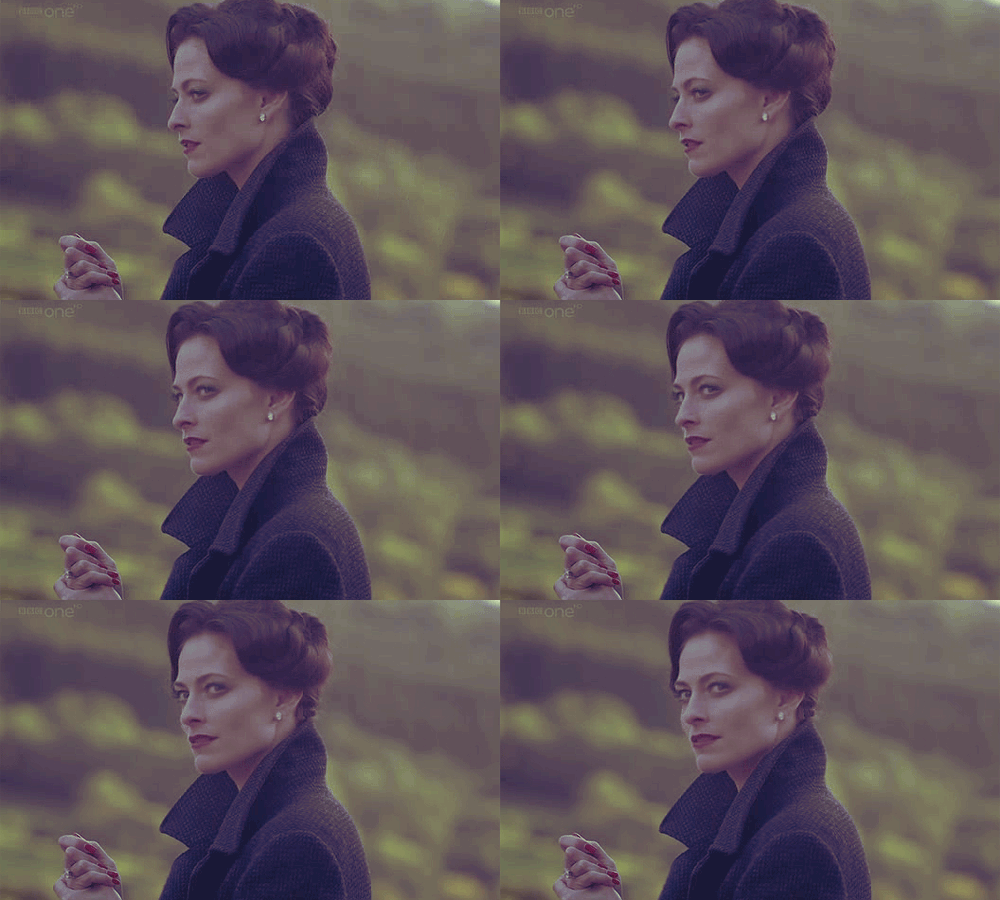
Irene Adler is played by young riser Lara Pulver, and from the moment we lock eyes with her on screen, we know we are witnessing someone special. Looks-wise, God spared no expense with her- beautiful eyes, the skin of an angel and the body of a Greek goddess, as well as a voice that exudes femme fatale all over. It was an important call in casting one of the fiercest female literary creations and the show’s producers could have easily opted for the easy option and gone for a more mainstream actress, but they put faith in Lara Pulver and she has repaid them handsomely with a fabulous performance that exudes sex and more than holds her own against the show’s talented and experienced males.

The episode, “A Scandal in Belgravia”, is loosely based around the Conan Doyle short story “A Scandal in Bohemia.” Except now, Irene Adler is a high class call girl who specializes in whip-play rather than an opera singer, and she has a collection of photos on her camera-phone rather than one bulky photo. These photos are of Adler with a female member of the Royal Family (or thereabouts), and Mycroft Holmes has enlisted his little brother (who’s relationship with is the very definition of love/hate) and Dr Watson to go get those pictures back.

Along the way, there are twists and turns aplenty. I was blown away by the ingenuity of the first series with how it subverted the Sherlock blueprint and managed to use modern day technology as part of the story-telling and detective process, and wasn’t sure if it would feel quite as fresh this time. Reality? It felt better. Doctor Watson’s keeping a blog is an amusing sub-plot and there is one terrifically crafted scene in which Sherlock Holmes, due to becoming somewhat of a C-list celeb due to said blog, is photographed by the paparazzi, a stream of photos which find their way to broadsheet papers, including The Guardian. Wonderfully filmed and a witty nod at the media obsession that we as a nation are getting.

As far as awkward, rude detectives go, this is also the first time Sherlock has shown interest in another woman. Irene Adler is stunning to look at, no question about it, but what really draws Holmes to her is her intellect. She is always three steps ahead of the chess game – each of her phones, combinations etc have two PINS – one which will open the safe and one which will alert the police, and even when you think she’s reached the end of the road and run out of lives, she manages to surprise you. There is one scene in which she half-seduces Sherlock by leaning into him, which plays out as one of the most erotic things I have seen in TV – yet no kissing or sex was directly involved. Incredible.

The first episode of Sherlock had everything I could possibly have wanted from a TV show and more. A showdown in Buckingham palace? Check. Some kick-ass fighting? Check. Retribution for some of the goons who hustled poor Mrs Hudson? Check. Some knowledge into the games Britain and Germany played with each other in the war? Check? A password that had me baffled for the whole episode and then finally, when it was revealed “Ahhhhh!”? Checkmate. The acting was faultless, with the camaraderie and banter between Holmes and Dr Watson timed to perfection. Something that has always bothered me about Holmes – although I wouldn’t expect him to be any different – is that he never gives Dr Watson the credit he deserves for everything he does for him, and this is exhibited here, when poor Dr Watson loses yet another girlfriend due to his need to protect Sherlock. The script was a work of genius, and I cannot but tip my hat to Gatiss and Moffat. All in all, the show was an overarching triumph. Next Sunday now seems an age away.
Grade: A+

Friday, June 10, 2011

Film review: SWINGING WITH THE FINKELS (Jonathan Newman, 2010)

Martin Freeman and Mandy Moore play an urbane married couple in London who find their marriage at a nine-year-itch. The frequency of their love-making is, we’re told – “once or twice a month”, and, witnessing the disintegration of the marriage of their close friends after the husband has an affair, leads the two to question the strength of their own marriage. They try various methods to cure their marriage – from her attempting to masturbate with a cucumber to him dressing up as a fireman in an attempt to instil some spice into it – but all fail miserably. Finally, the idea of swinging is suggested.


Mandy Moore, who was surprisingly funny as the sanctimonious, evangelical Christian teenager in in Saved!, gives another strong performance here, a capable blend of comedy and drama. Her acting in the cucumber scene was hilarious and she never veers into the “nagging wife” caricature at any point. At the same time, Martin Freeman re-visits the lovable shtick that suited him so well as The Office’s Tim. 

The supporting performances are all equally good, not least Melissa George as the mother who’s devotions, having swung to her kids, has lost her husband’s. The two leads have an easygoing, likeable chemistry that produces some charming moments at times, and the backdrop of London - I spotted Primrose Hill in one scene - gave the film - as it frequently gives films shot in London - a scene of whimsy and magic.

So the acting is not really the problem here. The main problem is the shoddy script and superficial depiction of a marriage in the danger zone and the precautions taken to try to fix it. In real life, marriages are rarely solved via some Love Actually-esque montages of cheesiness that can be summarised with a weak banana analogy and an over-arching "the grass isn't always greener on the other side" message, less so by some swinging, then the couple getting mad at each other before finally realising just how much they love each other and all being well in the end. 

Admittedly, the hectic-looking film poster for this film was a fair enough advertisement for what we could expect from the film, and in-depth insights into marriage was not one of them. But all the same, for the glittering cast, upbeat editing and potential for comedy gold that was available, Swinging with the Finkels was a very poor effort. The new millennium has not exactly been a fantastic advertisement for romantic comedies, and Swinging with the Finkels is another one to toss into the trash pile.

3/10