Showing posts with label crime. Show all posts

Monday, October 16, 2017

Film review: THE THIRD ALIBI (Montgomery Tully, 1961)


Composer Norman Martell (Laurence Payne) is the very definition of would pass in 2017 parlance as 'fuckboy'. Married to a devoted wife Helen (Patricia Dainton), he nonetheless carries on with her sister Peggy, which leads her to getting knocked up.

Out of betrayal and spite, his wife refuses to grant him the divorce he needs and being the nefarious individual that he is, Norma devises a plan to dispose of her, with the help of his mistress and a piece of recording equipment so that he has a watertight alibi.

Tuesday, November 15, 2016

Film review: LE FANTÔME DE LA LIBERTÉ (Luis Buñuel, 1974)


The third and final film of Luis Buñuel's triptych of movies which feature little plot and a lot of visual sight gags, Le Fantôme de la Liberté neatly ties off what La Voie lactée and Le Charme discret de la bourgeoisie started. Like the other two films, Le Fantôme de la Liberté consists of short, surreal sketches that follows a series of peripherally connected characters are their lives are peppered with all manner of curio, and in the name of decorum, the characters are completely blasé these bizarre occurrences, which just makes them weirder.

A creepy man distributes photographs to young girls. We assume these to be seedy, as he tells them to show friends but not parents, and indeed, when the parents discover them, they are disgusted. But the pictures actually turn out to be nothing more than photos of historical landmarks. Later, another little girl, declared missing, is actually present and well, and at the police station to aid an officer as he fills in her missing person report.

A chap who kills passers-by is hailed as some kind of celebrity at his court-hearing, with adoring fans begging for his autograph. A group of monks are invited to dine with a couple, who all of a sudden strip into latex and embark on some whipping in front of them. And perhaps most startlingly, a group of bourgeois families sit together at a dinner table to go to the toilet in each other's presence, occasionally excusing themselves to go into a private room, to eat.

There’s cinematic badinage of Le Fantôme de la Liberté boasts far greater variety than the other two films in the trio. Buñuel’s ability to synthesise them all into a collective unit illustrates his adroit ability to deliver narrative, even in an oeuvre that largely lacks one. The sight gags are wittier, and the film revels in its bizarreness, which means the audience doesn’t feel any obligation to invest themselves in the plot or the characters, which I have done in previous films, only to have the rug pulled from under me, and thus, felt frustrated by the director.

Possibly an artefact of 1972’s Le Charme discret de la bourgeoisie picking up the Foreign Language film Oscar, Buñuel’s follow-up is far less accessible and crowd-pleasing. But I preferred Le Fantôme de la Liberté precisely because it lacks a slightly grandstanding element that its predecessors have. Le Fantôme de la Liberté definitely feels like one of his most personal works, despite (or because?) of all the degenerates you meet in it. 

The fact that there isn’t a specific target of satire as La Voie lactée and Le Charme discret de la bourgeoisie had (Christianity and the middle class, respectively), per se, rather that free will, a much more abstract idea is the object of this film, means the director has far more scope to unbridle his anarchic vision upon. The episodes he confects span humour that ranges from the bizarre to the sublime.

While the plot sprawls, there is nothing ad-hoc about Buñuel’s tight direction, with each unsettling vignette modulating into the next with such fluidity that before the audience have time to dwell too deeply on the previous story arc, they’re immersed into a new one.

The main thesis of these chaotic scenes, that humans are predominantly irrational agents, and personal autonomy is purely a hoax, is intriguing; a theory given more resonance in the wake of ongoing current affairs. 

8/10

---

I've now reviewed all eight DVDs in my Buñuel box set. Read the others here.

Saturday, August 13, 2016

Goodbella.

Retrospective Outfit of the Day from when we celebrated my brother's 18th birthday (back in April) in a Petts Wood restaurant called Cyprianis. The wall art game in this place was strong!

Blue top: Marks and Spencer
Vest top underneath: Miss Selfridge
Glasses: Red or Dead

Friday, August 12, 2016

Film review: SORRY, WRONG NUMBER (Anatole Litvak, 1948)


This post is as part of Midnite Drive-In’s Film-noir blogathon. Movie bloggers all over the internet are coming together to discuss a wide range of film noirs, both well-known and less established, so do head on over to that fabulous blogathon and enrich your film knowledge!

-- 

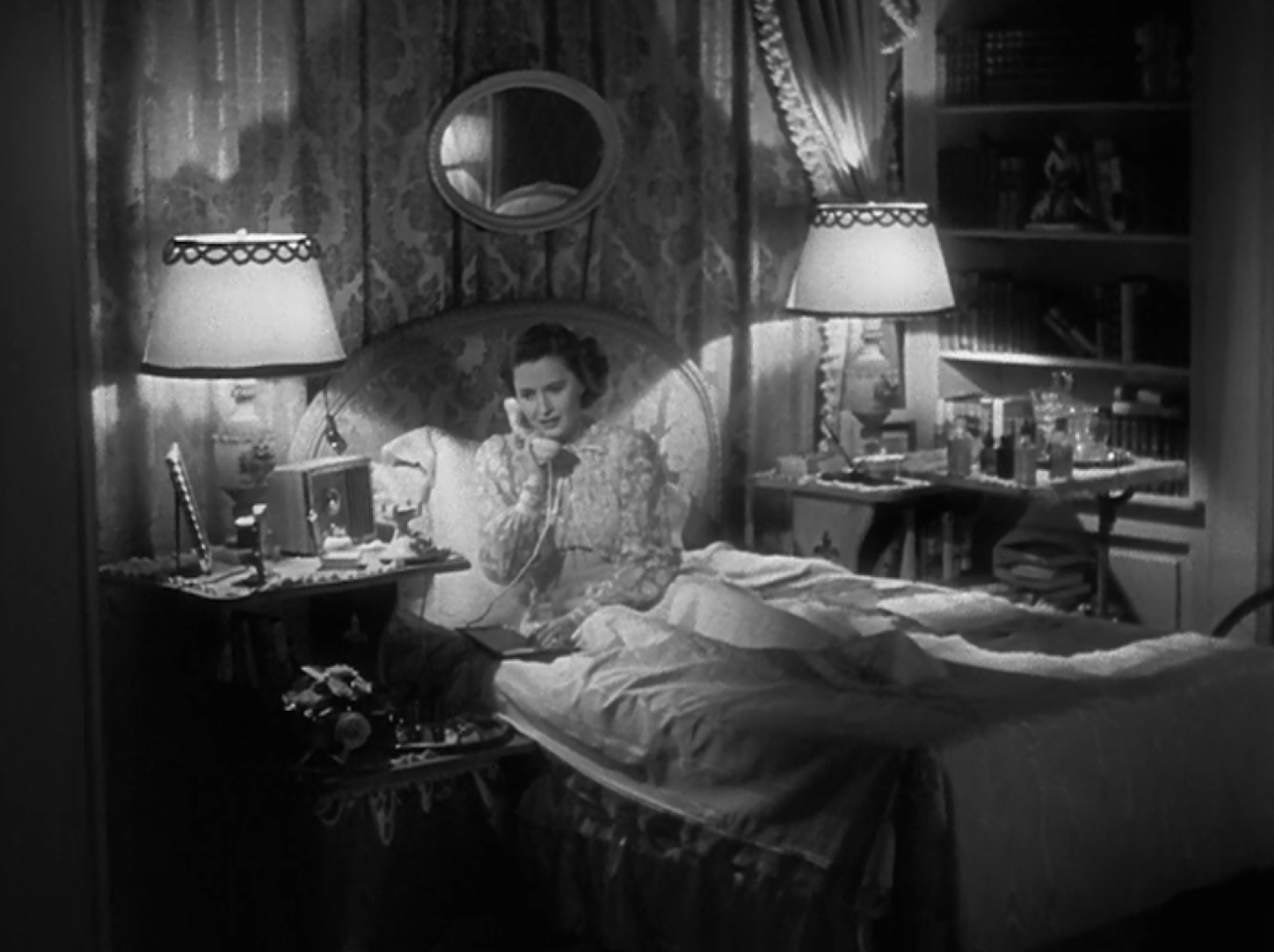
Leona Stevenson is the rich only daughter of a pharmaceutical magnate. She is also invalid, and in NYC from Chicago to consult with a doctor about her health issues. At the start of the fil m, it is apparent that her husband is avoiding her, screening her calls. His absence is even more gaping by the empty chair he leaves, which Leona addresses plaintively. In a stroke of (mis)fortune, she overhears two men’s plots to murder a woman at 11:15pm, with the time meticulously chosen so that the sound of the crime will be masked by a passing train. 

She reports it to the police and then her father, but both efforts fall on deaf ears. As she becomes increasingly agitated alone in the Manhattan apartment, she tries to locate her errant husband, only to inadvertently piece together the context of the phone call she overheard, which she involves her more than she’d care for.

One of Barbara Stanwyck’s four Oscar nominations for Best Actress, Sorry Wrong Number came out four years after her iconic turn as conniving seductress in Double Indemnity. Both are film noirs with a heavy sense of foreboding, but playing a bedridden character, her physical repertoire is limited here. Whilst she slinked around (who can forget that anklet and the way she shimmies down the stairs to show it off?) in Double Indemnity, she spends the majority of Sorry, Wrong Number fretting in bed. It’s a difficult role that only someone with the screen presence and acting guile Stanwyck is blessed with could pull off.

Graciously for her, she does get to stand up at some point in the film: a good proportion of the 
story is told via flashback. We discover how she and her husband (Burt Lancaster) met: he was actually at a dance with a girl called Sally Hunt, who plays an integral part in helping Leona piece together the clues. Leona, never having been deprived anything she wanted in her life, boldly makes a play for Henry. He’s initially put off by her entitled attitude, but, nonetheless, his head is turned by her wealth. Stanwyck conveys her character’s bratty attitude wonderfully: in one scene, she regards her husband with a contemptuous glance in that signature way Barbara Stanwyck looks people up and down. You mirror Lancaster's character's feeling of belittlement when it occurs.

Lucille Fletcher penned the script for Sorry, Wrong Number, which was originally a radio play by her. The translation is effective: few sets are required in Sorry, Wrong Number, and the art decoration of Leona’s grand but stuffy bedroom is conveyed excellently: she has expensive trinkets and bottles, but her loneliness is clear. The moral that money can’t buy happiness is an age-old one in cinema, but this message is conflated with another: money being the root of all evil, which motivates some shady actions by certain characters. Thus, the script, ahead of its time in this sense, touches on an almost Kafkian problem: the more Leona feels her husband pulling away, the more she tries to throw money in the problem, which in turn, makes him increasingly more detached towards her.

The cinematography dextrously plays with light and shade, true to the genre, to create ambiance and dread throughout the film. Also, in the vein of film noirs, there are few truly "good" characters (I would argue only Sally, Leona's former classmate who's love she stole in such a cavalier manner, is), and plenty of murky ones. Even our protagonist, who finds herself in increasing danger, is somewhat hard to take and completely root for, her arriviste persona accentuated by her plush wardrobe, multitude of expensive rings, and Stanwyck's virtuoso performance as a woman who refuses to see what's going on right under her nose, causing the audience to fear the moment the House of Cards will crumble.


The employment of flashbacks and the film being played in real time give Sorry, Wrong Number a real sense of urgency, and the protagonist being confined to their room gives them a powerless sense that makes this film a worthy predecessor to the more polished Rear Window. The beating heart of the film is Barbara Stanwyck; I can’t believe she never won a proper Oscar during her lifetime especially when frauds like Jennifer Lawrence and Natalie Portman have them! As mentioned, Leona is not likeable at all, treating other characters in the film as below her and talking down to everyone. Yet Stanwyck is able to inject sympathy into even an upstart like this! By the end of the picture, she has you rooting for Leona, warts and all.

The Academy gave her an honorary award in 1982, whilst she was still alive, though, for “For superlative creativity and unique contribution to the art of screen acting”, and that is exactly what she has, in spades, here. Without her, Sorry, Wrong Number would have been a fairly exciting film. With her, it’s a complete and utter thriller.

Friday, July 29, 2016

Film review: SHALLOW GRAVE (Danny Boyle, 1994)

I saw this title at the Prince Charles Cinema as part of their Summer celebrating 35 mm film. In a luxurious cinema with plush velvet curtains, there couldn't be a better way for movie buffs to spend their evening. The schedule runs until August 20th, so make sure you check out the itinerary! 

--


The lesser known of Danny Boyle's Scotland-set 90s collaborations with Ewan McGregor, Shallow Grave tells the story of three housemates, the mischievous duo of a doctor, Juliet (Kerry Fox) and a reporter, Alex (Ewan McGregor), and the more by-the-book accountant David (Christopher Eccleston, as un-Doctor Who'ish as you could possibly imagine). They recruit a fourth housemate who, overnight, is found dead from a drug OD. He also happens to have left behind a suitcase full of money, and the housemates decide to dispose of his body and keep the cash for themselves.


A Kafkaesque nightmare ensues as they find themselves interrogated by probing police, targeted by an unsavoury pair of henchmen who want to know where the money went, and, as a result, the paranoia and distrust between the three escalates. David, in particular, undergoes a character transformation in their precarious circumstances, changing from a meek white collar worker to a ruthless Machiavelli with a penchant for using his hammer.

The tension is wonderfully accentuated by a sparse but effective score from Simon Boswell, with discordant piano keys mirroring the audience's growing sense of discomfort. Yet, at the same time, Shallow Grave also offers levity; when arguing over who should cut up the corps, Alex says to Juliet, 'you're a doctor, you kill people everyday!'.

As the three leads find themselves in increasingly dire straits, the bond between them is stretched thinner and thinner, which potentiates David's magnetic transition from mouse into man. McGregor and Fox are very good, but Eccleston is brilliant, those owl-like eyes peering up from his tortoiseshell glasses throughout, in a sinister, wicked, yet utterly enjoyable morality tale about dishonour among thieves. 

Monday, June 20, 2016

TV Review: ORANGE IS THE NEW BLACK season 4

Ever since its inception, Orange is the New Black has been one of Netflix's USPs. Very loosely based around Piper Kerman's memoirs of her experience in jail, with Taylor Schilling playing the televised version of her character, 'Piper Chapman', the show has never failed to entertain, shock, amuse and trouble viewers. Season 3 was considered by some critics to be a slight misstep, but even so, the stakes were high for season 4, which, thanks to the way in which Netflix drop a whole season in one go, I devoured over the weekend it hit.

With Litchfield Penitentiary becoming privatised, the MCC are keen to squeeze as many bodies into the jail-space as humanly feasible. By viewing prisoners as currency, however, they do not consider the factions that could occur by the simple mathematical probability from there being more people. This manifests itself in the form of strained race relations that arise when there is a surge in the Dominican inmates, and a group of white supremacists who resent the way they've asserted their authority. Piper Chapman, who, in a late, rare moment of self-reflection, admits she wanted to 'win prison', unwillingly stokes the tensions between the two groups, only to see herself branded (in more than one way) as a racist herself for her unthinking egotism.

 photo Screen Shot 2016-06-18 at 18.19.53_zpszayy8w9j.pngIn order to keep these brawling inmates in line is the introduction of Captain Piscatella (Brad William Henke), a giant of a man who takes no prisoners and regards the women of Litchfield as absolute scum. Piper's manufactured, wide-eyed charm that may have twisted the arm of a warden or two in the past simply doesn't work on Piscatella, who has seen it all before and bought the T-shirt. His unconventional methods for showing the inmates who's in charge are met with opposition by Warden Joe Caputo, which makes for a power struggle between the two of Shakespearean magnitude. Caputo tries to do what is best in the majority of situations, and the unenviable juggling act of of running a prison with  insubordinate prisoners, sly, thuggish officers and a big corporate sector who wishes to monetise the jail to an inch of its life are really highlighted in season 4 of OITNB. Nick Sandow is extremely effective at humanising Caputo and at times one couldn't call who has it worse -the mistreated inmates of Litchfield (not having enough sanitary towels to go around so that menstruaters had to stick tissue inside themselves was a new low), or the hapless Warden overseeing them all.

Other plot strands of season 4 include sadistic officers who like to toy with the prisoners for their own entertainment, Lolly and Alex struggling to deal with the albatross of their defence-killing of one of Kubra's cronies, and Maria Ruiz emerging as initially unwilling leader of the Dominican girls. This reluctance is illuminated in her flashback episode, 'Power Suit', where we learn that her father was a low-level kingpin for people from the Dominican Republic, and, such was her distaste for his antics that she turned her back on him to live with a Mexican guy. Another interesting flashback is Maritza Ramos, by far the most striking girl in Litchfield, who used her beauty to trick car dealerships into leasing her fancy cars for a test drive, under the misapprehension that she's some rich old man's trophy wife. Watching flashback!Maritza untangle herself from a quagmire this gets her into is one of the funniest parts of season 4. Had I been a betting woman (which I'm obviously not. Ahem), I would not have wagered Maritza was incarcerated for Grand Theft Auto, showing, once again, that the employment of flashbacks in this show can completely toss your preconceptions of characters out of the window.

 photo Screen Shot 2016-06-18 at 18.34.47_zpsxjk2wwjb.png
Elsewhere, romance blossomons between annoying hippie Brooke Soso and Poussey Washington, the likeable class clown of Litchfield. The two are beyond adorable together, and Kimiko Glenn and Samira Wiley deserve kudos for crafting a romance that is organic, believable, and so full of love and hope. Judy King - a famous TV chef - gets sent to Litchfield for tax fraud, to which Poussey, a big fan, becomes turns into a starstruck fangirl whenever she's around. Brooke, in the way only Brooke can, tries to relieve her of her awe around Judy, only to cast some offensive aspersions of her own. This illustrates Brooke's narcissism and inclination for the farfetched, which is illustrated in her flashback. But in seeing how much her casual assumptions have hurt her girlfriend, Brooke gains the self-awareness that she never had when she was doing the same thing in the free world. It is a pleasure to learn each individual character's histories and see how much bad life choices and circumstance plays in them winding up where they are.

 photo Screen Shot 2016-06-18 at 21.12.14_zpsevh8unxw.png

Orange is the New Black also very sensitively continues with the fallout of the Pennsatucky's rape in season 3 by officer Coates. Her friend, the confrontational man-hating Big Boo, is, understandably furious. Pennsatucky also feels some anger, but mainly sadness, and the show graciously gives her some closure (after season 3's 'A Tittin' and a Hairin'' episode, watching her character being raped twice in the same episode really was too much). It's amazing how much Pennsatucky has grown since her intolerant, evangelical Bible-bashing days of season 1, and there's something rewarding about watching her help Nicky through going cold turkey; the Doggett of old would never have done that. Taryn Manning excels at her portrayal of a multidimensional character who could have so easily descended into farce.

In fact, Orange is the New Black is one of the few shows where I am yet to see a dud performance. Uzo Aduba usually reaps the awards come Screen Actor Guild and Emmy time, and she is indeed brilliant as the unhinged Suzanne Warren. But I think Aduba's best acting, and baitiest scenes, were in season 2, when the manipulative Vee took her under her wing. The acting love needs to be spread more evenly in the next round of Emmy's, and there's a plethora of choice.

Samira Wiley deserves a lot of love for making Poussey so awesome and lovably goofy, and injecting real passion into her and Brooke's tender romance that makes the audience root for them in a way we don't to the blah Piper/Alex romance. Hearing the two discuss their plans for getting their life on track after leaving prison was almost tear-inducingly optimistic. As Taystee, Wiley's fellow Juilliard alumnus  (hot dang, does Juilliard produce some talented dames!) Danielle Brooks, gets appointed Caputo's P.A. this season. In doing so, Brooks shows incredible diversity in her acting range, first in her hilarious keenness for the secretarial role, complete jazzing up her prison attire and demanding a watch, but later, when tragedy hits, her character's raw reaction to the event in question is really upsetting to watch, and nails the pathos of Orange is the New Black. Taylor Schilling, Natasha Lyonne, Kate Mulgrew and Yael Stone are a few other standouts from the supremely talented ensemble cast.

 photo Screen Shot 2016-06-19 at 00.19.00_zps2u3ipuqt.png


In season 4, Orange is the New Black might have hit its peak. The frank, earthy dialogue is absolutely hilarious, but it would be nothing without the cast to deliver it so well. Case in point: Cindy's sass when her new roommate dares her, "'You really want to go there with me?" and, she retorts "Oh, went there, bought a house, moved in, bitch. And now I'm remodelling the kitchen." Furthermore as with Brooklyn Nine-Nine, another New York-set show of a somewhat different flavour, the pop culture references come thick and fast in the everyday conversations of the inmates, but in a natural, unforced way that both illuminates the gaps in characters' knowledge ('The Hungry Games' will never get old) and occasionally flirts with the meta (all those Walking Dead and Game of Thrones references hint at some foreboding).


OITNB has always modulated between comedic and dramatic scenes with a kind of irreverence that made my eyes water (who can forget the employment of 'Cellophane' as the credit song as a character was being pummelled to death by rocks wrapped in a cellophane bag?) But in season 4, the catalogue of the prison being overfilled and understaffed and inmates' hatred of each other was never going to end well. When the collateral damage occurs, it's undoubtedly one of TV's most heart-breaking moments; almost George R.R. Martin-esque in it's 'SCREW YOU, WRITERS!!!!!!!!' brutalness. The sheer injustice of it all had me weeping. But I could recognise the significance of it to the show. That's prison. And that's also life. Sometimes, the good die young.

It's the mark of such a fantastic show that OITNB offers wit, morality and the hint of redemption (or further deterioration?) at the climax. June 2017 can't get here fast enough.

Grade: A

Tuesday, January 14, 2014

TV review: SHERLOCK series 3 (2014)


Few things have been waited for as eagerly as series 3 of Sherlock. The last time we’d seen the infuriating but brilliant sleuth, he’d hurtled to his death from the top of St. Bart’s hospital. Or had he? Through misdirection and false theories aplenty (including an amusing nod to slash fiction, which no doubt Mark Gatiss was mildly disturbed by when he first discovered, before choosing to use as a force to his advantage), the show’s creators Gatiss and Moffat finally revealed to us how the great detective did it, and it’s fair to say that the reaction of the general audience was that of being underwhelmed. 

Ignoring, for a second, just how muddling and convoluted it was, how many extra players Sherlock’s escape plan entailed, the thing that disappointed the most was the fact that the so-called independent, famously misanthropic man, had to enlist the help of his older brother to get him out of a quagmire.

That little quibble aside, the first episode of this season had a few treats, mainly in the form of Sherlock taking his sweet time revealing to Watson that he was still alive, at the worst possible moment: when Watson was about to propose. It was good to hear Molly had moved on from Sherlock, by getting herself a new boyfriend, though later, when he emerged, we realised we’d spoken too soon; the man looked like a bargain-basement Cumberbatch.

With all the characters being reunited, the plot sat on the back foot somewhat, and when Sherlock realised that the so-called “underground terrorist attack on London” was, quite literally, an UNDERGROUND terrorist attack, you weren’t terribly surprised. Especially when we’d been shown footage of a shifty-looking man wandering on a Tube, and then seemingly disappearing. As far as convoluted plots have gone, this wasn’t Gatiss’ best work.

If the first episode of the series disappointed, then the second episode truly flabbergasted with how poor it was. Every now and then, on a twenty-episodes-a-series show like Family Guy or Friends, the show’s creators will do a “whacky” episode; quirk for quirk’s sake. Due to there being 19 or so other regular episodes, we allow this one-off display of craziness. However, when there’s only three episodes a series of Sherlock, we’re led to expect high quality from ALL the episodes. 

Happily, we got this in series 2, where the three episodes - one introducing Irene Adler, one, a fantastic modern spin on the Hound of the Baskervilles, and the intense final episode with the showdown with Moriarty, both held our attention throughout. In series 3, the second episode’s main plot device was Dr Watson’s wedding, and, although there were flashes of brilliance, the majority of it was just ponderous.

Recently, I’ve been reading Arthur Conan Doyle’s original “The Adventures of Sherlock Holmes”. Bearing in mind that this was long before the era of iPhones, laptops, walkie talkies and the like, it really is enthralling to delve into the mind of such an old-school detective. Hints of Sherlock’s deductive prowess were shown in the first two episodes of series 3 of the TV show (for example, when he immediately susses that a lady’s internet boyfriend has gone missing, that it is the stepfather who was pretending to be him all along, that is based on the short story “A Case of Identity”), but, lamentably, series 3 seems more intent on carving him out better as a person than a sleuth. As such, he’s a more rounded human, but a less interesting character.

Redemption for series 3 came in the season finale, which was back at its finest, and like what we’d been used to in seasons 1 and 2, could work as a stand-alone watch. The storyline centred around a newspaper mogul, Charles Augustus Magnussen, played by the terrifically creepy Lars Mikkelsen, channelling Rupert Murdoch in his performance. We wondered if Sherlock had completed the full transformation into #human when he started dating Janine, a woman he’d met at John & Mary’s wedding in the previous episode. Graciously, it was just the Sherlock we all know and love, the cold, calculated man who tramples over people’s feelings; in this case it was because Janine was Magnussen mogul’s secretary.

There were shocks aplenty in the final episode, although seeing Sherlock in a crack den, for anyone who’s familiar with the book and his penchant for opium in them, was not one of them. The episode was unashamedly emotional, with the peak of the series’ writing coming when John tells Mary “The problems of your past are your business. The problems of your future are my privilege,” which is a Renee-Zellweger-in-Jerry-Maguire moment, if there ever was one. 

Whilst the writing this series was far from its best, Benedict Cumberbatch and Martin Freeman continued to be wonderful, and Freeman’s delivery of said line drew tears from this viewer. And, of course, the closing shot took us all aback. Gatiss and Moffat were reminding us that, for all the frivolity and second-rateness of episodes 1 and 2, Sherlock most certainly hasn’t lost its ability to entertain and gobsmack in equal measure.

7/10

To read more of my TV and film reviews, please click here.

Tuesday, June 18, 2013

Book review: MURDER MOST FAB (Julian Clary)


Having just suffered his first love and heartbreak, Johnny Debonair is uprooted from his farmhouse in Kent to the big city, where his grandmother enrols him in drama school, believing the change will do him good. However, his classes are filled with self-absorbed people, who think too highly of themselves, and he soon becomes disillusioned with acting, long realising that he won’t be going anywhere with his pipe dream.

Saturday, August 18, 2012

Film review: THE BOURNE LEGACY (Tony Gilroy, 2012)

In summarising the plot of The Bourne Legacy, I may fail somewhat, as I was more than a bit lost throughout my viewing of the film (a free advanced screening at a rather plush Vue cinema in Finchley Road, if I may say so).  

To the best of my understanding, what it involves is a group of people who were involved in “Outcome”, a different strand of the project Jason Bourne was involved, but the difference here being science is used to doctor their mental and physical capacity. A glitch in the set-up of the plan involving a YouTube leak of the connections between the people involved occurs and the film documents the lengths the creators take to avoid the catastrophic results of the Bourne saga. 

Eric Byer (played by Edward Norton), is the man trying to “shut down” the people involved, and whilst the majority are done so with ease (they are given a “new pill” to take which they believe will make them stronger but in fact sends them into cardiac arrest), Aaron Cross (Jeremy Renner) is the last man standing, who refuses to go without a fight.


I think the main problem with The Bourne Legacy is that they tried to tie it in with Robert Ludlum’s initial creation, and the Matt Damon films, when in fact everything that happened in the preceding films is very much in the background here. 

Had The Bourne Legacy been a different film, the character of Jason Bourne just been something of a prelude and the characters been given new names and companies, then I would have found The Bourne Legacy a lot less confusing. 

The continual attempts to try and tie the events of this film in with the third movie (the two storylines are supposed to be running parallel) definitely over-complicates matters. The story-line is more than cerebral enough to hold its own, and, as mentioned, the attempt to try and make this a spin-off of the Bourne movies is its ultimate downfall.

That being said, there’s a lot of good stuff here. The script is somewhat too clever for its own good in regards to the plotting, and there is little left in terms of characterization, but Renner, Weisz (playing Marta, a scientist working for a company who does the legwork of Outcome) and Norton all give strong performances. 

Norton in particular is very strong, as his character is far removed from the archetypal villain in that he is doing what he thinks he is doing for the greater good. He gives a brooding, tense performance and it is possible to imagine what it’s like for his character. Jeremy Renner has never been one of my favourites with his individual AVBesque brand of surliness, but I don’t find him as annoying her as I have found him in other movies, namely Mission Impossible III and The Town

Rachel Weisz, though unfortunate in that the script makes her out to be hysterical, acts very well indeed to make us sympathise for her character when the script was practically calling out for histrionics, as well as giving depth to Dr Marta Shearing in her facial expressions that is painfully remiss in the screenplay.

As with all the Bourne movies, the action sequences are a thrill to watch, and a chase sequence through the streets of Manila certainly doesn’t skimp on crashes, explosions and various other calamities. 

Slickly edited with some wonderfully glamourous locations spanning London to the Philippines, and featuring some genuinely tense moments (a showdown at Marta’s house when she is required to draw on her wiles in order to survive), it is, on the whole, an interesting watch, but not one that I was altogether satisfied by.

3/10

Monday, January 02, 2012

TV review: SHERLOCK series 2 episode 1, A SCANDAL IN BELGRAVIA

Arriving in time for the New Year comes a second series of Mark Gatiss and Steven Moffat’s wildly inventive Sherlock, which takes the classic stories from Arthur Conan Doyle and drops them directly in the hustle and bustle of modern London. 

Smartphones, blogs, laptops and fancy gadgetry all become part of the story-telling as Doyle’s clever creations are given a modern day spin. Leading all of this unlikely but massively successful creation are the odd couple of Benedict Cumberbatch as the genius yet friction-inducing eponymous detective, and Martin Freeman as his long-suffering army doctor companion, Doctor Watson.

Tuesday, August 02, 2011

Film review: HORRIBLE BOSSES (Seth Gordon, 2011)

Childhood friends Nick, Dale and Kurt, once known as the “three musketeers” are still friends into their adulthood, and meet up on a daily basis for a drink and meal at their local bar. Trouble is, whilst their friendship thrives, their work lives leave a lot to be desired. 

Nick (Arrested Development’s Jason Bateman) works in a corporate environment, with a psychotic boss Dave Harken (played by Kevin Spacey) whom gets arsey if he is so much at 2 minutes late – after 6am. In one scene, Harken entraps him into necking scotch – at 8 in the morning. Nick despises his boss, but puts up with his bullying, knowing – or thinking – that if he takes the shit for a while longer, he will receive the promotion to VP that he has so hardly worked for. That hope, we later find out, turns out to be completely misguided.

Photobucket

Sunday, April 03, 2011

Film review: THE GIRL WHO PLAYED WITH FIRE (Daniel Alfredson, 2009)

A year on Lisbeth Salander’s minor victory from the end of The Girl with the Dragon Tattoo, the eponymous character back in Stockholm. Mikael Blomkvist, who’s magazine Millenium, she had helped gain back a legitimacy in the first film, is now investigating sex trafficking. At the same time, a bunch of murders (including that o the lawyer who raped Salander in the first film) occur, framing Salander for the murders. Lisbeth Salander knows it’s time to go on the run. She also knows that someone is after her.

As with the first film, what makes The Girl Who Played with Fire is Noomi Rapace in the lead role. With her short spikey blame hair, multiple facial piercings and tattoos and skinny frame, she is the physical embodiment of Lisbeth Salander, but her performance is just as noticeable, if not more so, than her physical attributes. In one scene, where she has a man tied up by the neck and is trying to extract the truth from him, face painted white (for some reason), Rapace’s reactions to learning each new fact totally mirror our own. 

It will be interesting to see how Rooney Mara, who turned heads as Jesse Eisenberg’s love interest in The Social Network, will fill her shoes in David Fincher’s big-budget Hollywood adaptation of the series. From the photos, she looks every bit the part, but Mara has her work cut out filling Rapace’s shoes.

What distinguishes this instalment of the film from the first is that here, we delve deeper into Lisbeth’s murky past, with the reasoning behind her cold exterior illustrated somewhat, especially when we find out why she was labelled “incompetent” in the first place, and what she did to get herself thrown into scare. At the same time, as events become progressively more sinister, Lisbeth comes to accept that sometimes, she can’t handle the world entirely by herself, and becomes more receptive to the held from her friends. At the top of these people is Mikael Blomkvist, who’s belief in Lisbeth’s innocence never falters for a second. 

As anyone who has read the books will know, the Mikael/Lisbeth will they/won’t they romantic subplot is ongoing throughout the trilogy, and the natural chemistry between the two actors is likeable and believable. Unfortunately they spend much of this film apart, but even so, the way they communicate via short, staccato messages through computers (which Lisbeth hacks expertly) all builds to what I feel is one of the on-screen duos of the 2000s.


That the film is not quite as thrilling as the first is more down to two things. Firstly, the whole “missing person” plotline of the first was a little more interesting. Secondly, it is due to the very high precedent set by the first film. From some scenes, it is easy to see how these two films, and the finale, were adapted into a six-part TV mini-series in its homeland Sweden, as production value is generally not the highest. But, nonetheless, The Girl Who Played With Fire is an intense, well-sculpted bit of filmmaking, worth watching, and one that doesn’t shy away from the dark underbelly of the Swedish underworld. I eagerly await seeing the third.

Monday, February 14, 2011

Film review: FEAR IN THE NIGHT (Maxwell Shane, 1947)

Right now, the Film Noir Blog-a-thon is occuring, hosted by the very brilliant The Self-Styled Siren and Marilyn Ferdinand. The blogathon is occuring as part of a fundraiser to raise money for The Film Noir Foundation, a very worthy cause which helps to restore classic films. Click here to donate.

When looking for a film to review for the blogathon, I couldn't decide between reviewing or re-reviewing some of my all-time favourite noirs (Sunset Blvd., Mildred Pierce, Laura, Double Indemnity to name but a few), or to watch something new. In the end I opted for the latter -- because why not watch a new film in the hope of discovering a new gem? -- and I picked the somewhat obscure 1947 Maxwell Shane picture, Fear in the Night.


Vince Grayson (DeForest Kelley) dreams that he kills a man and when he wakes up he finds he has bruise marks around his neck from the guy trying to strangle him in self-defence. Seriously spooked out, he tries to hand himself into the police by telling his brother-in-law, Cliff, a cop, only to be told (quite fairly) that he cannot be arrested for a crime that he committed in his sleep, "you're dreaming. You've had those things before". 

Sunday, January 09, 2011

Three mini-film reviews: YOU AGAIN (Andy Fickman, 2010), PAPER MOON (Peter Bogdanovich, 1973) and CONVICTION (Tony Goldwyn, 2010)

Just three this week, a terrible film, a terrific film, and a film that I liked a lot more than I expected to; all three films are about family.

You Again (Andy Fickman, 2010)


Kristen Bell plays Marni, a girl who was a “loser” in high school complete with oversized glasses, a dodgy haircut, and a streak of constant clumsiness that made her an incredibly easy target for the school's head cheerleader, Joanna (Odette Yustman). Eight years later, she is a successful public relations VP, who returns home for her brother’s wedding. 

Sunday, April 25, 2010

Weekly Screening Log (19/04/10 – 25/04/10)

Sorry dudes, I’d slacked up on this for a few weeks, but I’m 20 now, I’ve decided to shove some consistency into my life (lol). Anyway, here we go.

The Nanny (Seth Holt, 1965)
Curious drama starring Bette Davis as a competent nanny who works for mentally fragile mother Wendy Craig, her husband and their bratty son (played by William Dix), who despises his nanny. At first, his antipathy toward her seems to be nothing more than a by-product of his spoilt brat attitude, but then we see that there is a dark reason behind it all. The old fashioned style of the film both works to its advantage and disadvantage – it’s unashamedly unfashionable, so the focus is on substance rather than style, but as a result, the clunky acting from Craig makes it, at times, difficult to take the film seriously. Bette Davis is, as ever, superb, and there was horror in the surprise.

Photobucket

In My Father’s Den (Brad McGann, 2004)
Matthew Macfadyen stars as a war photographer who goes home after the death of his father and his presence alone starts unravelling bitterly resentments and hidden family secrets. Although the film was fairly languid in tone and pacing, it still held my attention throughout. The characters were all fairly detestable, though the depiction of Macfadyen’s relationship with a girl that may well be his daughter was well done and intriguing. The twist, when it came, was as surprising as disturbing. Bizarre little movie, I appreciated it far more than I enjoyed it.

Clash of the Titans (Louis Leterrier, 2010)
Entertainment, though not the smartest. Full review here .

Chloe (Atom Egoyan, 2009)
Somewhat of a let-down considering the sheer volume of talent involved. Full review here .

Cruel Intentions 2 (Roger Kumble, 2000)
Cruel Intentions worked so well because of the sexual magnetism between Sarah Michelle Gellar and Ryan Philippe. Cruel Intentions 2, which tells the story of how the two characters came to be how they were, serves as a prequel to Cruel Intentions. Only this time, Amy Adams and Robin Dunne plays the respective roles. I quite enjoyed Cruel Intentions 2, even though it was extremely crappy, just because it knew it couldn’t live up to the original and didn’t attempt to. There was a weak, weak twist, which doesn’t even shock because the whole film itself is so weak. However, my main problem with the film was Amy Adams. She’s so lovely and warm and her attempt to play it bitchy just didn’t carry off at all.

Love, Honour and Obey (Dominic Anciano, 2000)
Oh dear. I don’t even. If you want to see bad acting, shitty camerawork and Kathy Burke and Denis van Houten get buggered, then watch this. If you have any appreciation for good cinema, then don’t.

Friday, July 04, 2008

Four brief book reviews.

I’ve been a bit behind on the whole “a book a day” thing, as well as reviewing them for the blog. But anyway, here’s four books I read this week:

Memories of My Melancholy Whores (Gabriel Garcia Marquez)
Underwhelming, to say the least. It was turgid, dull and extreeeeeeemely unsexy (I don’t want to hear about a 90-year-old man’s waning libido, cheers). Marquez, you can and have done so much better.

Dumb Witness (Agatha Christie)
One of my favourite Agatha Christie mysteries. Not quite up there with The ABC Murders and And Then There Were None, but certainly one of her finest, in terms of plot, character development, and narration. The idea - of Poirot investigating the murder of a woman who sent him a letter long before she died - is ingenious, and there are various twists and turns throughout.

Star Struck (Val McDermid)
Emma 4-xing loves this book!!! After I ploughed through my own “script” of Butterfly, I thought the two words “crime comedy” would instil nothing but a shudder in me. I was wrong, for Star Struck has got crime and humour in spades. It’s about Kate Brannigan, a P.I. in Manchester who has been hired to be the bodyguard of famous TV star Gloria Kendel, who has been getting death threats. But once she takes on the job, it's more than just scary letters that she has to contend with as a celebrity mystic-meg type gets murdered. 

The book encapsulates all of Kate’s life, from her employees who are getting arrested or hooking up in cyberspace, to her brooding boyfriend, to all the eccentric people she meets on the job. Kate Brannigan is an amazing role model. Honestly, with the influx of wags and empty-headed glamour models that we're seeing in the Media, reading about Kate, with her Thai-boxing, Chinese food eating, fast-talking ways was an absolute breath of fresh air. 

Star Struck is very clever, well-written and insightful, it played a bit like an episode of Jonathan Creek as written by Sophie Kinsella. I absolutely adored it. (And I've just found out that there are about 5 more Kate Brannigan books written! *is happy*)

The Lady and the Unicorn (Tracy Chevalier)
If anyone can make the process of painting and creating and weaving a tapestry interesting to a complete art-phobic like me, it’s Tracy Chevalier. 

Girl with a Pearl Earring was one of the most beautiful and underratedly sexy books I’ve ever read. TLATU is a little less subtle in its characters’ carnal desires, and I for one couldn’t see what all the women in the book saw in Nicholas (who didn’t sound that fit, imo) and why they were willing to run the risk of getting pregnant by him. 

That said, the narration, which jumps from character to character, is really well done – their inner monologues are completely believable and it’s refreshing to hear a story from different angles. And a tapestry of a unicorn sounds sublime.