Showing posts with label books. Show all posts

Saturday, December 31, 2022

Book review: THE ULTIMATE ACTUARIAL JOKE BOOK (John Lee)

John Lee, whose two books Actuarial Fairy Tales and Confessions of an Actuarial Tutor I have previously reviewed on my blog, continues with his streak of actuarial high jinx with his latest offering, The Ultimate Actuarial Joke Book. I was entertained greatly by those two creations, so I expected more comedy from this book, not least because it is, quite literally, compendium of jokes.


It certainly didn’t disappoint. The book features a wide variety of types of jokes formats, from zingy one-liners, jokes that follow classic ‘knock knock or ‘Doctor, Doctor’ formats, visual comedy in the form of memes, or gags that require more of a build-up before the punchline is delivered. By mixing the way the jokes are delivered, this means reading The Ultimate Actuarial Joke Book never gets stale, with the reader kept on their toes.

Friday, December 31, 2021

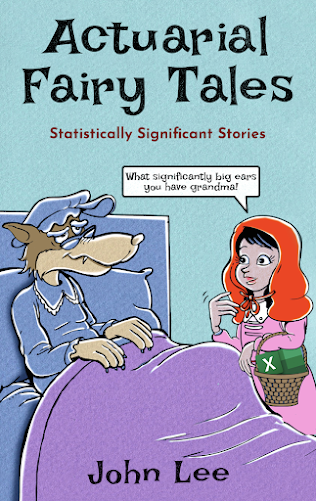
Book review: ACTUARIAL FAIRY TALES (John Lee)

John Lee, who gave us the eccentric joys of Confessions of an Actuarial Tutor, turns his brand of nerdy humour into re-telling well-known fairytales, such as The Three Little Pigs, Sleeping Beauty and Goldilocks, with an actuarial slant. The results are cerebral, engrossing and often laugh-out-loud hilarious.

Wednesday, June 17, 2020

Book review: THE BALLAD OF SONGBIRDS AND SNAKES (Suzanne Collins)

Set 64 years before The Hunger Games, The Ballad of Songbirds and Snakes is Suzanne Collins' prequel to her dystopian YA trilogy, a book series whose film adaptations launched the Hollywood career of that awful over-actor and recipient of the most undeserved Oscar win ever, Jennifer Lawrence.


For that reason, then, you'd think that I would dislike The Hunger Games books. But I actually really enjoyed them (I even enjoyed some facets of the films). The world-building exhibited in the books was extremely inventive, and, whilst it may have been a tad derivative of Battle Royale and various Roman and Greek myths, I maintain that most good art contains inflections of other artists that preceded it.

Central to the books was the first-person narrative of Katniss Everdeen, the tribute from District 12. Throughout the trilogy she displayed courage, resilience and resourcefulness beyond her 16 years, and her actions were underscored with familial loyalty to her more fragile younger sister, Prim. Collins shrewdly avoided painting her heroine as a Mary Sue, however, as Katniss was also stubborn, unforgiving, whiny and often downright unlikeable.

Thursday, December 26, 2019

Book review: CONFESSIONS OF AN ACTUARIAL TUTOR (John Lee)

As part of my job, I have to sit actuarial exams in tandem to working. I sat CM1 and CS1 in April, and CS2 in September (the M stands for Maths and S stands for Statistics). I have had the good fortune of having passed all three exams I sat this year (hence the rather extravagant Christmas present I got myself), but luck was only a small factor in why I was successful. John Lee, who’s expert tutelage I received for the two Statistics modules, played a huge part.

That's not him btw.

His new book, Confessions of an Actuarial Tutor, is a compendium of amusing things that happened to him in his ~20 years of teaching actuarial students. For anyone who’s ever met John, he writes as he speaks: a mixture of gallows humour, self-deprecatory banter, nerdy mathematical jokes and a sprinkle of that unique John Lee eccentricity.

Sunday, May 12, 2019

Film review: AN INSPECTOR CALLS (Guy Hamilton, 1954)


The Birlings, an upper-class family are celebrating the engagement of their daughter to her boyfriend. The patriarch of the Birling family owns many of the factories in their town, and the family certainly act like it. Then comes a knock at the door, with Inspector Poole interrupting their dinner party. He wishes to discuss the suicide of a local girl, Eva Smith, and the part each of the family members played in it. And their wealth isn't going to get them out of the awkward recriminations that will follow.

Sunday, September 02, 2018

Sharp Objects gets rated 18 by the BBFC

I finished reading Gillian Flynn’s Sharp Objects this week. The book has been turned into an 8-part HBO miniseries, and although I’m yet to watch it, it had very much been on my radar due to the expert way it had been marketed: ‘From the director of Big Little Lies, from the producers of Get Out, from the author of Gone Girl, and starring Amy Adams’. Any semi-cineliterate individual will know that that is a killer recipe for success.


Killer’ being the operative word. The plot revolves around a journalist, Camille Preaker (Amy Adams), who returns to her stifling Missouri hometown to investigate the disappearance of two young girls in the town. Having a tonne of baggage herself, including strained relationships with her frosty mother, the investigation causes Camille to revisit some of her demons, including the death of her beloved sister Marian, a death she never got over.


Friday, October 13, 2017

LFF Film review: ON CHESIL BEACH (Dominic Cooke, 2018)


Summer 1962. In a Dorset hotel, overlooking the seaside, two virgins, Edward and Florence, navigate their wedding night with shared trepidation, although the root of their anxiety are worlds apart. He, a History graduate from a humble but loving home, can’t wait to get his hands on his beautiful bride. She, a talented violinist from a richer family, is filled with revulsion at the thought of sexual contact with anyone.

Thursday, August 17, 2017

Book review: THE LOST SYMBOL (Dan Brown)


Robert Langdon, the Harvard professor whose impressive cognitive abilities was put through their paces in Angels and Demons and then The Da Vinci Code, finds himself at the centre of another mystery. This time, it involves the kidnapping of his close friend, Peter Solomon, a renowned member of the Freemasons. Along with Peter’s scientist sister Katherine, Langdon must piece together the fragmented clues to get Solomon’s abductor the information he strives, if he wishes to see his friend alive again.

Saturday, June 10, 2017

Book review: DAUGHTER (Jane Shemilt)


Although Jane Shemilt writes in lucid, gripping prose, her first novel suffers from several flaws.


Wednesday, October 05, 2016

Film review: THE GIRL ON THE TRAIN (Tate Taylor, 2016)


Rachel, a depressed 30-something alcoholic, embarks on a destructive Groundhog Day of a routine: taking a train which goes past her ex husband's house and peering at his newfound state of matrimonial bliss with the woman he cheated on her with, and their baby.

A few houses down from this seemingly perfect family is another equally photogenic, younger, couple, Megan and Scott, who have a penchant for shagging in clear view of commuters. One day, on her usual voyeuring, Rachel notices that Megan has switched up sexual partners, and, bringing up dark memories of her own, she reacts adversely, getting wasted and getting off the train at the station where she used to live. A while later, Megan goes missing.

In the title role, Emily Blunt is fantastic, giving a career best  turn. Her Rachel would be laughable if she weren't so pathetic, sipping vodka out of a plastic bottle, scaring off other commuters with her slurred speech and still pining for a relationship that long outgrew her.

Due to blackouts she gets from her deleterious drinking problem, her memory on the night of Megan's departure is hazy, rendering her a compelling yet unreliable narrator. Usually such a beautiful woman, Blunt de-glams considerably to play Rachel, looking quite rough indeed. She also convincingly plays drunk, no mean feat, given most attempts to act inebriated usually veer into insufferable caricature (see: Jennifer Lawrence as Rosalyn in American Hustle). 

With a stagger and slurred speech, Blunt evokes sympathy from the audience for such a broken woman, particularly her impassioned drunken monologues, which could be given from many a hammered young woman I’ve encountered on the 11.15pm train home, haha. That she was completely sober during filming (Blunt was pregnant), renders her performance even more remarkable.

As the audience tries to discern fact from fabrication, Megan and Anna, Tom's new wife, enter the fray with their narratives. In the novel, the story is told from the P.O.V. of all three of these women, but in film form, such a fussy storytelling device is frustrating and distracting. The end product feels like a very poor man's Rashômon, not aided by an awful script that features, amongst other things, whiny voiceovers from Rachel and Megan, and clunky conversations between characters. Note to the screenwriter: lines like 'I'm not the girl I used to be', and 'I'm the mistress of re-invention' don't really suit the big screen. They'd be better suited to stage. Or a bad shampoo commercial.

Furthermore, every single character in The Girl on the Train, from the therapist who Megan was confiding in to the incompetent cop investigating the case, are unlikable. The three main males in the film were all quite misogynistic in their own ways, and thus, I simply wasn't engaged with the plot. You find yourself not really caring what happened to Megan, and whodunnit. Although the plot 'twist', when it hits, is as contrived as it is predictable.

Finally, the film suffers from a crisis of identity, as Tate Taylor wants it to be both sensual (sex scenes pepper the film, but they’re loveless, mechanical, and as a result, completely unerotic) and unsettling at the same time. What he actually gets is a movie that is both bland and dull.

Emily Blunt deserves a Best Actress Oscar nomination for her tremendously convincing depiction of a fragile woman. Whether she gets one remains to be seen, but sadly, I have my doubts; it is a strong year for Best Actress with buzz surrounding a three-way frontrunner status for Emma Stone in La La Land, Natalie Portman in Jackie and hopefully the eventual winner, Viola Davis in Fences (it's Viola's time!).


Usually, for an actress to get nominated for her performance in a thriller (a genre that is not really one of Oscars' preferred), the film has to have fared well with the moviegoing public, as Gone Girl (the third highest grossing 18-rated movie in the UK after 50 Shades of Grey and Wolf of Wall Street) and Girl with the Dragon Tattoo did. What those two films had, which The Girl on the Train lacks, was an extremely adroit director in the form of David Fincher, who's dexterous ability to manipulate the audience helped Rosamund Pike and Rooney Mara, respectively, give performances that transcended their films' pulpy roots.

Tate Taylor is, lamentably, a less gifted storyteller, seems to feel that, when all else fails, he can always go to Plan B: heavy-handed close-ups of Blunt's blotchy face. The actress deserves so much better than the director, or the film, have to offer.

5/10

Tuesday, September 20, 2016

The Girl on the Bus


I’m a huge Emmy Blunt fan. She’s gorgeous, talented, and that West London accent does funny things to me. I even stood outside in the rain last year during the Sicario premiere just to get a glimpse of her, which resulted in me having a cold for a week just as I was beginning my thesis, so that was a bit foolish. (To add to the nonsensicalness of that exercise, I still haven’t gotten round to seeing Sicario . It’s just not my genre).

Anyway, I was really excited by The Girl on the Train trailer when I first saw it. The content looked extremely intriguing and dark, invariably evoking memories of Gone Girl. After all, both are big-screen adaptations of best-selling thrillers with a beautiful British actress playing the lead, unreliable narrators and the word ‘Girl’ in the title.

Furthermore, the employment of a remix of Kanye West’s Heartless was dope; it rivalled War Dogs’ using a cover of No Church in the Wild in terms of ‘using a Kanye song to entice the audience’ stakes (although the best use of Kanye West in a film trailer is still, IMO, Power in The Social Network trailer. The conflation of the lyrics [‘No one man should have all that power’] and the plot of that film, especially Jesse Eisenberg’s superb performance as a hubristic megalomaniac, is just so astute).

However, my interest in The Girl on the Train dwindled slightly when I saw it only got rated 15. I was hoping it was going to be the second 2016 film that I’d seen that was 18-rated, the other being the rather unremarkable The Neon Demon. I saw 5 2015 releases that were an 18 (Diary of a Teenage Girl, Fifty Shades of Grey, The Hateful Eight, Legend, Knock Knock), so I’d really be hoping to match that amount of 18s watched this year. But nah, The Girl on the Train is only a 15.

Not only that, it got a 15A in Ireland, who unlike the BBFC, have the 16 rating that they slap on movies that sit in that awkward 15/18 hinterland. But the fact that the Irish film board didn’t even need to get a 16 out tells me it’s not even gonna be a hard 15!

Boring.


So there goes my hopes of this film being 2016’s Gone Girl.

How could they be so heartless?

Wednesday, June 22, 2016

Photos from my trip to the Rijksmuseum.

My final post of four from my brief trip to Amsterdam will be a pic spam of photos I took from the fantastic Rijksmuseum. It's funny; when in London, I'm not really one for art galleries (the last time I visited was November), yet the second I'm in a foreign land, I actually engage the artistic part of my brain and want to check out what that country has to offer!

Girl with a Pearl Earring is my favourite novel (tied with Lolita of course), so I was delighted to see a Vermeer painting in the flesh!


Sunday, June 12, 2016

My 10 Favourite Performances of 2014.

I realised after I posted my favourite performances of 2015 list that I've been severely lax at doing these of recent years. So, I'm making up for lost time and completing the backlog now!

10. Jessica Chastain, A Most Violent Year
It's a mark of a versatile actress who can tackle roles from ditzy housewife, a single-minded C.I.A. agent, and a daughter nursing abandonment issues at father gone into space. Jessica does her Juilliard credentials proud in A Most Violent Year as the daughter of a gangster who, whilst appearing placid and law-abiding, isn't afraid to bare her teeth when her family is threatened. Her borderline elegant/common wardrobe, brassy Brooklyn accent and Lady Macbeth-style tete a tete's with husband Oscar Isaac are just some of the signals that Anna Morales is not a woman to be crossed. It's miles away from her performance as an altogether more serene matriarch in Terrence Malick's borefest, but Ms. Chastain shows in A Most Violent Year that she's yet to give a bad performance.


09. Simon Bird, The Inbetweeners 2 
The four leads are all comedy gold as their hapless characters take on Australia, but Bird gets extra kudos because he walked the line between believable and pathetic most convincingly. Whilst I do find Jay and Neil absolutely hilarious, and to some extent, recognise their traits in people, they are essentially caricatures. Will's brand of nerdy-misfit who wants to transcend the social box he's been shoehorned into is something I can sympathise with all too well, and it's the mark of an astute performer that they can seize such a loserish role and slowly transform him into something of a winner in his own way. Bird's line-readings in the scene where he tries to ingratiate himself with a bunch of insufferable Gap Year poshos is both embarrassing and relatable. 

Also, the shit-on-his-face scene. Ahahahahaha.

08.  Keira Knightley, The Imitation Game
As intelligent crossword solver Joan Clarke, Keira Knightley plays Alan Turing's trump card, confidant, and potential love interest. Joan's love for Alan Turing is unrequited on account of Turing's sexuality, and Knightley's poignant performance renders The Imitation Game an emotional watch as well as a cerebral one.

We view Alan, otherwise so aloof and focused, through her gaze as more than  a puzzle-solving machine (it's clear pretty early on that she has an intellectual crush on Alan) and it is really in the employment of Keira as a foil that Alan becomes a full-bodied person, rather than Cumberbatch's turn. The scene in which Cumberbatch's Turing breaks off their engagement and comes out to her, but she says she wants to marry him anyway, is really very moving indeed; I tore up when she said, 'We love each other in our own way'.

I used to be a Keira Knightley basher, deeming her more of a looker than an actor. With my re-assessment of her spirited, charming performance as Elizabeth Bennett in Pride and Prejudice, as well as that excellent stylised turn in Anna Karenina and now this, oh, how I am eating my words. 

07. Bae Doona, A Girl at My Door 
This underrated South Korean gem has to take the prize for 'Softest 18 rated movie Emma has seen'. It was rated 18 for one scene, which, without giving too much away, really wasn't that traumatic at all, especially given what was shown in the 15-rated and altogether more gritty Precious.

Aaaaaanyway, BBFC foibles aside, Bae Doona's turn as hard-drinking police officer Young-Nam who rescues abused schoolgirl Do-Hee from bullying schoolmates, and later, an alcoholic stepfather who treats her like a punchbag when he's had a few, is a fantastic blend of empathy, girl power, and, as Do-Hee grows attached to the police officer, frustration. The rapport Doona has with Kim Sae-ron is sweet and we are never in doubt that the policewoman's intentions with the girl are completely innocent, even when the disgruntled stepfather and backwards townspeople try to spin her sexuality and caring for the girl as dirty.  Doona's performance illustrates the sad fact of life that when one tries to be a good person, others will try to spin it into something seedy. But Doona instils her character with real backbone. Not for nothing is she a policewoman; she won't take unfounded rumours lying down.

As a sidenote, due to the limited budget of the film, the leads Bae Doona and Kim Sae-ron waived their acting fees. I think that's really commendable, and they did well; despite a few soapy elements, A Girl at My Door was an unexpectedly strong movie.

06. Marion Cotillard, Two Days, One Night
Marion Cotillard's raw depiction of a unstable woman who has the humiliating task of knocking on her co-workers' doors, begging them to forgo their bonuses so se can keep her job, makes for painful watching at times. But the protagonists' honesty and intensity is so convincing, it draws you in like a magnet. 

Sandra's journey through visiting her neighbours who receive her request with yeses, nos, or 'get the f_ck outs' has her yo-yoing between despair, to hope, back down to wanting to give up, before deliverance is dangled tantalisingly in front of her. It's a difficult voyage at the best of times, but factor in Sandra has recently had a depressive turn, and things seem 100 times more difficult. 

When the chips are down, the audience could completely sympathise with Sandra for sacking it all off. But Cotillard knows her character deserves better than that, and the determination and sheer force of will (ironically, force of  will was something the character she played in The Dark Knight Rises exhibited too) drive her to the next co-workers' house. Cotillard is superb; I think Two Days, One Night is her best performance to date.

05. J.K. Simmons, Whiplash 
Make no mistake about it, Whiplash is my favourite film of 2014. I bloody loved it. On the whole, I enjoy films about musicians suffering for the sake of their craft (Amadeus is in my top 10), and Whiplash is no exception to the rule. Andrew Neiman, played by Miles Teller, is a talented drummer, but who's skills need a bit of honing. In comes the terrifying Terrence Fletcher (Simmons), an instructor who takes no prisoners. He doesn't care if Neiman dies in the process of giving the perfect concert - he's giving that perfect concert.

The love/hate dynamic between Teller and Simmons is what makes Whiplash so great; their chemistry is electrifying. It helps that writer/director Damien Chazelle generously dishes the best lines to Simmons, but his caustic, curt deliveries of them are next-level. I certainly wouldn't want him as my instructor!

04. Jake Gyllenhaal, Nightcrawler
Just how was this masterwork of an acting turn ignored at the Oscars???? Jake Gyllenhaal's twitchy performance as petty criminal-cum-accidental-footage-filmer is my second favourite performance of his after Brokeback Mountain, though it's considerably less savoury a role. 

With an emaciated frame (presumably, Louis doesn't eat much because he can't afford to), he grafts his way into the world of filming crime scenes, but, unlike other news channel cameramen, isn't afraid to casually break a few laws to get the ideal shot. As he starts to gain clout due to the uniqueness of his work, he blackmails News Channel Chief Rene Russo into dating him and becomes yet more deplorable in his unorthodox methods of obtaining good shots.

Nightcrawler is a neo-noir with heavy satirical elements, so that, as much as you're repulsed by Bloom and his antics, Gyllenhaal imbues his character with an almost laughable sense of delusions of grandeur. In his mind, he's telling the truth when he brags 'I run a successful news business'.

03. Jonah Hill, 22 Jump Street
MY MAN JONAH, YOOOOOOO. Spoiler alert: I bloody love Jonah Hill and think he is a comedic genius. Exhibit A: The Wolf of Wall Street. Exhibit B: his self-parodying in This is the End. But most of all, most of all, the Jump Street franchise. His odd-couple pairing with Channing Tatum is sensational, and, other films may valiantly try to imitate their chemistry, but it remains one of a kind, the blueprint.

Particular acting highlights of 22 Jump Street include that unexpected moment of malaise when sexy college girl Maya who he's just bedded tells him she doesn't even know if she likes him when she's sober, to which Schmidt tries to hide how wounded he is, lying 'oh yeah, that doesn't hurt at all'. His  wondrous delivery of 'it's like a giant cube of Ice!!!' when he and Jenko visit their Chief's new digs is fantastically meta.

Then of course there's that unforgettable poetry freestyle, 'Cynthia! Cyn-thi-a! Jesus died for our sin-thi-as! Jesus cried, runaway bride. Julia Roberts! Julia Rob... hurts! Cynthia! Ooh, Cynthia. You're dead. You are dead. Bop boop beep bop bop boop bop. You're dead. That's for Cynthia... who's dead' not to mention his butting in on Ice Cube's swag when they take down the baddies. Cube says, 'We Jump Street. And we about to Jump in your ass', to which Hill coattails in with '.... right in the crack!'. It's so uncool, it's cool. My man Jonah.

02. Shailene Woodley, The Fault in Our Stars
I was surprised with just how much I loved cancer drama The Fault In Our Stars. I didn't care for the book that much, thinking it rather meandering and manipulative, and the protagonist Hazel Grace Lancaster a bit pretentious with the amount she kept droning on about that ONE book over and over.

But the film was a completely different kettle of fish. Shailene Woodley and Ansel Elgort were brilliant together, and rather than find their romance forced, which I did in the novel, I was completely sold. Woodley in particular was a revelation. Sporting very little makeup and a breathing tube attached to her face at all time, she's a far cry from the polished romantic leads I'm so used to watching, but infinitely more engaging. I loved her character's graduation from initially thinking Elgort's dreamboat a bit of a preening knob, before slowly letting her walls down around him, whilst all the while being precariously aware that time was running out for one of them.

And the pathos, oh god, the pathos. I bawled through The Fault in Our Stars like a baby. And it was because I cared so much for Hazel Grace, a character who I'd found irritating in the book. Every time she had a health scare, I sobbed. When she and Gus told each other how much they loved each other, I sobbed. Every time Hazel acted out at her parents for something slightly insensitive they said, I sobbed. Woodley's performance deserved so much more kudos; rather than escalating into histrionics, as is the convention in terminal illness weepies, she's nuanced, but still retains Hazel's playful, spunkier edge. I bought her romance with Elgort down to a T.

Towards the end of the film, I was sobbing every time Gus so much as looked at Hazel.

The Fault in Our Stars is a shining example of why romance will forever be my favourite genre. And Shailene Woodley was a perfect romantic heroine. 

01. Rosamund Pike, Gone Girl 
'I wasn't expecting that one!' said no-one ever. Given how every time I'm filled with murderous rage, I liken myself to Amy Elliot Dunne, and how I consider Gone Girl not just a film but a self-help manual, it's no surprise that I completely idolise Rosamund Pike for her role in bringing the most calculated villainess in movie history to life. But just because she played an awesome character doesn't mean I was bound to like her acting. Playing literary heroes of mine is a double-edged sword; sometimes I can judge you much more harshly if you're bad because I don't feel you've done my beloved character justice (e.g., Emma Watson as Hermione Granger).

Director David Fincher, who is no stranger to meticulously scouting for lead actors in his films until he's satisfied (he made Rooney Mara jump through hoops for the role of Lisbeth Salander, another fierce woman who gets revenge on her terms and her terms only), was swayed in Rosamund Pike's direction, on hearing she was an only child. Whilst that surely wasn't the only ingredient that swung things in her favour, I imagine having the pride and the burden of being an only child is something that Pike knows only too well, and was able to channel into her performance. Rosamund, like her cinematic self in Gone Girl who attended Ivy League Unis, also has a distinguished educational background, having read English at Oxford. As with my #9 choice in this list (Bird attended Cambridge), experiencing Oxbridge schooling certain hasn't done these actors any harm in taking potentially dislikable roles and making them unlikely anti-heroes.

Pike herself in an interview admitted she knew what a fantastic gift had been given to her. She said,  of Amy, 'it's every aspect of being a woman. You get to express the thing that's alluring, and the thing that's repellent. You get to create a facade and you get to strip it down'. 

And oh, how she does that. At the start of the film, the Amy we witness in her diary entries is sparky, intellectual, sassy and drop-dead gorgeous. It's no surprise that Ben Affleck's Nick should be drawn to her immediately, flirting with her at a mutual friends' party, and later heading back to her place for a bit of casual cunnilingus. As she recovers from a post-orgasm high, she tells him, 'I like you a lot, Nick Dunne'. Not long after their playful sparring, they are wed.

But then trouble kicks in. Both lose their jobs in the recession and are forced to re-root to Missouri to be with Nick's dying mother. Amy feels her husband pulling away, and he even begins raising his hand to her. Things escalate and she not only doubts her husband loves her, but that he hates her, that he wants her dead.

But does she? That's what we are told in Amy's diary entries, which jars with what Nick has to say, and when the Big Reveal
of David Fincher's delicious movie reveals something altogether different. And that's when Amy's Cool Girl Monologue comes in, one of my favourite speeches in movie history. Rosamund Pike's line-reading her is superb; the bile that Amy has nursing for years all spilling out into the mother of all movie speeches. The audience realise that they've had the rug pulled out from under them.

Pre-Gone Girl, Rosamund Pike had basically played pretty air-headed blondes (Pride and Prejudice, An Education). Admittedly, some of these airheads were hiding intelligence behind their glamorous veneer, such as in Made in Dagenham. But none had the bite of Amy Elliot Dunne, a Janus-like psychopath. Some critics had their qualms about a British actress with a track record of playing 'nice girls'  taking on such a complex, un-nice, role. But actually, playing airy society girls certainly helped Pike in her performance as 'Diary Amy', full of repartee and quick retorts, whilst not being so intelligent as to threaten Affleck's Nick's sense of manliness. 

But after the Big Reveal, when we see her true colours, Pike gets to unleash a side of herself she's rarely got to exhibit in movies. The Real Amy is far more terrifying than you could have dreamed of, even more so because you were so reeled in by vulnerable wife Amy. Her extensive revenge plan at Nick was a giant 'fuck you' at the man she felt mistreated her. It takes a special kind of performer to make Amy's entitled 'how dare Nick not appreciate what a Goddess he have for a wife?' attitude something not just I, but a majority of women can root for.

I'm not saying all women would go to the extremes Amy did, but women definitely do have the capacity to create what Pike described as a 'facade' in order to make themselves more fragrant to men, and when things go to shit, we can bare our teeth like the best of them. That is what Regal Rosamund encapsulated entirely in her turn in Gone Girl

The line-reading, the looks, the body language. The manipulation. 

What an actress. What a turn. 

Take a bow, Rosamund Pike.

--

Breakdown by BBFC rating
18: 2
15: 6
12A: 2

Dudes: 4
Dames: 6

Tuesday, October 14, 2014

BOOK REVIEW: Do You Come Here Often? (Alexandra Potter)

I read Alexandra Potter's chicklit novel when I was on holiday in Paris this weekend. It was a diverting read that killed some time when the weather outside was rainy; just the right level of froth for a girls' holiday, but didn't contribute anything substantial to the genre.


Grace Fairley and Jimi Malik, two Mancunian teenagers, were at school together, and hated each others' guts. Naturally, a chance encounter on A-level results day leading Grace to defend Jim's honour from racists at a bus stop mean they fall into each other's arms. However, Jimi's womanising bravado gets the better of him and he never calls Grace after taking her virginity, leaving her brokenhearted.

13 years on, both are living in London and have gotten over it. Grace is engaged to Spencer, one of London's top divorce lawyers and Jimi is a week away from marrying Kylie, a skinny cokehead he's fallen in lust with and seen fit to ditch his lothario ways for. Another chance encounter (this book has more than I could forgive, even with my "suspend the element of disbelief" hat on), this time on Grace's 31st birthday in an Elephant & Castle restaurant, throws both of their future plans, not to mention everything they thought they knew about themselves, into disarray.

Alexandra Potter's writing style is jaunty and amusing, if not particularly gripping, and at times her attempts to play it earthy just reek of desperation to be funny. The Grace/Jimi story is the focal plotline, around which a few other subplots dance around, including accounts of Rhian, Grace's single mother best friend's misguided attempts to find love. In one of the subplots, Maggie, Grace's older colleague discovers she has breast cancer, and Potter writes poignantly when conveying Maggie suffering a life-threatening setback, yet trying to sugarcoat it with her natural bubbliness. The descriptions of and social commentary on parts of London are also on point, and raised a chuckle in the Londoner in me.

However, the rest of the novel is so saccharine and predictable, not to mention the dialogue being so paint-by-numbers regarding gender roles (Grace spends the whole novel whining about Spencer not setting a date, and a conversation between Grace and Jimi about sex is woefully gender stereotypical), that I simply couldn't take it seriously. Potter is a writer with good intentions and some potential, but truth be told, I saw how this novel was going to end the second I read the blurb. And as much as I love my chicklit fiction, I don't quite love it THAT blatant.

Grade: D.

Thursday, October 09, 2014

Film review: GONE GIRL (David Fincher, 2014)

Gillian Flynn’s 2012 novel on which the film is based and for which she wrote for screen herself, was ubiquitous on the Tube throughout 2012 and to a lesser extent, last year. It opens with a quote from playwright Tony Kushner that reads: “Love is the world’s infinite mutability; lies, hatred, murder even, all knit up in it; it is the inevitable blossoming of its opposites, a magnificent rose smelling faintly of blood.” Fincher’s big-screen adaptation of the book captures the essence of this quote perfectly, slowly biding its time to illustrate the thin love between love and hate, and how, when it’s crossed, marriage morphs into deadly bouquet of barbed wire.


Nick Dunne (Ben Affleck), a writer who lost his job in the recession in NYC, returned to his hometown of North Carthage, Missouri with his beautiful and decorated wife, Amy (Rosamund Pike), a Manhattanite who suffered a similar plight. On the afternoon of their fifth wedding anniversary, he returns home to find she’s missing. A table has been upended and glass shatters are all over his dining room floor. He calls the local cops to investigate, but events transpire and soon he becomes their prime suspect.

Meanwhile, the film gives us Amy’s side of the story in the form of diary entries. The early entries are just as saccharine as described in the novel, from the flirtatious banter the couple first exchange at a party, to the way Nick poses as a journalist at a press event for ‘Amazing Amy’, the book series of Amy’s parents which is based on her childhood, to propose for her. This latter detail was actually missing from the novel, but played out on the big screen, has an appropriate Hollywoodesque touch which shows just how photogenic the couple are, not to mention the potential in their relationship.

However, as Amy notes herself, the true test of a marriage comes when the recession hits, they are both laid off their writing jobs (Nick, for a men’s magazine, Amy, putting her Ivy League Masters-level education to good use constructing personality quizzes). Nick’s mother is diagnosed with cancer and they move back to Missouri, a decision she resents not being consulted about. Further diary entries reveal Amy wanted a baby but Nick didn’t, and when pestered about it, he turned violent. The diary ends with Amy wanting to buy a gun, fearing her husband may murder her.

These entries, however, jar with Nick’s side of the story. He protests that he’s the one who wanted and a baby and she was opposed, and the spending habits of his described by her, non-existent. But it doesn’t look good for Nick. Evidence is mounting up against him: credit card bills for expensive golf clubs, a neighbour who claims to be best friends with Amy even though he never even saw them speak, and most damningly, a pert 20-something mistress.

With a running time of 2 and a half hours, Fincher takes his time telling the story, but even then, a whole lot of detail was cut from the novel, so it would be churlish to complain. Practically every scene is a necessity. His leads are both very good, perhaps surprisingly so.

That Ben Affleck has two Oscars to his name is a piece of trivia that surprises many, given the quantity of clunkers on his CV, but in the unlikable, unreliable role of Nick, he’s spot-on. As the main detective examining the case Rhonda Boney (Kim Dickens, doing the character justice with her brand of non-nonsense girl power) notes, we can’t tell if Nick is saying the wrong things because he’s actually that dumb. Affleck imbues Nick with just the right amount of moral ambiguity for us to hope that he didn’t do it.

As the eponymous lead, Rosamund Pike absolutely knocks it out of the park. It might initially jar to see an actress so used to being typecast as the pretty airhead a la Jane Bennett (in one of Nick and Amy’s happier days, they romp in a library, and Pride and Prejudice is mentioned, a quasi-meta touch) in such a villainous role, but it is my belief that this is the part Pike has waited her entire life for, and she seizes it with aplomb. Whether she’s Amy the glamorous Upper East Side princess with the unwanted mild celebrity status, or Amy the poor shunned housewife fearing for her life, she’s never less than fully convincing, which makes the starkness of (what we perceive to be) Nick’s lies ever the more brazen.

In my favourite scene of the entire film, Pike's line-reading on Amy’s ‘Cool Girl’ monologue is fantastic, and one of the parts of the book that benefited from a big-screen translation; that whole sequence was a thrill to watch. The venom in Pike’s voice there was so real it was almost contagious. It was rumoured that Fincher cast Pike on hearing she was an only child, just like Amy, and perhaps it was that little touch that gave Pike the extra mileage to really bare her teeth. Channelling Bette Davis in Whatever Happened to Baby Jane?, she's deliciously evil when she needs to be, yet unsettlingly unreadable at others.

Trent Reznor and Atticus Ross’ eerie score suits the creepy vibe of the film perfectly, although I did feel they tried a bit too hard with the sound effects to unsettle the audience. The supporting cast are uniformly impressive bar Emily Ratajkowski (aka the hot brunette from the Blurred Lines video), who plays the mistress as a caricature. Admittedly we are never supposed to warm to Andie in the novel, but I did get the sense that she was whiny, misguided girl acting in her best interests there. In the film, Ratajkowski does nothing but rack up the horny college student stereotype.

It’s a bum-note that is fortunately drowned out by excellence elsewhere, especially Carrie Coon as Margot, Nick’s twin sister (balancing sisterly love with a gritty determination to avoid a self-pity parade) and Tyler Perry as the legal eagle who specialises in defending shady husbands Tanner Bolt (slick, confident and exactly the kind of man you need if you were in Nick’s dire straits). I was extremely excited to see How I Met Your Mother’s Barney Stinson on the cast list when the film was in production, but sadly Neil Patrick Harris is somewhat underused.

The film covers a lot of base, examining marriage, revenge, the media, to name but a few. In lesser hands, Gone Girl could have been a hot mess, but David Fincher knows how to tell a story better than anyone, being the man who even made even the tale of Facebook an engrossing one.

There’s plenty of dark laughs to be had in Nick and Amy’s journey, and ironically reinforces the point that hell hath no fury like a woman scored. Flynn’s handling of her own material is superb; trimming the fat, adding tweaks here and there, but retaining tone of misandry present the book. The end product improves on the novel to make for a disturbing, entertaining and hugely enjoyable cinematic experience.

9/10

Friday, October 04, 2013

Tampa (Alissa Nutting)

 photo 51r32qMwWoL_BO2204203200_PIsitb-sticker-arrow-clickTopRight35-76_SX385_SY500_CR00385500_SH20_OU02__zps49e706dc.jpg


Celeste Price is a stunningly attractive, 26-year-old school teacher living in Florida. She is married to a good-looking man with a hefty trust fund who dotes on her, meaning that despite her teacher’s salary, she can drive about in a gorgeous red sports car. At her job, both the kids she teaches, colleagues and the parents of her students remark favourably on her looks. Life, then, sounds pretty sweet. Just one thing: she’s a massive paedophile, and nothing will do for her but a particular type of 14-year-old boy.

Tampa has been hailed as the female version of Lolita, and whilst Celeste does share attributes with Humbert – chiefly, their sexual aberration, the meticulous lengths at which they plan to ensnare their prey, being blessed in the looks department and thus having their pick of anyone normal aged should they desire it. But Tampa is an altogether different sort of book from the seminal Lolita. Whereas Lolita played with form and language to depict Humbert Humbert’s atrocities, Nutting leaves little to the imagination, vividly describing encounters with such fierce eroticism that you cannot but blush, especially when reading this book on public transport.

In fact, I would argue that Celeste is even more reprehensible than Lolita’s Humbert. Whilst he manipulated, bribed, blackmailed and used every tool in his arsenal to possess Dolly Haze, Nabokov was at pains to express that she herself, whilst definitely used and abused, was completely aware of the effect she has over men, and wasn’t afraid to use it.

Celeste’s chosen victim, an innocent-looking, slightly skinny boy with the double first-and-surname of Jack Patrick, is far more naïve than Dolores, deludedly believing himself to be more than just a fucktoy to his teacher, and they actually have a future together. In Lolita, you ended up despising both Humbert and Lolita, whereas in this book, it is much more black and white who the monster is. This, then, makes rooting for Celeste completely out of the question, and judging her, much easier.

Furthermore, by the end of the book, Humbert Humbert does at least gain the self-awareness to realise that his peculiar predilections ruined both his and Dolly’s life. We get no kind of self-realisation from Celeste, who actually in her mind fantasies that Jack had died, just so she can reach orgasm when masturbating. Unsurprisingly, it is only a matter of time before her rampant libido gets her found out, but even after a run-in with the authorities and the threat of jail time for her actions, she doesn’t learn her lesson, only becoming more sneaky in her conquests. She’s a real piece of work, and this is coming from me!

As you can probably tell from the book cover, the novel doesn’t skimp on sex scenes, and, whilst the sex is infinitely more realistic than anything in the 50 Shades of Grey novels, at points, even titillating (the reader will be disgusted at themselves for feeling this way, but trust me, they are), by the latter third of the book, you definitely sense that Nutting is trying a bit too hard to shock, as she ups the ante from the textbook 18-rated smut that you’ll find in any Mills and Boon novel, the altogether more deviant exploits. These don’t make for pleasant reading, and that she spends so much detail on anatomical after-effects of the screwing is definitely something I could have done without.

Still, it’s an extremely dark read – I chuckled to myself at various points, particularly at how Celeste dupes her adoring husband with lies upon lies, not to mention the odd bit of self-medicating to make having sex with him bearable.

Another quality she shares with Humbert is her mordant, amoral wit. Later on, she actually half-dates Jack’s father (parallels of when Humbert tolerated Lolita’s annoying mother Charlotte), just as a ruse to allow her to spend more time in his house, and whilst the heartless way she leads him on isn’t altogether pleasant, there’s a cruel comedy to be taken from such a sexist pig getting his comeuppance.

Ultimately, I don’t feel this book justifies its “female Lolita” reputation, but it is still an entertaining, well-paced, black-as-the-night story. It’s also extremely disturbing, and the most morally dubious thing I’ve read for years. Its ultimate downfall, however, is the uneven tone; it is unable to decide whether it truly wants to challenge the reader, or to turn them on. I can’t say I liked Tampa, but I definitely paid attention to it.  

6.5/10