Showing posts with label phones. Show all posts

Friday, August 12, 2016

Film review: SORRY, WRONG NUMBER (Anatole Litvak, 1948)


This post is as part of Midnite Drive-In’s Film-noir blogathon. Movie bloggers all over the internet are coming together to discuss a wide range of film noirs, both well-known and less established, so do head on over to that fabulous blogathon and enrich your film knowledge!

-- 
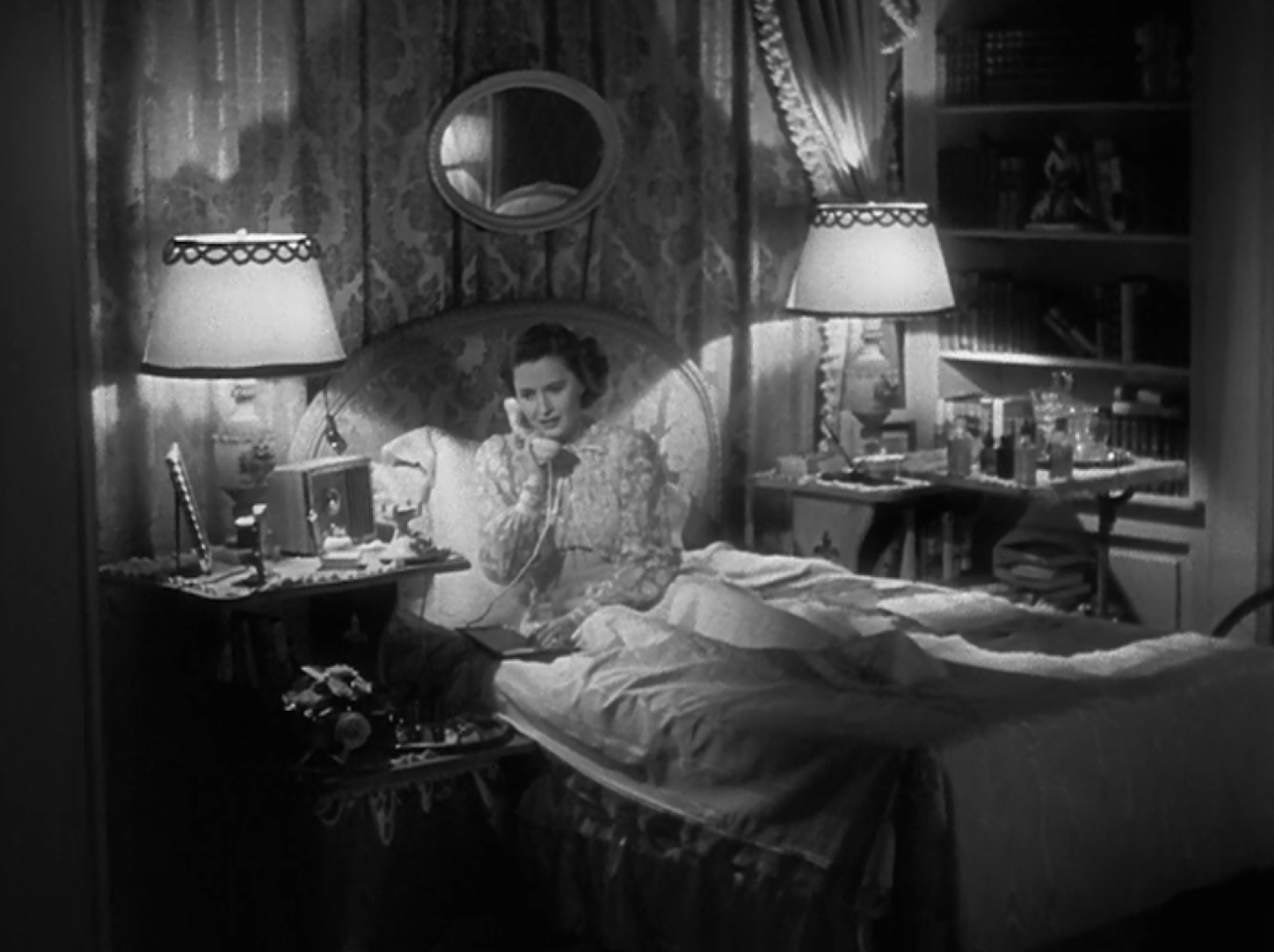
Leona Stevenson is the rich only daughter of a pharmaceutical magnate. She is also invalid, and in NYC from Chicago to consult with a doctor about her health issues. At the start of the fil m, it is apparent that her husband is avoiding her, screening her calls. His absence is even more gaping by the empty chair he leaves, which Leona addresses plaintively. In a stroke of (mis)fortune, she overhears two men’s plots to murder a woman at 11:15pm, with the time meticulously chosen so that the sound of the crime will be masked by a passing train. 

She reports it to the police and then her father, but both efforts fall on deaf ears. As she becomes increasingly agitated alone in the Manhattan apartment, she tries to locate her errant husband, only to inadvertently piece together the context of the phone call she overheard, which she involves her more than she’d care for.

One of Barbara Stanwyck’s four Oscar nominations for Best Actress, Sorry Wrong Number came out four years after her iconic turn as conniving seductress in Double Indemnity. Both are film noirs with a heavy sense of foreboding, but playing a bedridden character, her physical repertoire is limited here. Whilst she slinked around (who can forget that anklet and the way she shimmies down the stairs to show it off?) in Double Indemnity, she spends the majority of Sorry, Wrong Number fretting in bed. It’s a difficult role that only someone with the screen presence and acting guile Stanwyck is blessed with could pull off.

Graciously for her, she does get to stand up at some point in the film: a good proportion of the 
story is told via flashback. We discover how she and her husband (Burt Lancaster) met: he was actually at a dance with a girl called Sally Hunt, who plays an integral part in helping Leona piece together the clues. Leona, never having been deprived anything she wanted in her life, boldly makes a play for Henry. He’s initially put off by her entitled attitude, but, nonetheless, his head is turned by her wealth. Stanwyck conveys her character’s bratty attitude wonderfully: in one scene, she regards her husband with a contemptuous glance in that signature way Barbara Stanwyck looks people up and down. You mirror Lancaster's character's feeling of belittlement when it occurs.

Lucille Fletcher penned the script for Sorry, Wrong Number, which was originally a radio play by her. The translation is effective: few sets are required in Sorry, Wrong Number, and the art decoration of Leona’s grand but stuffy bedroom is conveyed excellently: she has expensive trinkets and bottles, but her loneliness is clear. The moral that money can’t buy happiness is an age-old one in cinema, but this message is conflated with another: money being the root of all evil, which motivates some shady actions by certain characters. Thus, the script, ahead of its time in this sense, touches on an almost Kafkian problem: the more Leona feels her husband pulling away, the more she tries to throw money in the problem, which in turn, makes him increasingly more detached towards her.

The cinematography dextrously plays with light and shade, true to the genre, to create ambiance and dread throughout the film. Also, in the vein of film noirs, there are few truly "good" characters (I would argue only Sally, Leona's former classmate who's love she stole in such a cavalier manner, is), and plenty of murky ones. Even our protagonist, who finds herself in increasing danger, is somewhat hard to take and completely root for, her arriviste persona accentuated by her plush wardrobe, multitude of expensive rings, and Stanwyck's virtuoso performance as a woman who refuses to see what's going on right under her nose, causing the audience to fear the moment the House of Cards will crumble.


The employment of flashbacks and the film being played in real time give Sorry, Wrong Number a real sense of urgency, and the protagonist being confined to their room gives them a powerless sense that makes this film a worthy predecessor to the more polished Rear Window. The beating heart of the film is Barbara Stanwyck; I can’t believe she never won a proper Oscar during her lifetime especially when frauds like Jennifer Lawrence and Natalie Portman have them! As mentioned, Leona is not likeable at all, treating other characters in the film as below her and talking down to everyone. Yet Stanwyck is able to inject sympathy into even an upstart like this! By the end of the picture, she has you rooting for Leona, warts and all.

The Academy gave her an honorary award in 1982, whilst she was still alive, though, for “For superlative creativity and unique contribution to the art of screen acting”, and that is exactly what she has, in spades, here. Without her, Sorry, Wrong Number would have been a fairly exciting film. With her, it’s a complete and utter thriller.

Monday, October 28, 2013

Review: BlackBerry Curve 8520

 photo SAM_0871_zps9f013f3b.jpg


Having trolled many a football journalist relentlessly with my trusted BlackBerry Bold, I got a taste of my own troll medicine when the damn thing died on me, and stopped working, with nothing but an error message. I followed the instructions on online, but to no avail, the old BlackBerry was well and truly busted. As such, I had to revert back to my pink Samsung Tocco, which had most certainly seen better days, and with it, couldn’t access the internet. I found myself texting my tweets, and come on, that is just so two thousand and late.

Deciding I could cope no longer without a Smartphone, I took my dad’s BlackBerry and got it unlocked for a tenner in Chinatown. It was contracted solely to Orange, but now I can use it, and, whilst it is inferior to the BlackBerry I had previously in pretty much every way, anything beats the three months of torture when I had to survive with a phone that… didn’t have internet on it.

Having used both a BlackBerry Bold and Curve, then, I feel myself to be somewhat of an authority in comparing and contrasting the two, like they’re two romantic era poems and I’m sitting an English literature exam. Well, my previous BlackBerry was definitely more stylish. It was more streamlined, weighed less, and just looked sexier in its case, whereas the Curve looks like a brick compared to modern smartphones.

Furthermore, whereas the keys on my BlackBerry Bold were linked together seamlessly and made practically no sound when I touch-typed on them, I have no such luck with the BlackBerry Curve, where the keys protrude, and each time you touch one of the plastic keys it makes an audible sound. Not good, especially at work when I’m trying to surreptitiously send a text without the bosses knowing.

The fact that the Bold was introduced later than the Curve is also apparent in the Curve’s deficiencies in functionality. On my Bold, I was used to going to sleep, being awoken by various alerts from Twitter/email/Facebook/WhatsApp/texts, and just hitting one bar to see them all listed together. We do not get this with the Curve, where instead I have to manually check each individual thing. It’s fractionally more time consuming, but it’s just the psychological element of being ~in control of mai social networks~~~; I miss being able to see everything, on one page, and deciding which I’ll choose to reply to first. Other downsides of the Curve? I can't download songs, I can't load webpages with too many graphics, and there's no such thing as a Favourites bar, meaning I have to keep wasting time selecting an icon when I need it. Grr.

There is, however, one aspect at which the Curve trumps the Bold, and it’s a pretty major one: battery life. When I had my 9790, I would have to carry the charger with me everywhere because the damn thing lasted about four hours, on a good day. It let to much faction with my parents, who like to know where I am EVERY SECOND OF THE DAY, despite the fact that I’m 23. With the 8520, I’m actually able to give them the façade of thinking they know where I am, as the battery is much more durable. So, for all my gripes about how uncool it is, when it comes to the basics, BlackBerry did good on the Curve.

My contract expires in March, and whilst the BlackBerry 8520 is perfectly functional, safe to say, I will be down the mobile phone at the crack of dawn to get an upgrade. It’s not so much that the phone is terrible, more, we are spoilt with the plethora of genius phones on the market. In 2013, something like the BlackBerry Curve simply doesn’t cut it anymore.

Grade: D

Tuesday, September 10, 2013

Two Short Book Reviews: CELL (Stephen King) and HICKORY DICKORY DOCK (Agatha Christie)

Cell (Stephen King)

A chillingly crafted novel channelling the dystopian world that unravels after mobile phones have the ability to send people into crazy killers, and how those who weren’t affected by “The Pulse” try to survive as the initially mindless “phone crazies” begin to get smarter. 
The protagonist Clay, is a likeable, resourceful guy who we can root for, and his sidekicks Tom and Alice, are good foils for him, interesting enough in their own right without detracting from Clay's voyage - to get to Maine to find his son. 
The story sometimes moves a little slowly, with Stephen King being particularly languid with Clay’s voyage, but there are shocks galore throughout the book, as well as dark laughs. Well-written with descriptions so vivid you could actually imagine this happening, this is a science fiction novel that even I could enjoy. Grade: A-

Hickory Dickory Dock (Agatha Christie)
Hercule Poirot gets up to another one of his adventures, this time, introduced to him by his assistant, Mrs Lemon. Mrs Lemon’s sister works at a youth housing centre, where things have inexplicably gone missing or been sabotaged. These petty thefts, however, are soon owned up to, but the perpetrator then appears to have committed suicide… or did she? 

As with most Agatha Christie, the joy isn’t in so much as the whodunit (though I never would have guessed, I was foiled again!), but in getting to know the characters, this time, the boarders in the hostel. Each have their idiosyncrasies and quirks, and it is to Christie’s merit that she pulled the wool over my eyes once again, and got me suspecting completely the wrong people. 

Grade: A-

For more of my book reviews, click here.

Monday, August 06, 2012

Review: BlackBerry Bold 9790

Before I got my BlackBerry back in April, I had had a Samsung Tocco for almost four years, a phone that served me extraordinarily well, but, obviously, having had it for four years, it was seeing the end of its days. 

I’m not hugely materialistic and into my labels so I would have gladly carried on using it until it stopped working (it was pink, my favourite colour, I liked the touch screen, and Samsung sponsor a certain football team which I believe I’ve quite fond of), but the sides were peeling off and my mum said she felt second-hand embarrassment seeing me using it. So my parents insisted on me getting a new phone, and I certainly wasn’t going to quibble with that.


In terms of aesthetics, I really enjoy looking at my phone. Some previous BlackBerries have been far too brick-like in their appearance, and their buttons have been clunky and completely unsexy. The BlackBerry Bold 9790 is both shorter and wider than an iPhone, so in that sense, not as sleek, but I genuinely adore the way they managed to fit a keypad on the bottom.