Showing posts with label newspapers. Show all posts

Saturday, November 04, 2017

Shade on the Orient Express.

Matthew Norman of the Evening Standard found Daisy Ridley's performance in Murder on the Orient Express forgettable. So much so, that he misidentifies her as another Star Wars actress:


This is a pretty egregious mistake, that any film critic worth their salt should not be making!

Thursday, September 07, 2017

The Times' review of MOTHER! (Darren Aronofsky, 2017).

Uploading Kevin Maher's review of the polarising Mother! because The Times has a paywall. (click on the image for enlargement)


Although I've not yet seen the film, the closing paragraph sums up the pseud that is Darren Aronofsky (a man who's work I've uniformly despised, bar the decent The Wrestler) remarkably well, I feel.

Friday, March 17, 2017

A Silent Microaggression.

You know, for a newspaper who loves to lecture their readership about racial stereotyping (in a case of timing you couldn't make up, just four days ago they ran this hectoring piece about Asian stereotypes), you'd think they'd bother to learn the difference between Japanese films:


The caption pertains to A Silent Voice. Yet the image is a still from Your Name. I guess all Japanese animes look the same to Guardian sub-editors.

Perhaps of Guardian writers focused on say, actually doing the research they're paid to do, rather than preaching piously or shagging about, they wouldn't have made such a mistake. Just suggesting.

This isn't the first time they've confused two compatriots, with embarrassing circumstances. In their tribute to the passed away Cruyff, they published a photo of Rob Rensenbrink:


No wonder The Guardian are begging for money now. #FakeNews

---

Bonus graphic, from The Evening Standard, which perfectly encapsulates my confusion on how Isabelle Huppert's icy tour-de-force in Elle lost to Yellowface Felicia dancing like she had two left feet:

Wednesday, March 15, 2017

Methink the lady doth protest too much.


Emma Watson has been working overtime recently in an attempt to quell rumours about her being too much of a diva to get the lead in La La Land, even saying 'I couldn't care less if I won an Oscar if I didn't feel the film I made said something'.

Whatever helps you sleep at night, sweetie.

Still, I guess she couldn't do La La Land, what with her busy schedule giving shite talks about white feminism.

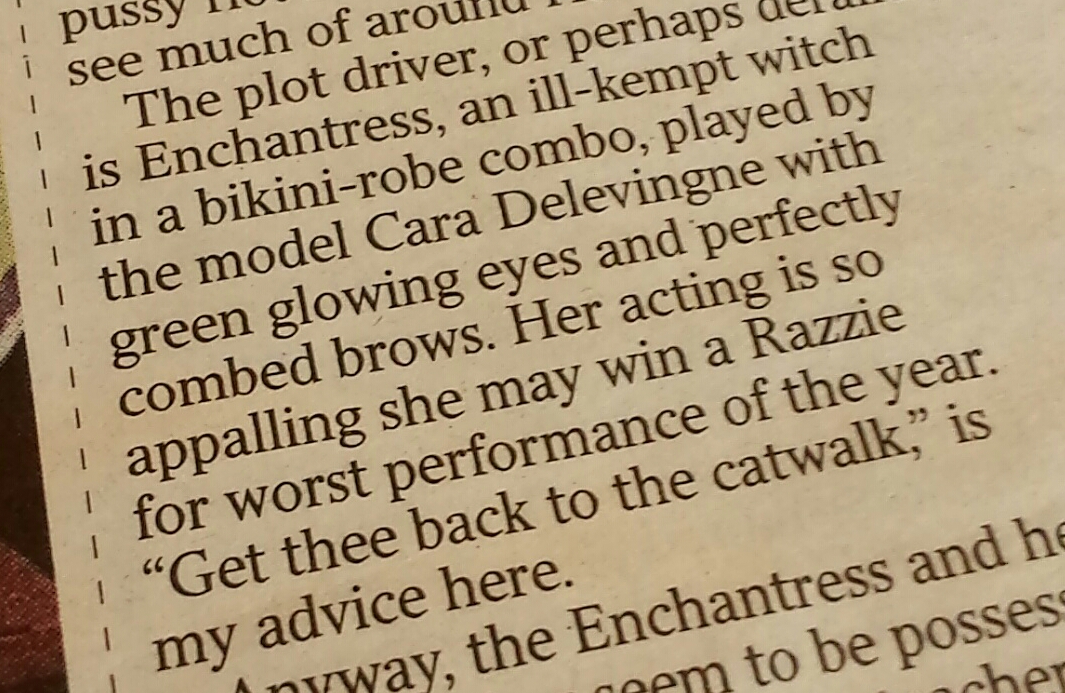
Another newspaper cutting that attests to my theory that Po-faced Watson is an absolute diva who is completely unabile to take a joke:

Wednesday, November 16, 2016

Fantastic Oscar-beggers and Where to Find Them.


Glaring mistake is glaring. Fantastic Beasts and Where to Find Them, starring professional awards-chaser Eddie Redcarpet, is a 12A, not a PG. Frankly, a PG certificate wouldn't be enough to contain all of Eddie's Oscar thirst and all of JK Rowling's virtue-signalling hypocrisy.

--

The BBFC replied to my email on Someone to Talk to, by the way. It's a lot more satisfactory a response than the one they sent me about So Young 2 Never Gone:


Dear Emma
Thank you for your email.
BBFC classification decisions are made in line with available research and our Classification Guidelines which are a product of an extensive public consultation process. This process is repeated every 4-5 years and over 10,000 people contributed to the creation of the Classification Guidelines 2014, which are available here. 
They state that: 'Portrayals of potentially dangerous behaviour (especially relating to hanging, suicide and self-harm) which children and young people may potentially copy, will be cut if a higher classification is not appropriate. '
The level of detail depicted in both films with regards to the suicide attempts is permissible at 12A. However the suicide attempt in Two Days, One Night is shown to have little in the way of consequences. The lead character is shown to gag but otherwise does not seem to suffer any ill effects. She looks serene and healthy in her hospital bed and the doctors seem unconcerned about any possible long term damage. The scene is therefore better placed at 15.
In contrast, the character in Someone To Talk To is shown weak but recovering in hospital. Suicide is not presented as an attractive option and so this content is permissible at 12A.
The references to suicide in Someone To Talk To start early in the film and occur throughout, becoming part of the theme of the work. They were not considered to be a 'spoiler' in that it's not an issue that suddenly and unexpectedly comes up later in the film. Also, given the prevalence of the references - which are not simply an isolated moment or element in the work - it was necessary to warn people about them, even more so because this is a 12A film on which parents may want clear advice.
We have an FAQ about spoilers on the black card on our website which explains our policy http://www.bbfc.co.uk/about-bbfc/faqs#insight-spoiler You may also be interested in Podcast Episode 20 which covers how the BBFC approaches classifying self-harm and suicide http://www.bbfc.co.uk/case-studies/podcasts/bbfc-podcast-episode-20-classifying-self-harm-and-suicide 
Yours sincerely
Joe
 BBFC Feedback Team
From this much better, detailed email, I've inferred that the BBFC spend more time on a query if you complain that the film should have been higher than it was, as opposed to lower. The speed at which they respond to you is almost halved, too - my So Young 2 Never Gone email took exactly 2 weeks to reply, the maximum time they stipulated, whereas this took just 8 days.

--

Finally, look who blocked me on Twitter:


(admittedly, a lot of my festering anger at this whole affair isn't just the fact that Vardy racially abused a Japanese man. It's the fact that he racially abused a Japanese man and esteemed football writers who purport to care about racism, like Henry Winter and Daniel Taylor, wrote sod-all about it).

#ByeFelicia

Tuesday, August 09, 2016

Tuesday, January 14, 2014

TV review: SHERLOCK series 3 (2014)


Few things have been waited for as eagerly as series 3 of Sherlock. The last time we’d seen the infuriating but brilliant sleuth, he’d hurtled to his death from the top of St. Bart’s hospital. Or had he? Through misdirection and false theories aplenty (including an amusing nod to slash fiction, which no doubt Mark Gatiss was mildly disturbed by when he first discovered, before choosing to use as a force to his advantage), the show’s creators Gatiss and Moffat finally revealed to us how the great detective did it, and it’s fair to say that the reaction of the general audience was that of being underwhelmed. 

Ignoring, for a second, just how muddling and convoluted it was, how many extra players Sherlock’s escape plan entailed, the thing that disappointed the most was the fact that the so-called independent, famously misanthropic man, had to enlist the help of his older brother to get him out of a quagmire.

That little quibble aside, the first episode of this season had a few treats, mainly in the form of Sherlock taking his sweet time revealing to Watson that he was still alive, at the worst possible moment: when Watson was about to propose. It was good to hear Molly had moved on from Sherlock, by getting herself a new boyfriend, though later, when he emerged, we realised we’d spoken too soon; the man looked like a bargain-basement Cumberbatch.

With all the characters being reunited, the plot sat on the back foot somewhat, and when Sherlock realised that the so-called “underground terrorist attack on London” was, quite literally, an UNDERGROUND terrorist attack, you weren’t terribly surprised. Especially when we’d been shown footage of a shifty-looking man wandering on a Tube, and then seemingly disappearing. As far as convoluted plots have gone, this wasn’t Gatiss’ best work.

If the first episode of the series disappointed, then the second episode truly flabbergasted with how poor it was. Every now and then, on a twenty-episodes-a-series show like Family Guy or Friends, the show’s creators will do a “whacky” episode; quirk for quirk’s sake. Due to there being 19 or so other regular episodes, we allow this one-off display of craziness. However, when there’s only three episodes a series of Sherlock, we’re led to expect high quality from ALL the episodes. 

Happily, we got this in series 2, where the three episodes - one introducing Irene Adler, one, a fantastic modern spin on the Hound of the Baskervilles, and the intense final episode with the showdown with Moriarty, both held our attention throughout. In series 3, the second episode’s main plot device was Dr Watson’s wedding, and, although there were flashes of brilliance, the majority of it was just ponderous.

Recently, I’ve been reading Arthur Conan Doyle’s original “The Adventures of Sherlock Holmes”. Bearing in mind that this was long before the era of iPhones, laptops, walkie talkies and the like, it really is enthralling to delve into the mind of such an old-school detective. Hints of Sherlock’s deductive prowess were shown in the first two episodes of series 3 of the TV show (for example, when he immediately susses that a lady’s internet boyfriend has gone missing, that it is the stepfather who was pretending to be him all along, that is based on the short story “A Case of Identity”), but, lamentably, series 3 seems more intent on carving him out better as a person than a sleuth. As such, he’s a more rounded human, but a less interesting character.

Redemption for series 3 came in the season finale, which was back at its finest, and like what we’d been used to in seasons 1 and 2, could work as a stand-alone watch. The storyline centred around a newspaper mogul, Charles Augustus Magnussen, played by the terrifically creepy Lars Mikkelsen, channelling Rupert Murdoch in his performance. We wondered if Sherlock had completed the full transformation into #human when he started dating Janine, a woman he’d met at John & Mary’s wedding in the previous episode. Graciously, it was just the Sherlock we all know and love, the cold, calculated man who tramples over people’s feelings; in this case it was because Janine was Magnussen mogul’s secretary.

There were shocks aplenty in the final episode, although seeing Sherlock in a crack den, for anyone who’s familiar with the book and his penchant for opium in them, was not one of them. The episode was unashamedly emotional, with the peak of the series’ writing coming when John tells Mary “The problems of your past are your business. The problems of your future are my privilege,” which is a Renee-Zellweger-in-Jerry-Maguire moment, if there ever was one. 

Whilst the writing this series was far from its best, Benedict Cumberbatch and Martin Freeman continued to be wonderful, and Freeman’s delivery of said line drew tears from this viewer. And, of course, the closing shot took us all aback. Gatiss and Moffat were reminding us that, for all the frivolity and second-rateness of episodes 1 and 2, Sherlock most certainly hasn’t lost its ability to entertain and gobsmack in equal measure.

7/10

To read more of my TV and film reviews, please click here.

Saturday, March 28, 2009

She flies like planes.

From the cover of an issue of The Guardian a while back -

Photobucket