Showing posts with label comedy. Show all posts

Thursday, December 26, 2019

Book review: CONFESSIONS OF AN ACTUARIAL TUTOR (John Lee)

As part of my job, I have to sit actuarial exams in tandem to working. I sat CM1 and CS1 in April, and CS2 in September (the M stands for Maths and S stands for Statistics). I have had the good fortune of having passed all three exams I sat this year (hence the rather extravagant Christmas present I got myself), but luck was only a small factor in why I was successful. John Lee, who’s expert tutelage I received for the two Statistics modules, played a huge part.

That's not him btw.

His new book, Confessions of an Actuarial Tutor, is a compendium of amusing things that happened to him in his ~20 years of teaching actuarial students. For anyone who’s ever met John, he writes as he speaks: a mixture of gallows humour, self-deprecatory banter, nerdy mathematical jokes and a sprinkle of that unique John Lee eccentricity.

Sunday, November 24, 2019

My 10 favourite films of 2018 [10-6]

I know, I know. 2019 is nearly complete, and I'm only now dropping the favourite films of 2018 blog? In my defence, I have to feel like I really endorse all the films in my top ten to merit writing a blog about them, and, for the most of 2019, I hadn't seen enough 2018 titles which inspired that level of passion.

However, having caught up with some of the titles that came out in 2018 that I wasn't able to catch then, you can now consider me sufficiently enthused! If you're curious about what my 10 to 6 was for 2017, click here (spoiler alert: some Chalamethirst is present).

10. Game Night


Max and Annie, a married couple who are somewhat uninspired by the monotony of their lives, find their weekly Game Night upstaged, when Max's brother Brooks gets fake-kidnapped. Or so they think. As they track him down, they begin to realise that he's truly in jeopardy, and Max, Annie and their group of friends must use their wiles, resourcefulness and knowledge of random trivia to save Brooks.


Sunday, March 10, 2019

OOTD: Okay ladies, now let's get in formation

Top: Primark
Earrings: Aldo
Glasses: Red or Dead

The larger-than-life hoops earrings are a homage to Taraji P. Henson as 'Cookie' in Empire. The next film Taraji's appearing in is the female reboot of  What Women Want, Want Men Want, and I will hopefully be seeing that soon! 

As a point of BBFC nerdiness, I find it interesting that the original Mel Gibson film was a PG-13/12A, yet the reboot is embracing the crude adult humour, and has gotten an R and 15, and even a 16 in Ireland. I'm guessing the film's producers have targeted the grown up audience following the success of Girls' Trip. If What Men Want is half as lulzy as Girls Trip, it will be a trip to the cinema well made!

Wednesday, August 08, 2018

Inbetween a 15 and an 18

This blog is rated 15 for strong sex references.

Every year, I like to analyse the BBFC short insight for a film, before I’ve even seen it. Last year, I nerded out to the BBFCinsight for Dunkirk, as it was an unprecedented case of four different adjectives for each of its classification issues.

The year before, I was excited because Suicide Squad got a 15, which is really unusual for a big studio superhero movie. Funnily enough, Suicide Squad’s short insight is actually subsumed in Dunkirk’s, ‘sustained threat, intense sequences, moderate violence, strong language’, yet Dunkirk is a rating lower.

Tangential, but Dunkirk has Harry Styles (a singer-turned-actor) and Suicide Squad has Cara Delevingne (a model-turned-cocaine addict). They used to ‘date’ each other. I daresay one was substantially more successful at acting than the other.


2018’s bout of ‘Emma critiquing the BBFCinsight of a film having not even seen the movie’ comes for the upcoming The Festival. For this film, Iain Morris and Damon Beesley, the creators of The Inbetweeners, collaborate again, as director and producers, respectively.


Wednesday, October 25, 2017

Happy Questionnaire Day.

Before I saw Happy Death Day on Saturday, representatives from Universal presented me with this survey which is, er, comprehensive, to say the least:


Needless to say, I didn't fill the whole thing in, but, Universal reps, if you're reading, I gave your film a 7/10. I thought it was nonsense, but unchallenging, enjoyable nonsense, anchored by a fine comedic turn from Jessica Rothe (the one in the green dress dancing behind Bugeyes in La La Land) and I also enjoyed the presence of Ruby Modine (aka Matthew Modine's daughter), who is very pretty, a decent actress, and testament to the good kind of nepotism (the bad kind being Cokehead Delevingne, naturally).

Also at the cinema, I saw this rather striking poster for My Little Pony: The Movie.


Wednesday, October 04, 2017

Film review: MY MAN GODFREY (Gregory La Cava, 1936)


Irene Bullock, a pampered Park Avenue princess falls for her butler Godfrey and is not used to being met with resistance as said butler gives his employers some much-needed schooling in humility in La Cava’s screwball comedy that dextrously traverses themes of love, class and humanity.


Thursday, July 20, 2017

When the BBFC TMIs.

Last week, my brother and I caught up with White Gold, a show about three wheeler-dealer window salesmen in Essex in the 80’s, on iPlayer. Written by one-half of the team behind The Inbetweeners and featuring two of the four lead actors from the show, it’s also about half as good as The Inbetweeners.

The main issues with the show were that it tried too hard to be funny, and Ed Westwick (Chuck Bass from gossip girl)’s character was a deeply smarmy, dislikeable bloke. I think the cover of the DVD pretty much tells you all you need to know about this show:

I miss Simon Bird. So much.


Saturday, June 10, 2017

NowTV's completely inaccurate listing of BBFC ratings.

I won a month's NowTV subscription from McDonald's Monopoly, which is super-handy as they have a bunch of shows and boxsets on there.

Prior to consuming the shows, however, I couldn't help but notice how off they were with the BBFC ratings of some of the shows:

Modern Family is a family show, who's episodes go up to 12, tops! Where on earth did they get the 18 from?


How I Met Your Mother and Delicious have episodes that are 15, but that's it.

Based on these three inaccuracies, I wondered if NowTV's default was just to autopilot everything as 18. But they get the show's rating wrong by rating it a lot lower than it should be, too:


And finally, it wasn't easy, but I found a show for which NowTV accurately listed the BBFC rating:
------

Nerding out over the BBFC is my thing, chaps. Check out all the other posts I've done on them here.

Friday, April 21, 2017

Are you sure, BBFC?

My Sex and the City season 5 DVD featured one of those old school-style BBFC boxes which I would argue was downright incorrect:


A show called 'Sex and the City' which revolves around the sex lives of four women contains infrequent sex references?? And just sex references, but no sex scenes?

The BBFC examiners for season 5 must have switched off for the entire boxset and just (lazily) churned out a report at the end.

----

Friday, December 16, 2016

Films and TV shows that have been rated 15 with absolutely no 'strong' components.

This blogpost will be continually updated with screenshots, film posters and back of DVDs that contain a fairly uncommon occurrence: things rated 15 for merely 'moderate' things.

Monday, November 28, 2016

My BBFC game (level 2).

Simon won the first level, congrats geezer!

Now I've made it a bit more taxing. As with the previous round, don't cheat and go on the BBFC website, that sucks the fun out of it. :P But by all means google the plot synopsis as that could help (altho some search engines show you the rating when you do that, hmmm).


Tuesday, November 15, 2016

Film review: LE FANTÔME DE LA LIBERTÉ (Luis Buñuel, 1974)


The third and final film of Luis Buñuel's triptych of movies which feature little plot and a lot of visual sight gags, Le Fantôme de la Liberté neatly ties off what La Voie lactée and Le Charme discret de la bourgeoisie started. Like the other two films, Le Fantôme de la Liberté consists of short, surreal sketches that follows a series of peripherally connected characters are their lives are peppered with all manner of curio, and in the name of decorum, the characters are completely blasé these bizarre occurrences, which just makes them weirder.

A creepy man distributes photographs to young girls. We assume these to be seedy, as he tells them to show friends but not parents, and indeed, when the parents discover them, they are disgusted. But the pictures actually turn out to be nothing more than photos of historical landmarks. Later, another little girl, declared missing, is actually present and well, and at the police station to aid an officer as he fills in her missing person report.

A chap who kills passers-by is hailed as some kind of celebrity at his court-hearing, with adoring fans begging for his autograph. A group of monks are invited to dine with a couple, who all of a sudden strip into latex and embark on some whipping in front of them. And perhaps most startlingly, a group of bourgeois families sit together at a dinner table to go to the toilet in each other's presence, occasionally excusing themselves to go into a private room, to eat.

There’s cinematic badinage of Le Fantôme de la Liberté boasts far greater variety than the other two films in the trio. Buñuel’s ability to synthesise them all into a collective unit illustrates his adroit ability to deliver narrative, even in an oeuvre that largely lacks one. The sight gags are wittier, and the film revels in its bizarreness, which means the audience doesn’t feel any obligation to invest themselves in the plot or the characters, which I have done in previous films, only to have the rug pulled from under me, and thus, felt frustrated by the director.

Possibly an artefact of 1972’s Le Charme discret de la bourgeoisie picking up the Foreign Language film Oscar, Buñuel’s follow-up is far less accessible and crowd-pleasing. But I preferred Le Fantôme de la Liberté precisely because it lacks a slightly grandstanding element that its predecessors have. Le Fantôme de la Liberté definitely feels like one of his most personal works, despite (or because?) of all the degenerates you meet in it. 

The fact that there isn’t a specific target of satire as La Voie lactée and Le Charme discret de la bourgeoisie had (Christianity and the middle class, respectively), per se, rather that free will, a much more abstract idea is the object of this film, means the director has far more scope to unbridle his anarchic vision upon. The episodes he confects span humour that ranges from the bizarre to the sublime.

While the plot sprawls, there is nothing ad-hoc about Buñuel’s tight direction, with each unsettling vignette modulating into the next with such fluidity that before the audience have time to dwell too deeply on the previous story arc, they’re immersed into a new one.

The main thesis of these chaotic scenes, that humans are predominantly irrational agents, and personal autonomy is purely a hoax, is intriguing; a theory given more resonance in the wake of ongoing current affairs. 

8/10

---

I've now reviewed all eight DVDs in my Buñuel box set. Read the others here.

Wednesday, November 02, 2016

Film review: LE CHARME DISCRET DE LA BOURGEOISIE (Luis Buñuel, 1972)

6 members of the French upper-middle class find that their best-laid plans to dine together are repeatedly and frustratingly scuppered, whether it be due to misunderstanding over the date, French army officers inviting themselves to their meal or suddenly getting arrested. Some of the most bizarre scenarios are revealed to be dream sequences in Luis Buñuel's Oscar winner of Best foreign film.


From the outset, the characters at the centre of Le Charme discret de la bourgeoisie are an attractive, urbane bunch, who converse on the finer things in life are of good scruples. But the audience's perceptions are quickly shattered. One casually deals drugs whilst bedding his mate's missus. A couple, the Sénéchals, shimmy out of the window to have sex in the garden whilst ignoring their guests.

Buñuel obviously had a rollicking good time exposing the false dichotomy between the bourgeois and the proletariat that they so smugly like to compare themselves to, and for the most part, his film is enthralling to follow. A little more clarity of focus might have rendered this a more complete watch; some of the dream sequences are nested within dreams of other characters, but finding this out merely adds to the confusion rather than answering any narrative questions.

It's highly probable that the many and varied sequences in Le Charme discret de la bourgeoisie wasn't supposed to make sense to the audience, and that the true interpretation of the movie is to be teased out on repeat viewings. If the watcher is to be merely amused and entertained,  then, Buñuel has certainly accomplished his goal. He sends the middle class up with far more flair and nuance than he poked fun of Christianity in La Voie lactée, not least because the vignettes in that film depicted characters that felt strawman-ish, whereas in Charme discret the funny parts are generally underscored by truth.

Surreal touches pepper the film. Fernando Rey (Tristana, That Obscure Object of Desire) is a diplomat for a fictional south American country, the Republic of Miranda, but, like the equally fabricated TV towns of Pawnee in Parks and Rec and Agrestic in Weeds, the country is evoked with such detail when characters discuss it, that the audience could easily believe it were a real place. A maid, played by an actress who couldn't be a day over 30, nonchalantly declares she's in her 50s, and no-one bats an eyelid. And, when hearing his wife is in his best friend's bedroom, the culprit coolly tells him to go wait in his car, and his missus will be out later.

In between displays of the director's signature playful dramatic irony, Le Charme discret de la bourgeoisie juxtaposes some disturbing imagery. These arresting scenes of corpses haunting various people now look a tad outdated by 21st century cinema's tendency to depict gore on a hyper-realistic level, but it's because they're so out of the blue and jarring with the rest of the film's comedic tone that they manage to retain power.

Overall, Le Charme discret de la bourgeoisie should be approached with caution; its wacky exposition and unconcern with tying up the plot won't be to everyone's tastes. But if you stick with it, it's a truly surprising movie, that will tickle and unnerve you in equal measure, and as a thesis on the power of dreams, it's a hell of a lot more gripping than Christopher Nolan's overrated Inception.

7.5/10

-----

This review marks my seventh of the eight DVDs in the Luis Buñuel boxset. Read my reviews of the other films I've seen of his here.

Friday, October 28, 2016

Film review: LUCK-KEY [럭키] (Lee Gye-beok, 2016)


Jae-sung, a struggling actor (Lee Joon) who is about to take his life, seizes an opportunity when he spots Hyong-Wook (Yoo Hae-jin), flash hitman who has slipped on a bar of soap and made momentarily unconscious, by switching locker keys with him and assuming his identity. The 32-year-old out-of-luck actor enjoys Wook's wealth whilst the older man, with a lost memory and only the insurance card of the man whole stole his identity, tries to figure out who he is.

The set-up means there are visual gags and situational comedy aplenty as Hyong-Wook realises he has supreme martial arts skills, but, rather than using them to kill, carves a range of creative foods at the restaurant he acquires a job at. There are hints of Trading Places in the stark contrast in the way Hyong-Wook and Jae-Sung live; one having rolls of cash stored in biscuit tins and the other living in squalor, with the equivalent of two bucks to his name. However, the film doesn't delve too deep into  examining its social conscience, deciding instead to enjoy the farce instead.

As the plot develops, both men acquire love interests. Jae-Sung develops feelings for Eun Ju, the woman Hyong-Wook was tracking, presumably his next hit, whereas Lina (Jo Yoon-hee), who took care of Wook after his accident, is the one who gets him the restaurant gig, and supports him when he decides to pursue an acting career (in a classic case of dramatic irony, Wook meets Jae-sung's father, believing that he's his dad, and Jae-sung's father speaks dismissively of his actual son's unimpressive acting career, giving Wook the necessary resolve to become famous).

Although Eun Ju's character is relegated to the damsel in distress trope, Lina is winning as Wook's love interest, and the two share a great, tentative chemistry. The parallels with OldBoy, in that a supportive female helps the protagonist try to work out their mazy past in a Korean film, was not lost on me, although Luck-Key was a substantially fluffier watch than OldBoy. By giving the two characters romantic subplots, it grounds them and gives them motivation for their actions, motivation that Jae-sung, a deadbeat who was contemplating suicide at the start of the film, could do with. 

Hyong Wook's adventures as an actor are comedy gold, and the film manages to traverse all manner of humour around the shooting process, some refreshing, some more clichéd. Hyong-Wook's adeptness in a fistfight catches the eye of the director, much to the chagrin of the divaish star of the show, a story arc that has been covered many times before, but given a Korean spin, still has legs. I also giggled as one of Hyong-Wook's competing actors, at the start of the process sensing he's fresh meat, tries to trip him up, but then, as Wook's star factor rises, he tries to coattail off his glory.


The other three leads are perfectly functional in their roles but Yoo Hae-jin is the shining star of the film, and it's not for nothing that Luck-Key revolves around him. A veteran of South Korean cinema, his character goes on a voyage that has him modulating between suave bad-ass, inept extra in historical movies, and bemused leading man, and Yoo Hae-jin excels at not only bringing plausibility to every wacky plot turn, but also imbuing Wook with an honest everyman quality that the audience will find endearing.

Overall, Luck-Key is a polished, charming film, with a neat subversive twist at the end that I didn't anticipate and more than enough chuckle-raising moments to keep the audience's attention until then. The fight scenes are well-choreographed and the big set-piece at the end was surprisingly gripping. Furthermore, for all the film's mockery of actors, it definitely has a soft spot for films, as hinted at by the affectionate closing credits.

Several have tried to balance comedy, drama, romance and action, and precious few of pulled it off. Luck-Key can count itself one of the lucky ones.

8/10

--

If you enjoyed my review, check out the others here!

Sunday, October 23, 2016

Film review: LA VOIE LACTÉE [THE MILKY WAY] (Luis Buñuel, 1969)


Luis Buñuel'a irreverent send-up of Christianity sees Pierre (Paul Frankeur) and Jean (Laurent Terzieff) embarking on a religious pilgrimage from France to Santiago de Compostela in Spain. Along the way, they come a series of unexpected events, from walking in on a ritual from a secret sect, being asked to moderate a duel, and a chance meeting with the Grim Reaper.

La Voie lactée's surrealist elements and indictment of Catholicism render it classic Luis Buñuel, but  neither of these two components were employed terribly effectively. As in Tristana, I found the dream sequences distractingly low-quality, and because the whole file had a trippy vibe, it was difficult to delineate the fantasy sequences from the actual storytelling. The cutaways didn't add anything to the narrative, and, perhaps because I'm treated due to shows like Family GuyI usually expect my cut-aways to be, you know, funny. Here, they were met with a *tumbleweed*-style reaction.

The Catholic Church offers ample material for mockery, and having their teachings torn apart, something that Pedro Almodóvar does effectively in several of his films. He achieves it by writing characters such as a shady priests into various stories (e.g. La mala educación), and then allowing the plot to unravel as the hypocrisy and corruption of said characters are exposed. That way, the audience sees these people for the monsters they are, whilst recognising their religious background played a formative role in this. We have been shown, rather than told.

But in La Voie lactée, the speeches delivered by characters in this film by preachers and brainwashed kids, written in such an brazen way so as to make the deliverers look stupid, felt like the audience was being spoon-fed to laugh at these characters and ridicule their beliefs. The contradictory things they were spouting were too out there and nonsensical for it to be plausible that the character believed in what they were saying.

The closing titles of the film, which laid out all the problems with religious dogmas, epitomises Buñuel's heavy-handed approach:  if the film had done its job properly, the audience should already know this. They wouldn't need it rammed down their throat. This complete lack of nuance meant I was, lamentably, not able to enjoy this film as much as I would have liked to. (I like ridiculing religion as much as the next person!)

However, as with previous Buñuel titles, I was still amused by the film, and scenes which were darkly comic and the audience unsure whether or not to laugh meant we were kept on their toes. One vignette, where a woman lies on the cross and has her hands pinned to it like Jesus Christ, was visually discreet but made an arresting impression. And the benefit of having so many short scenes, pieced together in a sketch-like way, meant that the viewer was at least, never bored.

I wouldn't classify La Voie lactée as Buñuel's best work. But it's a curious entry into his filmography that his aficionados might derive more enjoyment from than I did. 

6/10

--

If you enjoyed this review, the rest of my reviews are here!

Saturday, October 08, 2016

Film review: MISSION MILANO [WANG PAI DOU WANG PAI] (Wang Jing, Jing Wong, 2016)

Wang Jing and Jing Wong's painfully unfunny spy spoof sees Andy Lau's Interpol officer Agent Sampan Hung joining forces with Huang Xiaoming's playboy entrepreneur to retrieve a 'Seed of God' which has been stolen from them by a shady Japanese crime syndicate, Crescent. Their mission sees them bounce from Macau to Milan before ending up in eastern Europe. Along the way is all manner of comedy of errors as the directors and writers try to desecrate the memory of all decent spy films by pastiching them, woefully.

I was intrigued by Mission Milano, mainly because I noticed that the broadsheet papers, which review about ten film releases a week, didn't review this title. Having watched it, I can see why. This is one of the cheapest, tackiest films I've ever seen. It's an OTT satire, and thus, the audience are not supposed to take things too seriously. I'm not sure the cast and crew are supposed to heed that advice so rigorously, though. Characters have a nonplussed look on their face for the majority of the film, even when a knife is pressed up against their faces. The props alone would give any Hollywood set director nightmares; even the knives which get thrown around look plastic!

There's a big case of 'you don't know what you're doing' which indicates that the film could have done with a European script consultant. The film title pays homage to Milan, an Italian metropolis. Yet the Bond-inflected score which runs throughout, has a distinctly Spanish flavour. Furthermore, one of the scenes is supposed to take place in AC Milan's final. Due to budgetary restrictions (something which is all too prevalent throughout the film), the filmmakers were unable to properly superimpose footage of such a busy match, and instead show shots of the football-going crowd that is half empty. AC MILAN'S FINAL WOULDN'T BE HALF-EMPTY, YO!!!

I'm sympathetic to the fact that Chinese films don't get the eye-watering funding that their Hollywood counterparts do, so they can't compete with them on elements like CGI. But if that's the case, Chinese film companies shouldn't strive to be making films like this, which require extensive amounts of CGI, and thus nakedly reveal the gulf in quality of special effects in American and Chinese movies. When there's a disconnect between ambition and means, the result is Mission Milano.

The cast are all pretty awful, save 16-year-old Nana Ou-Yang, who has the fresh-faced naiveness of an oriental Hailee Steinfeld, and was winning in her scenes. I don't blame the flat acting so much on the cast, as I do the thinly sketched / inconsistent characters. For example, Andy Lau's Agent Sampan is supposed to be a hard man and a suave lady's man, all in one (massive Bond rip-off). Yet at inopportune moments, he's found longing over his ex-wife. This isn't even a Casino Royale case of cause-and-effect, where his character is crusty because he was burned in the past. The film wants him to be both sensitive and frosty at the same time.

I would be lying if I said I was stony faced for the entire 102 minute running time. There were several occasions when I let out a splutter - often of disbelief at how much they were insulting the audience's intelligence with such a gaping plot-holes, and when the writers ran out of spy movies to send up, they turned to Star Wars, which took me by surprise. There were some cheap visual gags which tickled me, including a weird seduction sequence featuring some toe-sucking which quite frankly, I was amazed the BBFC passed at 12A (not the first time the BBFC have dubiously classified a 2016 Chinese film, now is it?). But overall, this is mindless,  tonally uneven, low-rent film making.

Barely anyone will see this film (there was only one other person in the audience other than me). And that's how it should be.

4/10

Saturday, September 10, 2016

Sausage Party should NOT have been rated 15!!

Urgh, Sausage Party.


I wasn't the biggest fan of this film (5/10 for me), which is somewhat surprising given I love crude, non-PC humour a la Family Guy, and the Hollywood cast behind it was eye-watering. But I found SP ludicrous, try-hard, thinking itself cleverer than it was, as well as committing the cardinal sin of comedies: being unfunny.

The dialogue, for starters, felt forced, like they were trying to beat some record for the amount of f-bombs in a movie. The screenwriters inserted 'f_ck' into almost every line of dialogue and as such, it lost its impact. It also led the script to feel somewhat clunky; contrast that to the swearing in Martin Scorsese movies. In some of his films, the curse words come thick and fast, but you buy it, because it feels organic, and part of the character and the way they speak. With SP it just felt like they were trying to be edgy.

I didn't laugh at many of the jokes. I thought the scope was too ambitious - trying to cover racism, religion, and analogising each race to foodstuffs (how utterly groundbreaking), as well as having an underlying story about sausages discovering the truth about what happens to them. The weird plunger who kept wanting to get revenge on Seth Rogen and Kristen Wiig's character was creepy A F, didn't like him.

But I'm not here to rant about Sausage Party. It's doing well for itself at the Box Office, and you can't begrudge Seth Rogen and Evan Goldberg for that. What didn't do it for me, is clearly doing it for many other cinemagoers.

No, I'd like to discuss how on earth the BBFC gave Sausage Party a 15 certificate. There are two main classification issues that I thought should have taken it to an 18.

1. The male-to-female usage of the c-word
in the following discussion, when I refer to 'cnut', I'm actually talking about the word with the n and the u switched around.

The f-word itself is not enough to elevate a 15 to an 18, no matter how many times you say it. And you can actually say 'cnut' quite a few times in a 15-rated film (from the BBFC podcasts, I believe the record number of c-words you can say is seven or eight), depending on the context. 

But single uses of the c-word can lift it from a 15 to 18. I'm thinking of Sleeping Beauty, not the Disney classic, but a dark tale of a girl who lets men pay her to do whatever they want to her whilst she's asleep. There were three issues contributing to the 18 certificate there, but if you read the report I linked, one of them was an 18-rated use of the c-word, which was directed aggressively towards her whilst she's asleep. There's another such anatomical use of the c-word, directed from a man to a woman in François Ozon's similarly themed Jeune et Jolie, also an 18.

So the BBFC are pretty squeamish about male-to-female uses of the c-word, because of the misogynistic overtones, as well as the fact that men are generally taller and stronger than women, so the utterance of the c-word adds to an element of 'imbalance of power'. One episode of Californication was thus put up to 18 because a lady was called a 'f_cking cnut' by a drunk man because she accidentally bumped into him.

Similarly, one of the two issues that got Gone Girl its 18 rating was when Ben Affleck calls Rosamund Pike a 'f_cking cnut' repeatedly, to which she replies defiantly, 'I'm the cnut you married'.

Off the top of my head, one film which was passed 15 despite containing a male-to-female usage of the c-word is in Frank, when Domhnall Gleeson calls Maggie Gyllenhaal one. But that scene is resolved immediately in a comic manner to show that she hasn't taken offence, quite the opposite, it's turned her on, and in that case, the impact is greatly reduced.

Anyway, back to Sausage Party, which contained three uses of the c-word. Two of them were uttered by Edward Norton's bagel, and he's either referring to himself or another man, so they didn't bother me. His character has ongoing beef with a lavash called Kareem (Seth Rogen's laboured metaphor for the Israel/Palestine conflict), so one of the c-bombs was him calling Kareem that under his breath, pretty expected.

The third c-word, however, said near the start of the film, is delivered by Jonah Hill's sausage about Kristen Wiig's bun, after she's shown him up in front of everyone. He turns to Seth Rogen's sausage (Wiig's boyfriend in the film) and says 'Dude, um, how do I say this to you gently? But your girlfriend, um... She's a fucking cnut.'

Sidenote: we already know Jonah delivers the c-word with relish:


Given all the examples I've just given of films taken up to 18 because of male to female uses of the c-word, and what the BBFC repeatedly state themselves on their podcasts (which I have listened to over and over many a time on my commutes, how do you think I can just reel off examples off the top of my head?), a man screaming the c-word at a woman is likely to take the film up to an 18.

I get that Jonah's sausage didn't scream it in this scene, and he was also saying it about a woman rather than to her (although she was within earshot) but the matter of fact way in which he said it, the fact that misogynistic abuse was being played for laughs, meant that the BBFC should definitely have thought about the suitability of such language within a 15-rated framework.

2. The orgy scene
Firstly, I totally get that you can show quite a lot of sex in 15-rated films. Blue Valentine, Monster's Ball and Black Swan are held up by the BBFC as the upper bounds of sex that will be allowed in a 15; the former two flirted with the Kiss of Death rating, the NC-17 in the States, yet didn't even get the highest 18 certificate here.

(Interestingly, La mala educación, which, whilst being nowhere near Pedro Almodóvar's most explicit film and comfortably placed at 15, got NC-17 in the States. This is because the MPAA rate homosexual love scenes with a different yardstick to heterosexual ones, something that the BBFC, who treat all sex scenes equally, don't. Basically, the MPAA be hella homophobic).

The reason Blue Valentine and Monster's Ball had their sex scenes rated 15 despite being quite long and featuring mechanical thrusting motions, is, as argued by the BBFC in their podcasts, the crucialness they play to the plot of the films, as well as both movies featuring sex in the framework of a loving relationship.

It is for this reason that the BBFC are stricter on group sex scenes, even if the detail is minimal. The last Lindsay Lohan movie I saw, the 18-rated The Canyons, contained a ménage à quatre scene, but although there were some impressions of what was going on, it was so dimly lit that all you saw were shadowy movement. Because the shapes were so dark and vaguely made out, this group sex scene lacked the intimacy of something in, say, Blue Valentine.

Similarly, Straight Outta Compton: Director's Cut was rated 18 (the theatrical cut was a 15) due to one such scene, even though the BBFC's Irish counterpart, the IFCO, rated the Director's Cut a 15, and the Irish film board, whilst matching the majority of the BBFC's decisions, tend to be harsher with sex scenes overall. For example, some of the sex scenes that the BBFC allow at 12, the Irish rate 15. This tells me that the content of the Straight Outta Compton: Director's Cut scene couldn't have really been that strong, or else the Irish would have followed suit in rating it 18.

So the BBFC are more permissive than their Irish counterparts on sex overall, if it's within the framework of a couple doing it, whether it be man/woman [Never Let Me Go is a 15 in Ireland, 12 here], man/man, or woman/woman [Black Swan is an 18 in Ireland]), but stricter on orgies. Fair enough, every film board is different and operates by their own protocol.

So, why, then, if a sex scene involving more than 2 people usually gets a film an 18 certificate, was Sausage Party a 15?!?!?!?!?!

I lost count of the amount of members of the supermarket foods orgy scene, but there were a hell of a lot more people involved than just 2, and the detail was graphic, there was no ambiguity about what was going on, and the mechanical detail, in terms of sexual outlets was crude and nasty.

I was traumatised by that scene. The audience around me loved it, laughing their heads off at every frame, but honestly, I just thought it was tacky. And like I've said before, it's hardly like I'm epitome of highbrow; I usually find crude humour hilarious. But this was too much. And definitely too much for a 15 certificate.

I know the BBFC will just say that 'oh but it was with animated foods, it's not like it's humans' , but these foods are given anthropomorphic (foodthropomorphic?) qualities, so that argument doesn't really wash with me. They had arms, legs, faces, voices, and quite clearly, sexual libidos. To palm the explicitness of that sex scene off as 15-material just because they were cartoon sausages and buns is irresponsible, and irresponsible is not a word I often throw at the BBFC [I usually think they're too cautious].

Long post was long, I know. But Sausage Party should not have been a goddamn 15. I'm sure Seth Rogen and Evan Goldberg would have embraced the 18 certificate had they been given it, and taken it as a badge of honour in terms of what it said about the film's filth. Because it was filth, and 15-17 years old should not have been allowed to see it.

--------------


maybe I just wrote all this because I watched Sausage Party almost exclusively for Jonah Hill (just like the cartoon pictured above), and the film was ultimately disappointing. Here's hoping that Kubo and the 2 Strings, which I'm watching tomorrow for Rooney Mara, won't follow in SP's crappy footsteps.

Friday, August 19, 2016

Film review: DAVID BRENT: LIFE ON THE ROAD (Ricky Gervais, 2016)

15 years on from the BBC's mockumentary covering Britain's thirstiest boss, Brent is Back. Except, rather than back in the domain of being a Regional Manager, he's now a sales rep for Lavichem, a toiletries distributor. His heart, however, doesn't lie with tampons; he wishes to make it as a rockstar. So, impetuously and not at all financially judiciously, he cleans out his pensions fund to pay four musicians, an aspiring rapper Dom (Doc Brown, aka Ben Bailey Smith aka Zadie Smith's brother) and a sound engineer to go on tour with him as the band 'Foregone Conclusion'. A three week tour around Berkshire, to be precise.


As a big fan of the TV show, I was expecting cringe and situational comedy aplenty in David Brent: Life on the Road, and to that end, the film certainly delivers. Probably a little too much so. Brent's self-funded tour is, not surprisingly, a complete crash and burn. The four musicians can play their instruments and the sound engineer (played by Tom Basden) has experience aplenty, but no amount of aural wizardry could come close to atoning for the sheer egotism of the band's frontman.

Brent's delusions of grandeur, thinking he's singing about matters of substance (from racism, to disabled people, to the plight of the Native Americans) is toe-curdingly embarrassing. The cringe factor is compounded by his complete lack of self-awareness, and the earnest look on Brent's face as he delivers lyrics like 'they fly like an eagle, sit like a pelican' about the Native Americans. As audience numbers dwindle and Brent's sense of isolation kicks in, he actually has to pay his bandmates just to have a pint with him. It's mortifying, and where there should be laughs, we're just feeling unease.

But there's now a glossiness to David Brent: Life on the Road that betrays the films' TV roots. The film looks like a film, what with overhead tracking shots and excellent sound design (which must have been down to Gervais wanting the best possible platform to exhibit his pipes). But in having good production value, the intimate air that the TV show has been lost. And, even more of an issue, because the film uproots Brent to a new company with a new group of colleagues, you're not able to engage with them in the film's 90 or so minute running time.

For example, David Brent's only friend at Lavichem, Nigel (played by Phoneshop's Tom Bennett), admits that nobody really gets him, and hence why he and Brent gravitate towards each other. His social clumsiness make him a sitting duck for the rest of the office. It's not nice watching him get bullied, particularly as he definitely isn't an ill-meaning person, and I feel more character development on his part would have made the movie a more satisfying viewing experience.

The fact that Nigel doesn't get to come into his own and is relegated to the role of a sideshow is because this film, quite clearly, revolves around Ricky Gervais David Brent. Gervais writes, directs, stars, and, much like his cinematic counterpart, he can't stand it when the spotlight isn't on him. The fact that Gervais' most authentic acting in David Brent: Life on the Road was the scene in which  Brent jealously watches Dom, the rapper he 'befriends' (mainly as a get out of jail-free card for his un-PC jokes) rapping to the adulation of a crowd, speaks volumes.

Still, credit to the supporting players who are still able to make an impact despite their paltry screen time. Ben Bailey Smith captures the viewers emotions perfectly in terms of his reaction shots to each of Brent's misguided quips, and his rapping style is understated but incisive; the perfect foil to Brent's bloated singing style. Tom Bennett genuinely moved me as Nigel. His character has a bit of Mackenzie Crook's Gareth's zaniness, a bit of Martin Freeman's Tim's quiet compassion, as well as injecting a third element, of the overgrown schoolboy who sadly never outgrew getting picked on. And finally, Tom Basden, as Foregone Conclusion's Sound Engineer, is a dignified presence throughout the film, his low tolerance for Brent's crap gradually softening as his watches him go through degradation upon degradation. 

These three British talents are good factors that contribute to the quality of David Brent: Life on the Road. But what stops the film from achieving greatness is the sheer, unrelenting narcissism of Gervais. This was never really a film that needed to be made; The Office's co-creator, Stephen Merchant's absence on this film speaks volumes. Like Finding Dory, the superfluous sequel that should never have been made, this film is overkill.

The Office Christmas special was the perfect time to end it, because it balanced tying up story loose ends with long-suffering characters getting some well-earnt redemption. I really cared about Tim and Dawn. By the end, I'd even cared about Gareth. But I didn't care about David Brent a fraction as much as Ricky Gervais wanted me to, and tries to get you to, working overtime, in this film.

Because his affection for a character he created is not mirrored by the audience, after a while, the novelty of watching Gervais play himself wears thin.

There's a sequence in the film where David Brent pays for a photoshoot, where he goes through all the masturbatory notions of gazing into the camera in all manner of provocative poses. Brent really fancies himself a lead singer in a band.

Despite all the humiliation, the awkward silences and the tiny crowds throughout the film, it's quite clear that so does Gervais.

6/10

Wednesday, August 17, 2016

My 10 Favourite performances of 2011.

The only year of my backlog left to go. The force of playing favourites in this list is strong!

 10. Jennifer Aniston, Horrible Bosses
A nympho boss from hell, but Aniston's clearly had  blast taking on the role and the fun of that made for a very fun performance. And I never thought I'd see Rachel from Friends say such filthy things!

09. Jessica Chastain, The Help
I also loved Jess in Tree of Life which came out the same year, but as that's my second most despised movie ever after American Hustle, I listed her for this. Jess (I call her that because I like to pretend to myself that I'm BFFs with her) is a freaking chameleon!

08. Saoirse Ronan, Hanna
Obligatory mention of the best young actress around, whom I've been a loyal fan ever since I watched her as meddling Briony in Atonement. Here, she teams up with Atonement's director again to give a chilling portrayal of a girl who's been trained to be an assassin from birth. 

(Pointless trivia that only I find interesting: the director in question, Joe Wright, was engaged to Rosamund Pike (who he met on the set of Pride and Prejudice, where she played Keira Knightley's nice sister Jane, until Joe dicked her about. From interviews, Rosamund appears to have taken this in her stride and gotten on with her life. I'm disappointed she didn't Gone Girl him tbh)

07. Jonah Hill, Moneyball
As the shy Yale-educated economist who introduces Brad Pitt to the statistics behind baseball, Jonah Hill won plaudits from film critics, his first Oscar nomination, but most importantly for him, I'm sure, I started taking him seriously as an actor. In Moneyball, Jonah leaves behind his usual drunken frat-boy persona to inhibit an altogether more soft-spoken presence,  a subtle screen presence that lets Brad Pitt do all the heavy lifting.

06. Kristen Wiig, Bridesmaids
A brilliantly cringe performance in a brilliantly cringe film. Line-readings on point, especially when she puts the awful customer in the shop in her place.

05. Melissa McCarthy, Bridesmaids
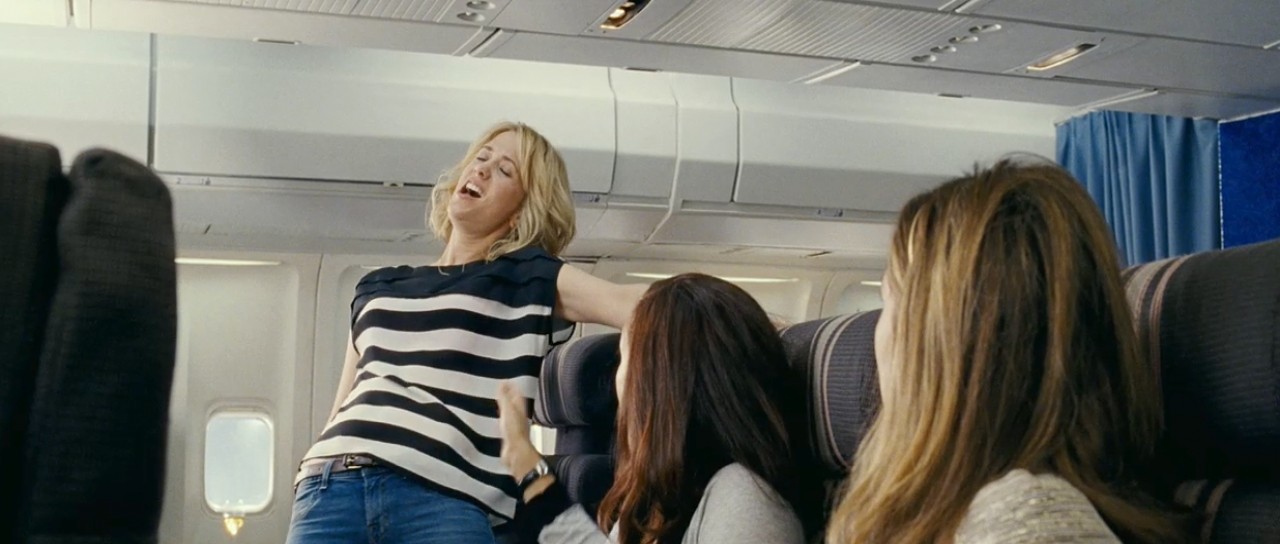
A bold, audacious performance of great confidence and exuberance. In the photo above, she's seducing her real-life husband. Who doesn't want it. Melissa and Kristen's sick comic timing is ensured 2016's Ghostbusters was anything but a flop in my eyes!

04. Elizabeth Olsen, Martha Mary May Marlene
I never knew what her character was thinking. After everything that Martha went through, I think that's apropos. 

03. Rooney Mara, The Girl with the Dragon Tattoo
Fierce A F. Following in Noomi Rapace's footsteps was a formidable challenge, but my Queen more than rose to the task. Her commitment to her role, and the element of relish and bite in that revenge scene is some of Rooney's finest acting. 

02. Viola Davis, The Help
Every piece of acting Viola touches turns to gold (she did a lot with underwritten characters in both Suicide Squad and Ender's Game). But in The Help she's given a role and a script where she can flaunt the true extent of her acting talent, and brings us a woman who's outwardly strong and maternal, inwardly vulnerable. She's the emotional core of The Help, and completely breaks your heart.

Trivia: Viola and Jessica, both on this list for The Help, both attended Juilliard Drama School. And both are astonishingly good actresses. Stay in school, kids!

01. Alan Rickman, Harry Potter and the Deathly Hallows Part 2
... speaking of heartbreaking, for me, one of the most pathos-injected performances of all time is Alan Rickman as Professor Snape in the final Harry Potter film. Whilst the casting of the Harry Potter series has, shall we say, been variable in quality (Emma Watson seems to think wiggling her eyebrows earnestly equates to acting. Bye Felicia), Rickman was everything I imagined as Snape and more. Snape's stony face hid years of bottled-up love for a girl he still feels guilt for his part in losing. 

The finest part of J.K. Rowling's saga was this Big Reveal, and in conveying how much the secret meant to him, Rickman has crafted one of the most memorable Byronic heroes. R.I.P. to a great talent.

The shot above is a scene that still lingers in my memory.

Stats and Shiz, because it's not like that's what my PhD is in or anything
Gender
Men: 2 (haha)
Women: 8
... but this is the first time (going backwards from 2015) I've listed a fella in the prestigious top spot.

Playing favourites (previous appearances)
Jessica Chastain: 6th in 2011 (Zero Dark Thirty), 10th in 2014 (A Most Violent Year)
Jonah Hill: 7th in 2012: (21 Jump Street), 9th in 2013 (Wolf of Wall Street), third in 2014 (22 Jump Street). 
This makes Jonah Hill the only actor to be in my 10 favourite performances of the year four years in a row. Dunno if you can tell but... I'm a fan.
Rooney Mara: 6th in 2013 (Side Effects), 2nd in 2015 (Carol)
Melissa McCarthy: 8th in 2013 (The Heat, from the same director as her entry in this year's list)
Saoirse Ronan: 7th in 2009 (The Lovely Bones), first in 2015 (Brooklyn)
^^^ this may give you an indication of who my favourite actors might be

And of course.... by BBFC rating (gives you a rough indication of grittiness of the film from which the performance came)
12A: 5
15: 4
18: 1 (the 18 in question being The Girl with the Dragon Tattoo. And boy did it earn that 18 certificate!) #RevengeRape

Tuesday, July 19, 2016

Hit Me with Your Best Shot: ZOOTOPIA


I've been a long-time reader and admirer of Nathaniel's Hit Me With Your Best Shot series over at every film fan's Bible, The Film Experience, devouring all the entries from afar. The premise is simple: each week, a set movie is decided, and film bloggers present their favourite shot in the film, with their justification.

I thought I'd make like the protagonist Judy Hopps from this week's target, Zootopia, and take a step out of my comfort zone. Rather than just reading the articles, I thought I'd contribute with my entry, about my favourite scenes in Byron Howard, Rich Moore and Jared Bush's fabulous Disney cartoon, which remains, at my time of writing, my favourite 2016 cinematic release.

Because I have a lot of feels about this masterwork, I'll list not one, but five scenes, in descending order, just so I get to ramble on about Zootopia for longer. ❤️

SPOILERS FOLLOW, so don't read if you haven't seen Zootopia yet!!

Five: pirate DVDs

The pirate DVD scene tickled me for many reasons, mainly because I love allusions to other movies, trivia and Easter eggs, and this scene contained them aplenty. The bootleg DVDs that the shady Duke Weaselton is trying to flog are all plays on Disney movies, past and present: Pig Hero 6 (Big Hero 6), Wrangled (Tangled), Wreck-It Rhino (Wreck-It Ralph), and three upcoming movies: Mewana (Moana), Giraffic (Gigantic) and Floatzen 2 (Frozen 2).

Personally, I could not get enough of the Frozen allusions in Zootopia, and howled when cynical Chief Bogo at the ZPD tells Judy to "let it go". The knowing film and pop culture references littered throughout Zootopia really were a welcome treat!

In fact, even Duke Weaselton's name is a play on a  character name from a previous Disney movie: the Duke of Weselton in Frozen. In a savvy bout of voice-casting, Alan Tudyk does the voice of both characters.

Four: now you're just milking it
Although Zootopia is Disney, and with Disney, I generally know to expect a reassuring outcome, I must admit they had me fooled briefly in this scene. The way Nick's fangs were bared and the malevolence in his green eyes, not to mention the apparent terror in Judy's eyes, made me think for a second he had genuinely turned wild and really was going to eat her.

But, fortunately, in a nod to the first scene of the film, where Judy as a child had put on a play extolling her well-intentioned but naive belief that any animal could be anything they wanted, the fox and the bunny were just acting. Our hero remained intact.

Three: Gideon's Redemption


This scene played well because of the resolution it offered something that had occurred at the start: in one of the film's few distressing scenes, child!Judy had been scratched by a school ground bully, a fox by the name of Gideon Grey. The way Gideon was drawn, clothed and voiced gave the impression he was an anthropomorphic version of the 'hillbilly' trope. Judy had felt the brunt of his claws because she had stepped in when her helpless friends had their tickets stolen by him. Gideon, having earlier been embarrassed publicly by Judy at the school play, obviously felt bad blood towards her, and decided to teach her a lesson.

In the scratching scene, the actual scratch was masked, but, as with another Disney movie Tangled, when the witch stabs Flynn below the screen, sometimes it's what you don't see that is even more haunting. Here, you just saw Gideon pounce at Judy, him swiping at something, and then two savage scratch marks. Surprisingly intense for Disney.

Fast forward 15 years, and Gideon has learnt the error of his ways. He's doing well for himself, as one of the top pastry chefs in the tri-burrows and even partners up with Judy's parents. He seeks out his one-time prey, explaining that he had 'a lot of self doubt, that manifested itself in unchecked rage and aggression', offering personally baked goodness as a peace offering.

I like this scene a lot, for two reasons. Firstly, it gives Judy some closure for a fairly traumatic experience that occurred at the start of the film. I felt better knowing she had received a genuine apology. And secondly, Gideon's seemingly simple ramblings about 'night howlers' offer our heroine, when she seems to be at pit bottom, a revelation that reignites her sleuth senses, just when she was all ready to give up on her dream of being a police officer. This story arc both propels the plot along, and accentuates the film's overarching message: that you shouldn't judge a book by its cover, and anyone, no matter what shape or size, can achieve anything.

Two: Don't Know When to Quit

 photo 2_zps5dh5rhpn.png
The aforementioned scratching scene did offer one ray of light: despite Judy getting wounded, she achieved what she came for: recovering her friends' tickets. This illustrates her resourcefulness and never-say-die spirit that may infuriate jaded co-workers, but makes her a tremendous heroine and a character female Disney fans can really look up to, regardless of species.

Judy's determination and grit in the face of man other characters who instantly judge her to be too small, too cute, too weak to be a police officer, carry her throughout the movie. Along with Kate McKinnon in Ghostbusters, she represents my choice for #MovieCharacterGoalz of 2016.

One: Dumb Bunny
 photo 1_zpst2njnsgv.png

2016 is the year of the Odd Couples solving mysteries. In The Nice Guys, Ryan Gosling and Russell Crowe must put personality differences aside to investigate a missing actress. In Central Intelligence, big Dwayne Johnson and little Kevin Hart have to retrieve a USB stick. In Grimsby, sloppy Sacha Baron Cohen and slick Mark Strong have to team up to save the world. I could go on (I mean, Kevin Hart's been in two odd couple movies this year alone).

In each of these cases, I have enjoyed the chemistry in the duos, and the way the characters play off each other; how they go from hating to loving each other. But this dynamic works the best between Judy and Nick in Zootopia.

The two get off on a ropey start, when Nick cons Judy into paying for a giant ice lolly which he later repackages and sells to others for profit. Things get worse before they get better, when she, playing the cunning fox at his own game, entraps him into helping her on a case, which she is desperate to crack, to prove her worth as a bonafide cop.

Gradually, over the process of cracking the case, the two build a rapport. Then rapport turns to trust, as Nick confides in Judy about why it is that he's so crusty (the flashback sequence in which this occurs was even more upsetting than the scratching scene; I'm not ashamed to say I cried). But Judy, in all her well-intentioned loquaciousness, dubs predators as 'primitive savages' at a press conference,  in doing so, revealing some subconscious prejudices of her own. Their friendship is shattered as a result.

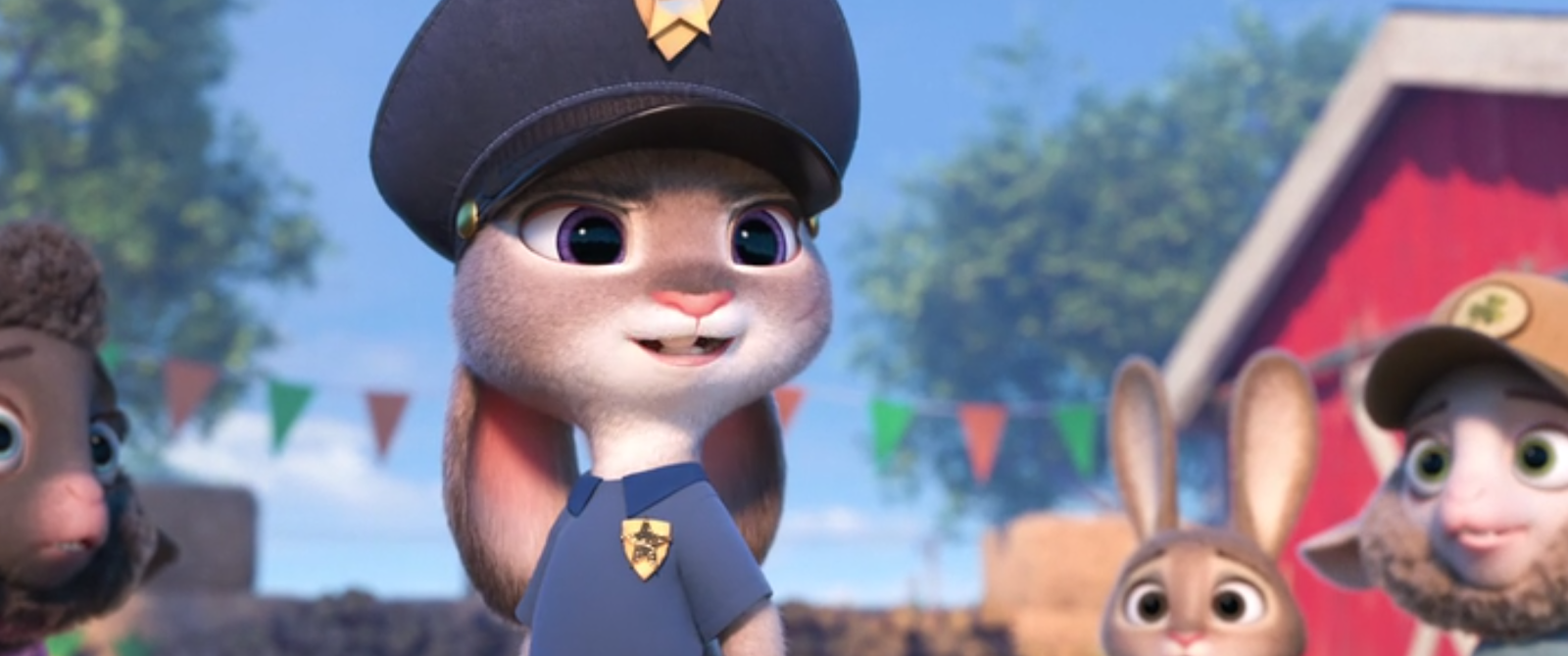
In this scene above, Judy begs for Nick's forgiveness.  Ginnifer Goodwin, who delivers some exceptional voice-acting in this movie, really shines in this scene, delivering a monologue embedded with regret, sorrow and pathos. Jason Bateman, equally as good, imbues Nick with good-natured cheekiness and playfulness.

I mentioned that Judy was a great role model for girls, and I think the fact that she isn't infallible, and committed this mistake, makes her more appeasing. Because like Judy, humans, too, are flawed. We all make mistakes, some of them colossal. Nick recognises this, and forgives her. But not before a bit of payback: recording her admitting that she 'really is just a dumb bunny'.

The shot above encapsulates everything about Judy and Nick's friendship that made Zootopia such a delightful movie. They bicker, they banter, but they've always got each others' backs. 🐺🐰