Showing posts with label classical music. Show all posts

Saturday, December 17, 2016

What a Character: Ben Mendelsohn

This post is my contribution to the What a Character! blogathon as organised by ONCE UPON A SCREEN, Paula of PAULA’S CINEMA CLUB and yours truly, Kellee of OUTSPOKEN & FRECKLED which celebrates supporting performers in film. I have gone with a contemporary actor who has stolen the show in almost everything I've seen him in, Mr Ben Mendelsohn (aka the baddie from Rogue One).


I first noticed the actor before having watched him in anything, and it was seeing his name on the Starred Up poster (a film, lamentably, I still haven't seen, although it's high up on my to-see list for the trifecta of reasons that it's from the director of Hell or High Water, and it stars Ben and Skin's Jack O'Connell, easily the best actor to emerge from that show).

The reason Ben Mendelsohn's name struck with me is because there is a composer of the same name (albeit with two 's's, Mendelssohn), who composed the famous Wedding March from A Midsummer Night's Dream. It's funny how the mind makes irrelevant cognitive connections like that, but with a memorable surname like that, I was curious to watch his acting performances.

He had a short-but-memorable appearance in The Dark Knight Rises in a suitably shouty, sweaty cameo, but the film that gave him an outlet to truly show his acting range was in The Place Beyond the Pines, a three-act story which follows the intersecting fates of a bank robber Luke (Ryan Gosling) and the cop, Avery, who pursues him (Bradley Cooper).

In The Place Beyond the Pines Mendelsohn plays Luke's only friend and co-conspirator who helps him commit the bank robberies (a nice counterpart to the role he played in The Dark Knight Rises). The two men, both outcasts, share a tentative, wordless bond, and the chemistry between Gosling and Mendelsohn is excellent, deftly portraying how the latter can pre-empt the former's actions before he's even done them. In the final act, when we see Mendelsohn's character again, and in his inarticulate way, he shows how much he cared for Luke, hinting that there may well be honour among thieves.

Ryan Gosling enjoyed working with Ben Mendelsohn so much on The Place Beyond the Pines that he cast him in his directorial debut, the critically panned misfire Lost River. Almost everything about that film sucked, bar Saoirse Ronan (who is amazing in everything), and Ben Mendelsohn, as a smarmy bank manager Dave who will do anything to get his way with struggling single mother Billy (Christina Hendricks).


Throughout the film, Dave repeatedly tries it on with Billy, only for his brusque courtship to be knocked back every time. However, as one of the patrons of a local burlesque studio, and her financially precarious situation, Billy has little choice but to play right into his hands by first working there, and then agreeing to partake in an after-hours 'shell game' for more money. In this bizarre ritual, a woman is locked in a transparent case and the payer can do what ever they want... to the shell. In theory, the woman should be safe as the shell is looked, but that doesn't render the whole experience any less terrifying.

Naturally, Dave seizes his opportunity, and such has been his unsettling demeanour that you have no idea what form of depravity he will unleash onto the shell. As a matter of fact, he dances in front of it!


The lousiness of Ben Mendelsohn's dancing in this scene, accentuated by the neon backdrop and the electro-score playing in the background, that the whole sequence is incredibly discombobulating. The way he looks at Billy whilst doing so, too, tells you that this is his idea of asserting his raw masculinity, a kind of recompense towards the woman who has had the temerity to turn him down.


As a very amusing stray piece of trivia, Ryan Gosling revealed that the music Mendelsohn had during this scene was 'Bad Bitches' by Kendrick Lamar, which would explain a threatening line of dialogue he barks at Hendrick's character whilst dancing at her. At the time I thought it was his character being crude, but now I see he was just quoting the song.


Ben Mendelsohn has plied his trade as an actor playing villains, of which Director Orson Krennic in Rogue One: A Star Wars Story, an appropriately evil performance, will add to his litany of baddies. One such villainous turn from him that I particularly liked was as Payne in Slow West, a character who teases with an (almost ingratiatingly) amiable veneer, but deep down, you wouldn't trust them as far as you would throw them. Mendelsohn uses his whole face when acting (a quick sly look sideways, a twitch of the lips, a twist of the jaw) to convey thorny characters who occasionally let their masks slip.

Ben Mendelsohn didn't rise to prominence until relatively late in life (he's 47 now), but he has such a characteristic look about him, that once you see the Aussie in one role, you won't forget him. His acting style is distinctive but never distractingly mannered. As I've always said, I tend to identify more with villainous characters in movies, so it was only natural that I would gravitate towards Mendelsohn, who's ability to mould sinister antagonists in films is prenaturally good.

I'm delighted at how well things have gone for him (he is a massive Star Wars fanboy so getting to play the main antagonist in the film must have been a special moment) and eagerly await whatever film roles he takes next.

Saturday, June 04, 2016

REVIEW: Daria van den Bercken: Handel and Scarlatti at the Keyboard

Two weeks ago I visited Kings Place for the first time. Up until then, I’d been avoiding this venue like the keyboard warrior that I am, as it’s very close in geographical proximity to where The Guardian headquarters are, and, naturally, I’ve had some beef with more than one Guardian football writer. So for my own safety, I’d decided it best to stay out of there way. Hahaha. 

Anyway, I grew a pair and manned up, because I wanted to watch a piano concert. I’ve been to my fair share of orchestral concerts, both amateur and professional, but never actually watched a solo pianist of any kind live, so what better way to start than at Kings Place @ 90 York Way, a very reasonably priced venue in King's Cross to let up-and-coming musicians exhibit their many and varied talents. 


The musician in question was Daria van den Bercken, and she certainly knew her way around a piano. Her fingers dextrously hit all the right keys, she was comfortable with the music, and her passion for Baroque music was clear; she wasn’t just playing the notes (and what difficult notes they were!), but making the pieces come alive. As a violinist and a guitarist myself, I always enjoy listening to sad pieces more than happy ones, and her performance of Sonata in C-sharp minor, K 247 was on point; the use of dynamics would surely have made Scarlatti proud. 

In fact – and I feel churlish for saying this – but it was probably van den Bercken’s overzealous passion for Handel, Scarlatti, and their life stories, that let the recital down a little. Before playing the piano, she gave us a brief history of the musical beef between Handel and Scarlatti, which was fair enough. But then, after playing Handel’s Suite in E, HWV 430, she picked up the microphone again, to tell some other musical anecdotes which might have been interesting to her, but weren’t too fascinating to me, and, judging from the impatient looks on the audience faces, weren’t too much to their liking either. I mean, to lay a setting for the pieces you’ve chosen to play is prudent. But to throw around non-sequiturs that are more about your development as a pianist rather than the two men who’s pieces are headlining, is meandering, bordering on narcissistic. 

That said, I really did enjoy listening to her piano-playing. The piano is an instrument I’ve always struggled with, and I have the utmost respect for people who can play it, and play it well. Daria’s talent, confidence, and musical panache were clear. I would be interested in seeing how she fares with romantic and modern pieces too. I just don’t want the 45 minutes of one-woman-show that gets tacked on with it. 

Grade: B
---

Some other photos I took from Kings Place...


Tuesday, July 17, 2012

Restaurant review: SARASTRO (Strand)

Just off Covent Garden, next to the theatre playing Woman in Black is Sarastro, a truly unique little restaurant with a wonderful kooky vibe and some delicious plates to boot.


Cute little alcoves (reminiscent of the boxes one sits in to listen to the opera) make up the restaurant, and eating your dinner in a box, slightly detached from the rest of the room, really gives your meal a cosy feel, making Sarastro a great place to bring potential dates. The menu didn’t offer a huge range of dishes, but what it did offer was creative, with each dish offering something distinctive. 

Sunday, October 09, 2011

Film review: MELANCHOLIA (Lars von Trier, 2011)

Film stars rarely let us into their own private worlds. So it was a great surprise, then, when Kirsten Dunst recently admitted to suffering from depression. In her Cannes-winning performances in Melancholia, she plays Justine, a woman who also suffers from depression. The film, set a few nights before the apocalypse, centres around Justine’s wedding night and her trepidation regarding it, as well as her sister Claire, who is struggling to hold everything together.

The film is divided into two acts, one centring around each sister, but not before we are “treated” to a montage of the world ending, set, rather portentously, to Wagner’s Tristan And Isolde. Those who are bigger von Trier loyalists than myself would say the choice of music is appropriate for the weightiness of such scenes. 

I, on the other hand, found myself struggling not to laugh as the audience are forced to sit through a truly tedious 10-minute overture, which featured some footage of Charlotte Gainsbourg running in slow-motion on a golf course, and Kirsten Dunst floating in her wedding dress in a pond full of green lily pads, ala the portrait of Ophelia. The whole vignette just reeks Kubrick at his self-serving worst; it’s just so awfully self-important that only those who have pretentiousness for breakfast (and, truth be told, I am fairly pretentious as it is) could take it seriously, however gorgeously it is shot.

When the actual film begins, however, things pick up. In Part I: Justine, we are thrown into a sort of wedding-from-hell scenario; Dunst and her tycoon husband-to-be (Alexander Skarsgaard, cute as a button) arrive late to their own wedding reception. Her sister Claire (Charlotte Gainsbourg) is already fretting as it is, Claire’s husband, John, is resentful at having to pay for the whole thing. As that dog/fox in von Trier’s equally pretentious film from last year, AntiChrist might say, “chaos reigns.” Justine and Claire’s estranged mother (played by Charlotte Rampling, epitomizing froideur in a way that only she can) carelessly drops waspish comments throughout, whereas their fun-loving father, played by John Hurt, brings two mistresses and has the time of his life swiping spoons. 

There is a claustrophobic sense of foreboding throughout, not helped by Justine’s predilection for sneaking off to be alone with her own thoughts. As the night unravels, she becomes increasingly fraught and depressed, despite the best efforts of her husband to cheer her up. Only Claire comes close to understanding her sister’s plight, but even then, she can’t prevent it. It is a self-fulfilling, self-destructive cycle to which no happy ending can be found.

In the second half of the film, Part II: Claire news has spread about Melancholia, a planet several times the size of earth, on a collision course, which may or may not take it straight where the earth is. Now it is Claire who is slowly losing her mind, as Justine finds a strange sense of consolation in knowing that life will soon end. The dynamic between the sisters change, and both Dunst and Gainsbourg give terrifically nuanced performances throughout to demonstrate thus. 

It was Dunst who picked up the gong at Cannes but personally, I was more taken by Gainsbourg in the film. Unlike in mysogyndrama AntiChrist, where she had some full on gynacological scenes, she doesn’t subject herself to such humiliations in this film, and her balancing act between being the caring sister trying to stop everything from falling apart and the worried mother fearing for that it all might fall apart anyway, lends to a terrifically layered performance.

Indeed, I would say it was the only thing about Melancholia which had any true layers, for I found other parts of the film horrifically caricaturist, bordering on farcical. The absurd opening, the over-usage of Wagner bordered on nauseating (note to the director: Terrence Malick’s used Wagner in the past, and done it much, much better than you could ever hope to, just truthin’). Long passages of the film are empty and downright uninteresting, the 130 minutes running time is nothing if not generous, and von Trier’s treatment of mental illness is done with a careless flick of the hand when it deserves much more.

On balance, Melancholia is a beautifully shot and excellently acted drama, but, for me, impossible to view as anything other than a comedy. Either Lars von Trier is having a gigantic laugh at our expense, or arthouse fans try far too hard to read deeply into things; but this film was not anywhere near as deep as it liked to think it was. 

Played out half as a fairly amusing satire on social airs and graces, half disaster movie, I could have accepted Melancholia. But if it thinks it has anything profound to say about depression, or the bigger picture in life, than the film, then Lars von Trier, can make like Keifer Sutherland at the end of the film, and get stuffed.

5/10

Sunday, March 13, 2011

What are the musical references in Ernest Tomlinson's Fantasia on Auld Lang Syne?!


This is a beautiful, whimsical and very busy piece of music which apparently references 152 works. All I can spot are a few!

- Beethoven’s Ode to Joy
- Chopin's Marche funèbre
- Schubert's Trout quintet
- Bach's Wohl mir, dass ich Jesum habe
- Adagio from Spartacus
- Haydn’s Surprise Symphony
- Tchaikovsky's Swan Lake
- "This Old Man" - nursery rhyme
- O Come All Ye Faithful
- The Can Can

Care to have a listen and see if you recognise any of the references?

Wednesday, June 16, 2010

5. BRIEF ENCOUNTER (David Lean, 1945)

To most, having to have grit removed from one's eyes is not the best circumstance under which to make an acquaintance. But for Celia Johnson's Laura, this is how, on a railway station, she meets dashing doctor Alec Harvey (Trevor Howard). The two form a friendship that soon becomes more than platonic. Despite their love for each other, their relationship is never consummated. Caught in such a bad romance, they realise that due to social rules and their commitments to their family, the tempting option of running away together is simply impossible.

Photobucket
Cinematography goes a long way in telling the story. The camera shots are so close-up that they frame just Laura and Alec, suggesting that, for the time being at least, they are in their own perfectly formed world.

Photobucket

The fact that the title gives away the fact that Laura and Alec's romance is short lived does not detract from the poignancy and power of their brief time spent with each other. Although the two do not sleep together, there is no doubt of their desire to do so, making their restrain even more admirable (the scene in which they are interrupted by a prying friend was extremely frustrating when I first watched the film but now I see that it fits perfectly with the themes of social decorum and doing what is right rather than what we want).

Photobucket

Many things make Brief Encounter the gem it is, but two things stand out. The first is the usage of Rachmaninov's Second Piano Concerto. There have been films which have been ruined by the terrible music in them, and others wherein the music is either so good or so bombastic that it deflects attention away from the film. In Brief Encounter, the elegiac piano tune complements the film perfectly. Used throughout, it evokes the emotions that Laura is feeling in us. 

And the second? Why, that would be Celia Johnson's exquisitely beautiful performance as the housewife who looks for an exciting, new thing in her life, only to realise that when all is said and done, however exciting, however much it thrills her, she cannot throw away what she already has. As Alec places his hand over Laura's shoulder as they say their goodbyes, tears never fail to come to my eyes. Brief Encounter is as deep and British a film as they come.

Wednesday, June 02, 2010

Words actually can't describe how much I adore this performance

Musically, it's not the best, but Bad Romance, Dance Wiv Me, Fight for This Love, Everybody in Love and I Dreamed a Dream are all songs that have five stars on my iTunes, and I love the personality of this lovely little group:


The Arrangement to win BGT!!

Sunday, April 25, 2010

Last night’s Britain’s Got Talent.

Oh, how I love the BGT. The over-usage of Requiem for a Dream music. The crazy acts. Simon’s bitchy comments. As entertainment, it is second to none.

We start with auditions in Manchester, where the first act, a Christine from Leeds dubs herself a “triple threat” – she intends on dancing, singing and playing an instrument. However, we soon see that she is using all three of those terms in the loosest possible sense when the music to Michael Jackson’s Billie Jean comes on, and she a) moonwalks terribly, b) sings out of tune and out of time and c) merely shakes some castanets about. The fact that her ill-fitting sequined leggings and jacket make her resemble a Christmas bauble simply adds to the sheer incredulity of her performance. She’d said that she wanted to take over the world in five years, but on that performance, the only way she’ll achieve that is by blinding us all with her dodgy attire. The audience are unrelenting, shouting “Off! Off! Off!” and even Piers Morgan has it in him to make a joke, “I haven’t seen moon-walking that slow since Neil Armstrong.”

The dubious amalgamations of two performances in one continue with Sinead, who claims she can play the guitar whilst jumping on a pogo stick. As with the previous act, though, in trying to be groundbreaking and mixing two acts, she doesn’t get either one right. Then we get a 39-year-old man who says he’ll “body build” whilst singing, but his bodybuilding consists of lifting two puny little weights. Lame. Lastly, a woman named Tina tries to fuse fire and singing. In an embarrassing attempt to sex her act up, she removes her robe to remove nothing but her tatties underneath. Whilst is succeeds – Piers and Simon gives their yeses – I think it’s mortifying and that women should act their age.

The next act is both sickening (literally) and beguiling. A man has five coins laid out in front of him, and he swallows each one. After the first one’s been swallowed, we can actually hear the sound of the next coin hitting it, which proves to be an extremely disturbing sound. He then proceeds to chunder up four of the five coins, much to the shock of everyone. The icing on the cake, if you will, is when he swallows a billiard ball (yes, a billiard ball!), in order to get the final coin to come back up. It’s one of the most dangerous things I’ve ever seen and I still don’t know how he did it, but as I have no intentions of trying it myself, I’m happy not knowing. Such acts are extremely polarizing, but this one was just so crazy (plus, unlike the previous acts, he actually did it well), so the judges send him through. The Britain’s Got Talent sob story factor comes out when the dude explains how he came to swallowing coins – growing up in a children’s home, he did it to stop other kids from stealing his money. Whilst I’m usually quite wary of these types of stories, the idea of a child going to the extent of swallowing scabby coins just to save a bit of money does genuinely make me sad.

We leave Manchester and go to the London auditions. First up are Melissa & Laika. Melissa is the proud owner of Laika, who she claims is a guitar-playing dog. Only, it doesn’t quite end up like that. Melissa plays the guitar and sings. The dog, wearing a ridiculous hair band, just lounges on the stage. When asked why the dog isn’t playing, Melissa lamely tries to get the dog to strum the guitar. One crappy strum =/= playing the guitar.

The terrible attempts to try and get animals into acts continues. We get a pig that supposedly does tricks, but he runs off the stage as soon as the act begins. It’s pretty farcical, truth be told, especially how the pig so clearly scares Dec. Then there’s snail racing, which needless to say, is not the most titillating thing I’ve seen in my life. The acts have pictures stuck on them, and hilariously, the Ant and Dec snails seem to be mating. Next up is a girl, Louise Sinclair, and her horse. “Is it a boy or a girl?” Simon asks, before he checks for himself. Anyway, Louise’s act is to do gymnastics on her horse. Animal cruelty if you ask me. It’s boring and tepid and lacks any flavour, and naturally, she gets nos. Not the most talented bunch of animals by any stretch of the imagination.

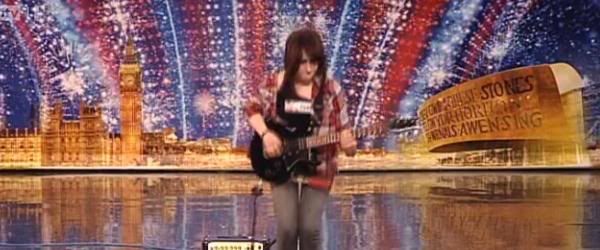
Thankfully, the next act actually is a bit different. They are The Arrangement, a group of Sixth Form students. I’ll admit, when I first saw them, I didn’t think they were up to much. But they soon prove me wrong, with their classical renditions of Black Eyed Peas’ “I Gotta Feeling” then “Low” then Beyonce’s “If I Were a Boy”, which is not fashionable, but kinda works.

Photobucket

The best bit is at the end when it goes to Lady Gaga’s “Poker Face” because it’s the only time the orchestra show a bit of a life. The centrepiece of the performance is definitely the lad with the microphone, who I think is incredibly brave, and, whilst not the best singer in the world, has enough public school swagger and energy to carry it off. All three of the judges give their yeses, much to the delight of the audience. I really really enjoyed it, and can’t wait to see what The Arrangement do for next time. If they pick four totally new songs and the orchestra come to life a bit more, I could really love it. However, if they use the same four songs, then I’ll be quite bored.

Someone who’s got Lady Gaga’s style down with the platinum wig and extravagant clothing rather excites things, because the audience think it might actually be Lady Gaga. It turns out to be a man. And their performance is atrocious – just crappy parading about the stage, and the part where he tries to sing the part in French from “Bad Romance” brought to me another song title “Can’t Speak French”. “If we’ve got Lady Gaga, why do we need you?” demands Simon. Not for the first time, Piers, Amanda and the audience love the act, and Simon hates it. I’m with Simon. I love Lady Gaga, and watching a weird guy bastardise her isn’t my idea of talent.

As is the way with the show, there are equal amounts of sweet and sour, and the gymnasts who perform next are definitely sweet. Their act has epic classical music, and it takes a while to get started, but when it does, it spellbinds. Cartwheels. Lifting people up. Balancing. All synchronised. It’s very impressive. The precision and control is second to none. There’s a bit where the girls all do a synchronised backwards flip and no-one puts a foot out of place. Spinning, throwing, body turns. The linking between different sections in the act is fluid too. Best part – when a girl is used as a skipping rope and a lad jumps over her. SO good, you wouldn’t believe kids did that. I think I'm more impressed by acts if I've attempted the things they do so I know how hard it is, and, I was always terrible at gym, so to see them succeed so much spellbinds me. It gets 3 well-deserved yeses. To sum up Ant & Dec, “wow.”

To end on a high, we go back to Manchester auditions, wherein there is a Mr Christopher Stone, an accountant. In his introduction, WALL-E music is played. I recognise it, yeah? Anyway, he sings, and he has a beautiful baritone voice. What he also has, and is picked up by Simon, is a lack of conviction. “You’ve got to have a slight swagger” Simon notes, which makes me happy obviously, as swagger is one of my favourite words. Nonetheless, he gets three deserved yeses, and that is BGT for another week.

Monday, April 05, 2010

I can hear the sound of violins long before it begins.

Photobucket

Downloads available for the three Princess and the Frog tracks.

01. Sorry Seems to Be the Hardest Word (Blue ft. Elton John)
All throughout March, I was on a bit of a Blue kick, and downloaded all of their albums to relive my early teen years, wherein I would frequently dance around the living room to their songs. Whilst Sorry Seems to Be the Hardest Word probably isn’t my all-time favourite of their’s (that’s probably You Make Me Wanna), I love how amazing Blue sound with Elton John, as well as the truth behind the lyrics.

02. Ma Belle Evangeline (The Princess and the Frog soundtrack) download
This song is completely and utterly adorable, and, for me, sums up the cuteness of The Princess and the Frog, plus the theme of the song is used later, in a minor key. It’s just lovely.

03. Fly By (Blue)
Haha, more Blue. The music video for this song makes me chuckle quite a lot, because of the way the men think they have swagger.

04. Stephen (Ke$ha)
Right, I don’t actually like Ke$ha one bit. I think she looks like she has lice, and she really can’t sing. That said, I do think Stephen is an extremely likeable song, and a decent counterpart to Taylor Swift’s Hey Stephen.

05. Du bout des lèvres (Mélanie Laurent)
In addition to being beautiful, a stunning actress and one of the coolest women in Hollywood, Laurent continues to stun me by singing too! I don’t know any French so if anyone fancies translating the lyrics for me, that’d be greatly appreciated, but even if the meaning’s completely lost in translation, it still sounds pretty.

06. The Swan (Camille Saint-Saëns)
Standard. Saint-Saëns seems to be me classical composer du jour recently, as I’ve also been listening to Danse Macabre a lot since last night’s episode of Jonathan Creek. But The Swan is absolutely gorgeous.

07. Down in New Orleans (The Princess and the Frog soundtrack) download
Yeah, I like The Princess and the Frog soundtrack.

08. Chelsea Hotel (Leonard Cohen)
So many lines in this song actually make my heart pang from the level of beauty. “Giving me head on the unmade bed” and “You told me again that you preferred handsome men / but for me you would make an exception” come to mind. Regina Spektor captured the beauty of the song in her own cover. Both rock.

Speaking of Chelsea (ha, see what I did there?SEE?!), I did the BBC online predictors for the remaining fixtures, and... it doesn't look good for my team D:
Photobucket

Admittedly, I am being super-pessimistic, but I can just see us fudging up against Liverpool and Spurs. Hence the Surrey Reds getting another title. Wah.
Photobucket

09. Something Kinda Oooh (Girls Aloud)
Just a fun, sexy, amusing song. Stupidly catchy, and Cheryl, Kimberley and Nadine are all awesomesauce.

10. Almost There (The Princess and the Frog soundtrack) download
*sings along*

--

Finally, if you fancy learning Chinese, nothing's better than this cribsheet:
Photobucket

:P

Sunday, April 04, 2010

Photobucket

01. Katy Perry. Discuss.
02. Which cities have you never been to, but want to?
03. Do you exercise? How much? What kinds of exercise?
04. What's the most important quality you look for in a friend?
05. March. How was it for you?

Thursday, February 18, 2010

8. He ni zai yi qi (Chen Kaige, 2002)

Together tells the story about Liu Xiaochun, a thirteen year old boy with a prodigal talent at the violin. His father, Liu Peiqi enters him for a musical competition in Beijing, and although his son finishes fifth, his residence not in Beijing renders him invalid. His dad persuades a music professor to take his son on whilst he goes back home, thus leaving Liu Xiaochun away from his dad for the first time in his life.


Appropriately, for a film about the violin, the music in this film is stunning. This humble story is also written by the director, telling the story with stirring emotive force. Liu Xiaochun proves to be the kind of sensitive soul that far few 13-year-olds are. In its own little way, Together makes me appreciate my parents much more and evoke tears whenever I think about how much they’ve sacrificed for me. The supporting actors are all good, showing the subtle ways in which the people young Xiaochun meets shape his development and life. 

It’s refreshing to witness the friendships and platonic loves that the protagonist meets throughout the film. Xiaochun has two music teachers throughout the film, and each is at a dead end in his life about something, and these themes are investigated with sensitivity. Far be it from being a film about just the violin, themes of friendship, determination, courage, and love are all in here. The film is not without its melodramatic moments, but that only heightened my enjoyment of it. And, whilst it has been criticized by some for being too saccharine, to that I say, what’s so bad about sugary once in a while? As Chen Kaige himself said, "being Chinese isn't all misery”.

Tang Yun, a real-life violinist, was selected for the role when director Chen Kaige saw him at a concert, and his performance is genuine as it is heartfelt. Liu Peiqi is incredible as the father who makes sacrifice upon sacrifice because he wants the best for his son – a gesture that is shown to be even more affecting when the flashback shows how the father came to find his son (few films scenes have had me crying so much, and for so long). 

In fact, despite his violin skills being the catalyst and plot driving force in the film, I see Together more as a universal tale of the love between a father and son. The father isn’t perfect; he’s poor and struggling to make ends meet, but this is something that makes his devotion to his son easier to relate to.

Photobucket

There are two things about Together that resonated with me: the fact that I’m Chinese and the fact that I play violin. And it’s true; watching Together did make me appreciate the violin more, as well feel nostalgia for my homeland. But my appreciation for the film came from far more than just those similarities. 

Cinema is an art form that transcends mere entertainment. It can inspire debate, conversation, raise pertinent topics. It can make an everyday story more exciting and interesting with the aid of music, cinematography and beautiful art direction. But the main reason I watch films is to feel. Human emotion can be felt by anybody, anywhere. And in getting me to feel pathos, bathos and the spectrum of emotions in between, Together achieves that aim perfectly.

Tuesday, February 16, 2010

9. Amadeus (Milos Forman, 1984)


Hands up who hasn’t felt jealous of someone else’s talent at some point in the past? Jealousy, is, after all, innate. One poor sod who’s life was driven by his jealousy is Antonio Salieri, who, for all his mediocre, even semi-decent musical talent, never matched the level of genius attained by Mozart. And, whilst Salieri slaved away, devoting all his time to form his passable scores, Mozart’s came naturally. In fact, considering Mozart’s hedonistic and general sloppy living, his musical talent came to him in spite of, rather than because of his lifestyle. This fact drove Salieri crazy, letting this take over his life, as he devoted all his energy into somehow evening out the score.

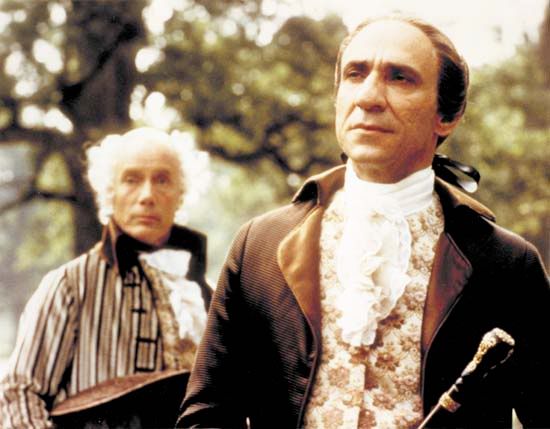
F. Murray Abraham plays the lead in a beautifully controlled depiction of jealousy, resentment and rage, all hidden under a façade of that carefully forced smile. Tom Hulce is terrifically annoying as Mozart; his crazy high-pitched laugh rang in my ears long after the credits rolled. Amadeus was the last movie to bung two actors in the Best Leading Actor category at the Oscars. Had Hulce been pushed for supporting, he very probably would have won. As it was, he went up against his co-lead Abraham, who won the Oscar, perhaps the first time Salieri has done one over on Mozart.

The film is gorgeous to look at and listen to. Many of Mozart’s most sumptuous pieces are used throughout. The film carries a tone of underlying sadness throughout, but that doesn’t mean our eyes and ears aren’t deprived of a treat throughout. The costumes, so intricately designed, evoke the feel of 18th century Europe, and the sets, so cleverly architectured, succeed in capturing the grand scale of the opera houses.

Adapted from Peter Schaffer’s play, the script modulates from moment of great comedy to desperate sadness. The story is told in flashback by Salieri, who now resides in a mental asylum and has just had a failed suicide attempt. As a sympathetic priest listens to his tale, Salieri recounts his traumatic and disturbing tale. The direction of F. Murray Abraham is wonderful, both restrained and indulgent, it captures the many sides of the composing industry as well depicting the sadness of the human condition.

The fact that the film is so historically inaccurate does not matter a jot. Rather than attempt to paint a vivid picture of Mozart’s life, Forman instead goes for a painting of jealousy, and in doing so, he has achieved his masterpiece. The title, Mozart’s middle name, “Amadeus”, translates to “Loved by God”, and Salieri spends the whole film opining as to why it is Mozart who chooses to be loved, not him. Mozart, who seemingly has no appreciation of his massive talent, and chooses to piss and debauch his life away rather than making the most of it. And this is the central message of Amadeus: hard as it is to accept, sometimes it is those that deserve it the least are blessed the most.