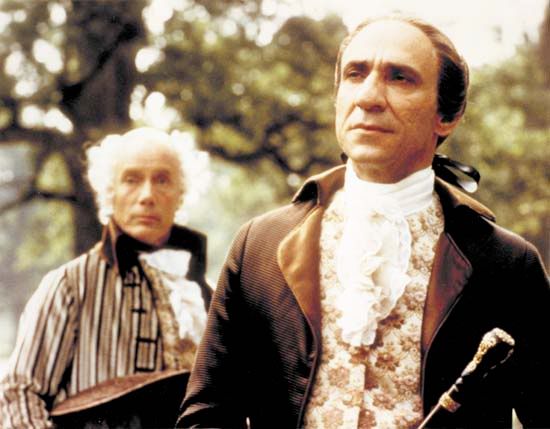
 Hands up who hasn’t felt jealous of someone else’s talent at some point in the past? Jealousy, is, after all, innate. One poor sod who’s life was driven by his jealousy is Antonio Salieri, who, for all his mediocre, even semi-decent musical talent, never matched the level of genius attained by Mozart. And, whilst Salieri slaved away, devoting all his time to form his passable scores, Mozart’s came naturally. In fact, considering Mozart’s hedonistic and general sloppy living, his musical talent came to him in spite of, rather than because of his lifestyle. This fact drove Salieri crazy, letting this take over his life, as he devoted all his energy into somehow evening out the score.
F. Murray Abraham plays the lead in a beautifully controlled depiction of jealousy, resentment and rage, all hidden under a façade of that carefully forced smile. Tom Hulc
 e is terrifically annoying as Mozart; his crazy high-pitched laugh rang in my ears long after the credits rolled. Amadeus was the last movie to bung two actors in the Best Leading Actor category at the Oscars. Had Hulce been pushed for supporting, he very probably would have won. As it was, he went up against his co-lead Abraham, who won the Oscar, perhaps the first time Salieri has done one over on Mozart.
The film is gorgeous to look at and listen to. Many of Mozart’s most sumptuous pieces are used throughout. The film carries a tone of underlying sadness throughout, but that doesn’t mean our eyes and ears aren’t deprived of a treat throughout. The costumes, so intricately designed, evoke the feel of 18th century Europe, and the sets, so cleverly architectured, succeed in capturing the grand scale of the opera houses.
Adapted from Peter Schaffer’s play, the script modulates from moment of great comedy to desperate sadness. The story is told in flashback by Salieri, who now resides in a mental asylum and has just had a failed suicide attempt. As a sympathetic priest listens to his tale, Salieri recounts his traumatic and disturbing tale. The direction of F. Murray Abraham is wonderful, both restrained and indulgent, it captures the many sides of the composing industry as well depicting the sadness of the human condition.
The fact that the film is so historically inaccurate does not matter a jot. Rather than attempt to paint a vivid picture of Mozart’s life, Forman instead goes for a painting of jealousy, and in doing so, he has achieved his masterpiece. The title, Mozart’s middle name, “Amadeus”, translates to “Loved by God”, and Salieri spends the whole film opining as to why it is Mozart who chooses to be loved, not him. Mozart, who seemingly has no appreciation of his massive talent, and chooses to piss and debauch his life away rather than making the most of it. And this is the central message of Amadeus: hard as it is to accept, sometimes it is those that deserve it the least are blessed the most.

