Showing posts with label Billy Wilder. Show all posts

Thursday, January 19, 2017

Review of the 133 films I watched in 2016 [with BBFC analysis]

I’m slowly going through my review of 2016 releases, one blog post per week (backlog: un et deux). As I still have quite a lot of the 2016 awards-nominated films to see and thus don't want to complete my 'review of the year' without giving them a chance first, I thought I’d buy some time by looking at all the films I watched in 2016, not just the ones that were released that year.

I watched 133 films in total last year, in a mixture of mediums, from at the cinema (my Cineworld Unlimited and Odeon Unlimited cards have both recouped their charges), at the cinema with ISENSE, whatever that is, on DVD, on the TV, on Netflix and Amazon Prime, and a few other mediums that I shan’t detail.

The arithmetic mean for the 133 films I gave out of ten was 6.54, which unfortunately shows some erroneous decision-making on my part, given I generally only watch a film if I expect it to be 7/10 in quality.

However, the appearance of a couple of lesser-seen films with my favourite actresses in, Saoirse Ronan and Rooney Mara, on Netflix, including a couple of real stinkers (Lost River, Dream Boy, Dare, Trash), would have no doubt bought this average down. Plus, while catching up with the 2015 Oscar-contention films, there were a handful which I didn’t think were that great, but watched for the sake of completeness (eg The Revenant and The Big Short), so they, too, would have skewed the average.

I recently went on an R course, so here be three graphs that indulge my statistical fascination with films (and the BBFC in particular).

Thursday, October 13, 2016

Things I Learned from the Movies: 5 Life Lessons from Romance

This blog entry is my submission to Speakeasy’s Things I Learned from the Movies blogathon. I thought I’d share five invaluable lessons that I learned from devouring so many romantic films. Because romance is the warmest genre.

Vague spoilers for Blue is the Warmest Colour, Café Society, Carol, Cinema Paradiso, Slumdog Millionaire and Some Like it Hot follow!

--

05) Sometimes it’s not about changing the other person. It’s about changing yourself. (Carol)


Carol, my favourite film of 2015, has plenty to recommend about it: flawless performances, and chemistry between, Cate Blanchett and Rooney Mara. Sensuous cinematography and production design that transported me right back to 1950s Manhattan. Carter Burwell’s swoon-worthy score. Todd Haynes’ subtle, meticulous direction, never putting a prop wrong.

But what I really love about Carol was how Therese Belivet (Rooney Mara, on transcendent form, and despite the Weinsteins forcing her to commit category fraud at the Oscars, very much a lead performance) transformed over the course of the film. At the beginning she is so wide-eyed and callow that she even mimics what Carol orders for lunch. Her eagerness to please the sophisticated older woman proves to be her downfall, leaving her exposed and a sitting duck to have her heart broken.

At the end of the film, however, we notice how this bruising experience has moulded her. She isn’t the pushover she once was, standing up to Carol when they next meet, and whilst Carol is taken by surprise about this, this makes the older woman respect her more. The closing shot of the film, where the two smile at each other across a crowded restaurant, tantalises with hope, but at the same time, is intelligent enough not to make any empty promises.

The love story in Carol encapsulates that age-old adage: how can someone else love you when you don’t love yourself? Therese’s head-over-heels passionate voyage with Carol was more about finding herself than it was the titular character.

--

04) Sometimes, the improbable happens. (Slumdog Millionaire)

It was Jane Austen who observed ‘Friendship is certainly the finest balm for the pangs of disappointed love’. Whilst I don’t refute this, I have another route I take when I don’t want to piss off my friends by ranting about the same cnutty boys hi Wasteman. Hi Boy with the Forest Tattoo / Wolf of Fleet Street. for the ten thousandth time: movies. And Slumdog Millionaire is one of my favourite feel-good movies.


Danny Boyle’s multi-Oscar winner Slumdog Millionaire is regarded by many a sniffy film critic as one of the weakest films to win Best Picture (and they would be wrong in that assertion. That would be Crash). But I bloody love this movie.

The film revolves around a youth from an impoverished part of Mumbai who, from personal life experience, is able to correctly answer all 15 of the questions and win Who Wants to Be a Millionaire, as well as the heart of the girl he’s adored since childhood.

In theory, I should be averse to such a film, as my chief criticism of a lot of the romances I watch are that they are projecting dishonest messages to the audience, an audience of which will surely include impressionable young girls who will take what they see at face value. As a more distrustful 26 year old woman (dating in London means I’ve met far too many Ben Afflecks in Gone Girl-type clowns, let me put it that way), I know better.

But such is the thrill and entertainment value of Slumdog Millionaire that I was able to take off my cynic’s hat and not only forgive the film its contrivances, but positively bask in them. Slumdog Millionaire is a fairy tale. Such a story would never happen to me. But that doesn’t make Jamal’s quest to find Latika any less touching.

No one in the corner has swagger like them.

--

03) Well, nobody’s perfect (Some Like it Hot)

A pithy lesson, but an important one. Some Like it Hot, Billy Wilder’s fabulous film about two jazz instrumentalists who go on the run from the mob and disguise themselves as women, has inspired many imitations (for example, the very amusing White Chicks), but the original remains the blueprint.

Even without an important life lesson, I strongly recommend y'all watch Some Like It Hot. It's got sensational zingers (Marilyn Monroe's curvy figure is described as 'Jello on springs'), a musical number with a very sexy Marilyn Monroe and all manner of comedy of errors. 

Much of the laughs arise from Tony Curtis' playboy encouraging  Jack
Lemmon, who's female disguise who has caught the eye of Joe E. Brown's dim-witted millionaire, to lead him on, so that Lemmon can get access to Brown's yacht, which Curtis plans on wooing Monroe with. Does it pay off? Well, it's a romantic comedy...

The film’s most famous line comes at the very end. As the two men escape on a boat with their respective love interests, Lemmon's character takes off his wig, as a means of ending the facade and explaining why he can't marry his besotted admirer. Brown's response, 'well, nobody's perfect', is one of cinema's greatest punchlines.

Man isn't wrong, either.

-- 

 02) Even if it ended, that doesn't stop us dreaming (Blue is the Warmest Colour and Café Society)


The dreamy look that came over Jesse Eisenberg’s Bobby and Kristen Stewart’s Vonnie in Café Society simultaneously as they are on opposite coasts of the United States was some of the most emotionally honest storytelling Woody Allen’s given. Similarly, the ambiguous ending of Blue is the Warmest Colour has Adèle Exarchopoulos still not moving on from the love she shared with Léa Seydoux’s arty Emma, some years after the relationship broke down.

I've included these two examples although there are a tonne of moments of people savouring momentos from past lovers that have affected me (Ennis cradling Jack's shirt in Brokeback Mountain was heartbreaking), because they illustrate two instances of longing: mutual and unrequited. Regardless of whether, like in Café Society, that melancholy feeling is shared, or in Blue is the Warmest Colour, the object of longing has moved on, in both cases, it's best to just cherish the memories.

Cherish the memories and let it be.

There’s nothing wrong with giving old relationships the odd flitter of thought now and then. There are many good reasons why you’re not with that person any more. But the fact that you still occasionally think about them merely shows that what you had was of substance.

--

01) Life isn’t like in the movies (Cinema Paradiso)

Cinema Paradiso is a film that means a lot to me, because it conflates the two elements that define my existence: love of cinema, and having a tendency to fall truly, madly, deeply, in love. 


The film charts a young lad, Salvatore’s journey through adolescence and adulthood and the role his local cinema plays on his formative years. At the age of 6, his passion for films and cheeky nature catch the eye of Alfredo, the cinema’s elderly projectionist. Salvatore comes to view Alfredo as a father figure and asks him for advice when he falls hard for the local beauty, Elena, to which Alfredo offers guidance, often in the form of movie quotes.

As life gives him lemons, Salvatore comes to realise that life isn’t quite like the stories shown on the screen, where the love interests always end up together and tribulations of life evaporate. Reality isn’t like that, and Salvatore’s idealised imagining of the world, etched so deeply into his cerebrum from his many hours spent at the cinema, render this harsh lesson ever the more poignant.

It’s a straightforward story, but gorgeously told, and the way Salvatore’s amorous experiences and his cinema-going ones dovetail with each other to build his character, is something that resonates deeply with me. To this day, I’m incapable of hearing Ennio Morricone’s ‘Love Theme’ without crying.

Life doesn't turn out how like in the films. The boy doesn't get the girl. He might get someone else instead, and that person could well be even better.

Ironically, only a film could show me such a crucial lesson.

--

Gosh, I love romantic films so much!

If you're new to my blog, holla! If you'd like a flavour of what I cover on my blog, check out my archives!

Tuesday, May 17, 2016

The Day I Met Per Mertesacker in Sushisamba.


I was in Sushisamba with Anna (my best friend who this blog is named after) on Saturday evening, and out of the corner of my eye, I clocked someone who resembled PM a lot. I wasn't certain it was him though (the lighting in the Sushisamba bars is very dim), so I took a photo on my phone to investigate. As soon as the flash went off, the guy in question covered his face, which was basically an admission of guilt on his part. Not to be deterred by the fact that he obviously wanted a quiet drink and not be bothered, I gulped down my wine for a bit of Dutch courage, and approached the 6'6'' giant.

To Mertesacker's credit, he was very classy and obliging given this sort of thing happens to him all the time. I didn't give any intimations that I was, in fact, a Chelsea fan, and instead just gabbled 'I can't believe it's really you!!!' Smooth. But, despite recognising what an inconvenience I was, I still forced his friend to take a second photo, in case the first didn't turn out that well.

Koscielny and... Mertesacker? HAHA.

And, much as it will damage my Chelsea Girl credentials to concede it, Mertesacker is much more handsome up close and in photos than he is during games when he's being oafish and getting sent off against us because he can't deal with Costa.

One last thing: when I bothered his friend to take another photo, Mertesacker said something to the friend in German and he looked at my breasts. Given that I'm not quite dressed like a nun and the revealingness of the dress (I bought it because I thought it had an element of Marilyn Monroe in The Seven Year Itch about it), we'll allow Mertesacker this one.

Sunday, March 21, 2010

You’re very unsatisfactory, scram.

Photobucket
Only saw six movies in two weeks. Poor.

Dorian Gray (Oliver Parker, 2009)
Curious little adaptation of Oscar Wilde’s world-known novel. The acting from Ben Barnes was ok, Colin Firth was amazing as ever and I was absolutely beguiled by Ben Ben Chaplin’s depiction of Basil Hallward, but Rachel Hurd-Wood was turdtacular. Dorian Gray’s downfall was interesting and bizarre at the same time, and the way the painting of him deteriorated over time was genuinely creepy. The rest of the film itself was pretty unspectacular.

Bright Star (Jane Campion, 2009)
I expected to loathe this film, as Luke and I saw the trailer to it many, many times, and lol’d each time. However, I ended up loving it. I just adored how unashamedly old-fashioned and uncool the film was, as well as the sheer love and depth of emotion on display. Ben Wishaw and Abbie Cornish made a terrific couple and their interactions were beautiful. The entire film built up to one, solitary kiss (aye, there are no bunging scenes at all in this love story), and the kissing, when they came, were so moving and powerful. The ending, as you’ll know, was heartbreak, but I got a bizarre sort of relief from the sadness and woe. Gorgeous movie, inside and out.

Inglourious Basterds (Quentin Tarantino, 2009)
Photobucket
LOVE THIS FILM

Hairspray (Adam Shankman, 2007)
Photobucket
Aww! One of the sweetest, loveliest, most enjoyable films I’ve seen in my life. Nikki Blonksy is terrific fun in the lead, and I loved so many of the songs: The Legend of Baltimore Crabs, I Can Hear the Bells, Good Morning Baltimore, Mama I’m a Big Girl Now, and more. The supporting cast were all wonderfully charming: Amanda Bynes, adorably dappy, Queen Latifah oozed wisdom, Michelle Pfieffer made a delicious bitch and John Travolta was loltacular. Also, I feel so dirty saying this considering the amount I’ve slagged him off in the past, but, I’m starting to accept my crush on Zac Efron. He can be rather awesome sometimes, and in Hairspray, he was. Anyway, so much fun, and I loved all the messages it promoted: equality, the power of friendship, and it’s what on the inside that counts.

The Last Seduction (John Dahl, 1994)
Famous for that scene against a fence, Linda Fiorentino is half-fierce, half completely psychotic as Bridget, a modern day femme fatale. The background music was so Sex and the City-esque, which gave mixed messages about the genre about the movie, but, not putting it into boxes, I totally enjoyed it .The plotting was intelligent and appropriately cruel and there were plenty of moments of black comedy.

The Major and the Minor (Billy Wilder, 1942)
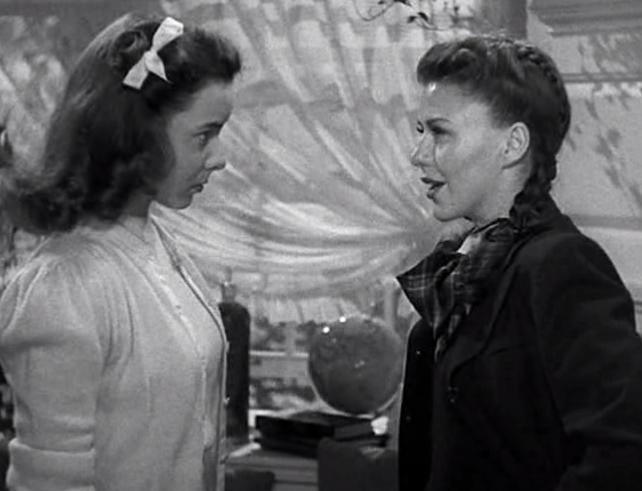
Terrific fun! Ginger Rogers ditches the all-singing, all-dancing schtick she usually does (though she does get to display her happy feet, albeit briefly) plays a woman who masquerades as a 12-year-old girl to avoid paying the full train fare. In doing so, she meets Ray Milland’s army major, a nice, charming, but slightly guileless guy who believs her when she lies about her age. He takes to becoming her uncle and introduces her into his world (including a less-than-keen fiancé), but, rather predictably, both parties end up falling for each other. A wonderful prelude to the gender-swapping in Some Like it Hot, The Major and the Minor instead deals with age-lying, with Ginger Rogers giving a brilliantly double-edged turn; sweet and sour, she’s 12 and 21 at the same time. There are some sequences when the young army trainees who date Rogers try to shag her which border on paedophilic, but on the whole, it’s a wickedly funny comedy of errors. The title is also a work of genius =)

Saturday, March 06, 2010

7. The Apartment (Billy Wilder, 1960)

I love to laugh. Whether it be at some lame inside joke with my mates, laughing at silly lines in old episodes of Friends or laughing uproariously at stand-up comedy, I believe that laughter is terrific for the soul. Sadly, it isn’t all fun and games in my top 10, where there are 9 drama/romances and just the one comedy. And even the comedy, by the director and star’s standards, are surprisingly somber at times. The movie in question? The Apartment.

Photobucket

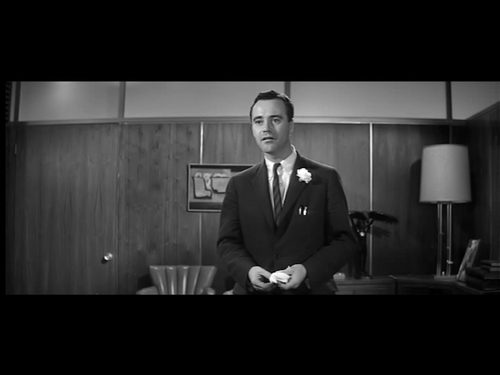
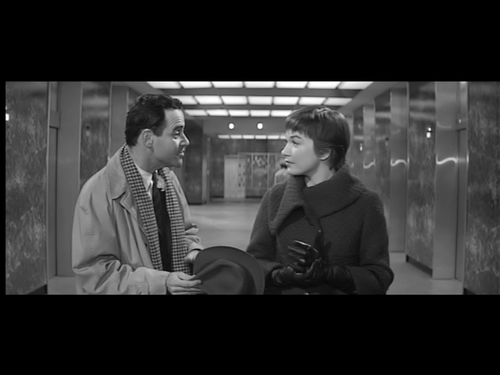
It’s 60s New York City and the protagonist, the kookily named C. C. Baxter (Jack Lemmon) has a dead end job and an even more lamentable love life. He has an apartment on the Upper West Side (there’s your Sex and the City-style location referencing), which he lends the key out to four of his managers, so that they can take their mistresses there and bung without their wives finding out. It’s not a position C.C. particularly enjoys being in, but he’s not one for confrontation so he expresses his displeasure by purposely mixing up his workmates’ liaisons. Meanwhile, C.C. finds his eye caught by Fran Kubelik, the elevator operator from where he works. C. C.’s apartment earns him glowing reports from all four
managers and following that a promotion, though his director Mr Sheldrake suspects something. He allows for the promotion, only on the condition that he can also use the apartment, to which Baxter, delighted with his promotion, acquiesces. It probably won’t surprise you to hear that Sheldrake arranged the apartment to use with Fran Kubelik, thus making for a very dysfunctional love triangle.

At the time of its release, the themes of infidelity depicted in The Apartment meant it made for uncomfortable watching amongst American audiences, who until then had led a sheltered cinema-going experience where all is well and the only bad things in a marriage is when the wife undercooks the breakfast. As such, the film received pretty bad reviews. By today’s standards, however, the film is an extremely smart satire on the working world and the so-called “sanctities” of marriage, and one only needs to look in a local workplace or an ailing marriage and a husband with a wandering eye to know how this cynical film hits the nail on the head.

The wonderful thing about C.C. Baxter and Fran Kubelik is that they’re both far from perfect, getting themselves into some sticky situations, but the joy of it all is that they can get themselves out of it. Jack Lemmon, in one of his best roles, is wonderful as the mild-mannered, exploited Baxter, who’s sense of moral values leave him with precious little. But the star of the show is easily Shirley MacLaine, who shows the world that she’s more than just a pretty face. Her acting skills are truly tested as the complex Fran; smart and together at the start, a complete wreck in her confrontation with Mr Sheldrake, but sharp and getting some of her swagger back by the end. It’s a glowing and multi-layered performance that cemented MacLaine’s place as a true auteur. Fran likes C.C., for his kindness and warmness, but her feelings aren’t quite as ardent as his towards her, and it is both refreshing to see a film wherein it is the woman who is the more disinterested party, yet equally frustrating, because C.C. is a much better match for her than Mr Sheldrake ever could.

As you’d expect from a Billy Wilder film, the screenplay is flawless, taking us from one genre to another. The dialogue feels unforced and natural (C.C. Baxter could be the guy in the supermarket who you’ve known for ages), at the same time holding some wonderful repartee and sparring. Shirley MacLaine once revealed in an interview that much of The Apartment was improvised by the actors as they went along. It’s these little touches – along with the strong plot based on the script – that elevate this film out of “standard romantic comedy” territory, such as Jack Lemmon humming as he prepares the meatball sauce. There are moments in the film when things turn extremely sour and the tone is almost desperate, but Billy Wilder, being the expect director that he is, knows how to balance these emotions perfectly and make light of even the deepest sadnesses.

Like many of the films in my top 10, The Apartment is a romance. Unlike the other nine, it is a comedy. But within the comedy, there is also tragedy. We see good people compromising their principles in order to get a step up in the working world, as well as how love can lift you up, then, just as you’re feeling nothing can bring you down, give you a gigantic kick in the bollocks. In this love story there is duplicity, infidelity, depression, loneliness and despair aplenty. The Apartment doesn’t sugarcoat things like plenty of other films from that era did, and its honesty – and cynicism is invigorating. Because, at the end of the day, love ain’t all a bed of flowers, but Fran’s ambiguous closing line hints that she may or may not be willing to give it another chance.

Friday, April 03, 2009

The Simpsons, Season 20, Episode 13: Gone Maggie Gone.


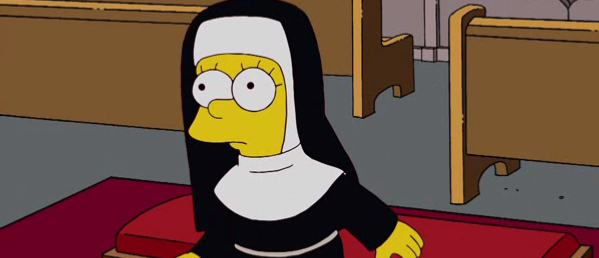
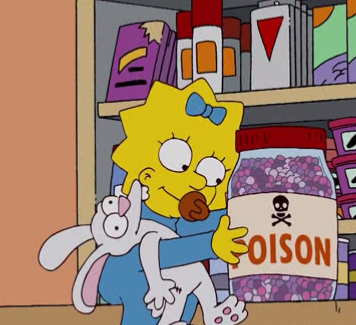
The Solar Eclipse hits the world, and, as Kent Brockman declares, "A solar eclipse is like a woman breast-feeding in a restaurant - it's free, it's beautiful, but in no circumstances should you look at it." Springfrield residents are recommended to look at it through a Camera Obscura, but Homer being Homer, breaks his before they can get started and Marge being Marge, donates her to him to keep him happy. Unfortunately, she decides straight away that she wants to look at the Solar Eclipse, and in erroneously looking straight at it, goes blind. Without her sight, Homer is assigned all the housely chores, all of which he neglects, leading to their home to be infested by rats. On his way back from buying poison, Homer crashes their car and in rowing back across the water, he abandons Maggie, who gets taken in by the local nunnery, who refuse to give her back to her incompetent father. It's up to Lisa to get her little sister back by infiltrating the nunnery and solving a stage of convoluted clues to unearth a Da Vinci Code-style secret.

Photobucket

I deeply enjoyed this episode of The Simpsons. Although there were no real belly-laughs, you could tell quite a bit of thought had gone into the The Da Vinci Code parodying. There were nods to other films too - Ratatouille and The Seven Year Itch, namely, as well as witty one liners - "if you're happy and you know it that's a sin." The funniest part was easily when an Ed Begley solar powered car stopped right in front of a solar powered train... which also stopped. Heehee.

Saturday, March 22, 2008

19. All About Eve (Joseph L. Mankiewicz, 1950)

omgz i wrote something?!!


All About Eve came out in 1950, the same year as Sunset Boulevard, Billy Wilder’s subversive portayal of Hollywood and its actors. Mankiewicz was equally scathing in his look at the world of Broadway stage, portraying the mythical ruthlessness and petulance of stage actors. Both were big hits, and All About Eve was nominated for a record fourteen Oscars, winning six, including Best Picture, Best Director, and Best Writing.

It’s the best film about theatre that I've seen, also happening to say more about the film industry too. Sunset Boulevard might be the film about stars that dwell in the glory days of the past and live in self-delusion, but All About Eve demonstrates how they allowed their egos to get like that.

Like Sunset Boulevard, All About Eve tells its story in the form of a flashback. It all kicks off with the presentation of a prestigious stage-acting award to the eponymous Eve Harrington, accompanied by the commentary of theatre critic Addison DeWitt (George Sanders). He introduces us to the players in the world of Broadway before we go 9 months back in history before Eve was a star.

The film then charts the story Eve and how she has wormed her way into the acting clan. She does so by getting into a circle of theatre friends around an aging (and insecure about it) actress Margo Channing, whom she attempts to be a protégé of, using her a persona of friendliness and self-deprecation to mask a sinister plan of getting to the top.

All About Eve is an absolute treat in terms of acting. The role of the older actress, Margo Channing, was considered for a range of in-form actresses, from Gertrude Lawrence (wanted script changes that the director did not), Susan Hayward (too young), Claudette Colbert (pulled out back injury), Marlene Dietrich (Mankiewicz didn't love her), and Ingrid Bergman (would not leave Italy) before Bette Davis was finally chosen.

It’s the role of her lifetime, playing a character that ran only too true – a brilliant actress, but one who felt her time was running out. Bette Davis knew she was handed a dream role when she was cast as the resolute diva caught up in the throes of mid-life crisis both on- and off-stage, and she’s amazing her in performance. She’s selfish and tough yet at the same time, vulnerable and insecure.

Getting suspicious about her increasingly distrustful follower Eve, Margo lets her friends know that she doesn’t trust her, though they, taken to Eve’s put-on niceness, disagree, mistaking her fear for jealousy and harshness. Not willing to resolve the problem in a dignified way, Margo goes on a rampage and has a go at anyone who comes near her.

Bette Davis was born to play Margo Channing and, in my opinion, is even better than Swanson in Sunset Blvd. She can be a catty cow or a coy pussycat, and Davis loves every scene she gets to tear into. At the same time, however, she evokes real sympathy for Margo. The film may be titled All About Eve, but Margo is and always will be the real star of the movie.

Her supporting cast are to die for. Celeste Holm is excellent as Margo's sensible best friend, who at first is on Eve's side but eventually sees how conniving she can be and how ruthless she is in climbing to the top. When she took on the narration, I just got the feeling that things would turn out alright for Margo. She's the closest character to any of the audience throughout the movie, as, she is pretty much a spectator herself.

Gary Merrill and Hugh Marlowe are a joy in their respective roles as Margo’s boyfriend and playwright. George Sanders plays his trademark role as the cad with such cynicism and unfriendliness that it’s no wonder he bagged the Oscar. As the diabolical theatre critic, he has some of the best lines of the movie.

Thelma Ritter again proves why she is the best supporting player in the biz - as coarse but loyal Birdie Coonan, a member of Margo's "drone". Anne Baxter is pretty good as the sneaky Eve, though obviously my opinion of her performance is tainted by the fact that I despise her character (realistic as it was). There’s even space for a Marylin Monroe cameo, in which she steals the show in the ditzy-blonde trope that she would carry for the rest of her acting life.

All About Eve's screenplay is another one of its assets. Written by director Joseph L. Mankiewicz from the Mary Orr play "The Wisdom of Eve," it features strong characters and great dialogue that is witty, bitching and biting. Despite its running time, at nearly 2 and a half hours, it never drags on. Each of the characters are so perfectly drawn, you could imagine them doing things just like that in the 50s.

Femininity, aging, betrayal, manipulation and ambition are just a few of the themes touched upon in All About Eve. It's funny, but it's also a lot cleverer than it looks. It's got melodrama, yet somehow never goes over the top. All About Eve takes the age-old story of a young performer buttering up an old one, with the intention of usurping them, but makes it into something new, something utterly brilliant. Not to be missed.

10/10