Monday, April 23, 2007

Happy Birthday, Mr. Shakespeare.

In honour of this very special occasion,Coffee, coffee, and more coffee is holding a Shakespeare on Film blogathon. My contribution to this will be…

Top 5 Cinematic Hamlets.

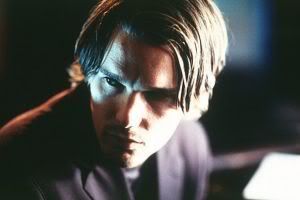
05. Ethan Hawke in the 2000 Michael Almereyda version.
Mr. Hawke does a fantastic job in the role, giving us the moody, confused, lovesick, and ultimately self-destructive adolescent that Shakespeare intended. His performance fits the contemporary style of the movie’s perfectly. Quite fine too. :P

04. Derek Jacobi in the 1980 Rodney Bennett version.
An actor who has appeared in many Shakespeare adaptations, including playing Claudius in Branagh’s 1996 version, Derek Jacobi captures the true essence of the character, from the beginning to the brutal climax. His experience of Shakespeare shows through, and, through him, Hamlet is a dreamer, a plotter, a voyeur in the corrupt court of Denmark. He makes the four hour epic worth the watch.

03. Kenneth Branagh in the 1996 self-directed version.
Probably my favourite cinematic version of the play, and, in my opinion, the truest to the original source. Some have dubbed his performance Hammy, but I think he played out his character exactly as Shakespeare intended, with the audience continually second guessing his supposed madness. His sharp, irresistible performance is one of a kind, and manages to stand out in a supporting cast that boasts the likes Judi Dench, Julie Christie, Helena Bonham Carter and Jack Lemmon.

02. Simba in The Lion King.
Yes, really, The Lion King. The Hamlet influences are clear, think about it! And Simba was such an influential movie character to me ever since I was little, that I just had to list him. In The Lion King, the role of the young prince whose father is murdered is embodied in the rookie form of Simba, whose naiveté procures him more than his fair share of hardships and troubles. But watching his trials and tribulations are an utter delight for the audience, and I adore every second of this movie. Although much of entertainment make it appear like nothing but a Disney singalong, if we probe deeply enough, we can find connections to some of the greatest literature of all time. Can you feel the love?

Zummer.

01. Laurence Olivier in the 1948 self-directed version.
The pace is slow, at times it feels stiff and artificial, the woman who plays Ophelia is a joke, but this movie has to be seen, if only for Olivier’s master class in acting. As the man who cannot make up his mind, his subtle acting brings to his role a deep understanding of his character's inner struggles and dilemmas, both moral and practical. Through him, Hamlet is every bit the enigma we read about: dignified and noble, reserved and mistrustful, emotional and ruthless, and deeply, deeply frustrated. And his soliloquies shall blow you away. Already an international star from his turn in Henry V, he won an Oscar for his work here, but didn’t bother to turn up to collect it. Probably because his performance surpassed any awards; it truly is that good.


So, hope the Bard has a good one.

Monday, March 05, 2007

My 20 Favourite Performances of 2006.

This is a mixture of talent & personal liking, with the latter making 75% affect on the final rank. :)


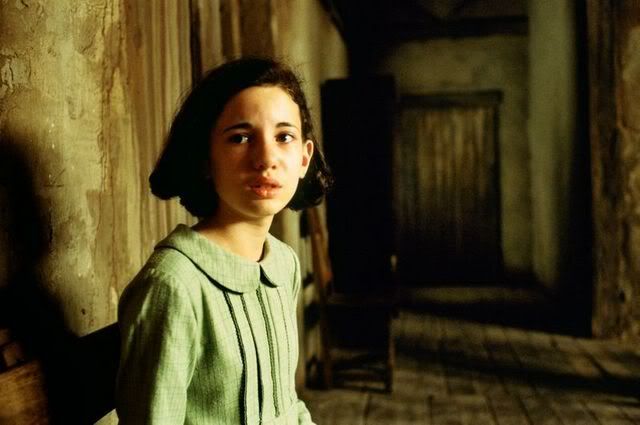
01. Ivana Baquero, El Laberinto del FaunoThe most breathtaking performance I've seen for a long, long time.


02. Leonardo DiCaprio, The DepartedYep.


03. Ryan Gosling, Half Nelson

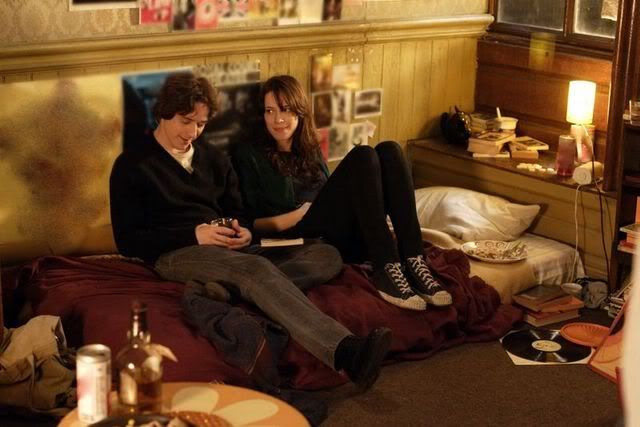
04. James McAvoy, The Last King of ScotlandHe'll be on the list later too.

05. Forest Whitaker, The Last King of ScotlandGreat performance. But McAvoy was better.

06. Emily Blunt, The Devil Wears PradaYep.

07. Penélope Cruz, VolverWonderful performance.

08. Helen Mirren, The Queen
Much praised, but definitely worthy.

09. Leonardo DiCaprio, Blood Diamond
Amazing.

10. James McAvoy, Starter for 10Yummy James.

The rest...

11. Samuel Barnett, The History Boys
12. Harry Dean Stanton, Alien Autopsy
13. Kate Dickie, Red Road
14. Shareeka Epps, Half Nelson
15. Danny Dyer, Severance
16. Peter O'Toole, Venus
17. Rupert Grint, Driving Lessons
18. Danny Perea, Duck Season
19. Jennifer Ehle, Alpha Male
20. Vera Farmiga, The Departed

Thursday, February 15, 2007

The sheet music for one of my favourite film tunes.

La la la..

La la la..

La la la..

That was the sheet music to Comptine d'un autre été by Yann Tiersen

Sunday, February 04, 2007

How effective is Act I as an opening to Arthur Miller’s The Crucible?

Written by Arthur Miller in 1952, The Crucible is a play in 4 Acts that recounts the chilling events leading up to the witch trials of 1692. Set in Salem, Massachusetts, the government is theocratic—rule by God through religious officials. At the centre of the play is John Proctor, an independent, confident, and essentially, good man, but one that made a mistake, a mistake that will cost him his life. Such a characteristic to the story is similar to that of in a tragedy, as The Crucible spirals into downfall, the hints that were left in Act I become more and more apparent.

Act I introduces to us many of the major characters. It displays the nature of these main characters, and this is the basis of why they behave like they do later. The Act opens with Reverend Parris praying for his comatose daughter. At first, it seems he is mourning for her health, but later, he tells Abi, “now my ministry’s at stake, my ministry and perhaps your cousin’s life.” This shows he values his job above his daughter’s life, and this gives a taster of his personality and the nature of his actions later on in the play; in Act 4, he pleads for the release of Rebecca Nurse and Proctor, not because he cares about them but for his own safety, “You cannot hang this sort. There is danger for me.” 

When he questions Abi, it’s because he fears that the girls were all engaging in witchcraft when he caught them dancing, and his worry is not of their safety, but his own reputation. Reputation is one of the main themes in The Crucible, and Parris is one of the men who value their reputations so much that they would give everybody else’s lives for the sake of their reputation.

Abigail Williams is also introduced, and on first meeting, the author’s notes read, “a strikingly beautiful girl, an orphan, with an endless capacity for dissembling.” This is shown when Parris accuses her of conjuring in the forest and she denies it, although, later, with the girls, she gives them instructions on what to say happened, “tell them we danced”. Abigail is shown as the ringleader of the group of girls, “They’ll be calling us witches, Abby!” and fully able to control and manipulate each of them, “Let either of you breathe a word… and I will come in the black of some terrible night and I will bring a pointy reckoning that will shudder you.” In the “trance” of Act III, Abi is able to lead the girls perfectly, “Abby, you mustn’t!” This representation of Abigail causes the audience to fear and dislike her, which is exactly the dramatic effect desired of the antagonist.

The entrance of the protagonist, John Proctor, is a significant one. He starts by exercising power over his maid, Mary Warren, with, “I’ll show you a great doing on your arse one of these days,” proving him to be a tough character, unafraid of anyone else. However, when he is alone with Abigail, a different side of him is presented, as well as different side of Abigail. This encounter between Abigail and John Proctor will be the cause of everything, and Abi hints at this, “I have something better than hope, I think!” 

John is evidently over Abi, but as she is still in love with him, “I am waiting for you every night.” Her unrequited love drives the hatred of his wife, “She is a cold, snivelling woman, and you bend to her!” as well as hatred of the town, “I never knew the lying lessons I was taught by these Christian women and their covenanted men.” This offers foreshadowing - both of these will be brought together later; Abigail will make them all pay.

The set is described in detail to create the effect of austerity that the Puritans live in. The set is very bare, “clean spareness,” which leaves more room for the drama. The importance of religion to every character is portrayed, through the amount of prayer and hysteria caused through even the mention of witchcraft – “They’ll be talking of witchcraft”. Symbolism is used that will come up again, such as that of heat: “it’s cold in here yet,” is said by Proctor, and he is inadvertently also speaking of the relationship between he and Elizabeth.

Conflict features heavily in the play, and it is one of the dramatic elements used that makes the play so interesting. One of the main disagreements is between Parris and the other men; he complains that he is not given enough land, which again shows his mercenary disposition, “I am paid little enough without I spend six pound on firewood.” 

Another is between the Putnam family and Rebecca Nurse – Rebecca has had many children, and they only have one, “You think it God’s work that you should never lose a child and I have all but one?” These little grudges held by each of the characters will re-emerge later in the play, and Act I lays some of the groundwork for upcoming accusations and the true motives behind them – Putnam uses the witch trials to increase his own wealth.

From conflicts come scapegoats, and the easiest target always suffers. Here, it is the women. Abigail, though clearly evil and disturbed, can be excused for her actions a little by the fact that she is a poor, unmarried orphan – seen as the lowest of social classes. As the men question Abigail on witchcraft, she looks for the easiest target to shift the blame, “I never called him! Tituba, Tituba.” By saving herself, she is also creating fear amongst others into respecting her. Tituba, whose has an even lower status because she is a slave, manages similarly to deflect blame by accusing, “Aye, Sir, and Goody Osburn.” 

This shows that to some, the accusations are every bit about survival as they are about retribution.

Rebecca Nurse is also an unlikely scapegoat – the good mother, good neighbour and general good woman. When others fret, she consoles, “Pray John, be calm.” Though she is killed, her inner strength influences the actions of John Proctor, “I speak my own sins, I cannot judge another”. Rebecca’s calmness and sincerity show her to be a symbol of the true goodness that the Puritans in this play claim to believe in. She is accused by Mrs. Putnam, who, having had 7 babies that all died on the day of their birth, convinces herself that someone used witchcraft to murder them, and will look for a person to blame, one that has everything that she has not. Act I hints shows the faction between the Putnam family and Rebecca Nurse, and later, Putnam uses the witch trials to express his feelings of persecution and undeserved failure, and to satisfy his need for revenge.
Act I is a gripping scene dramatically. It contains violence, “smashes across her face,” implied sex, “I know you sweated like a stallion whenever I come near!” all in a very compressed time frame. There is also the mystery of what actually happened in the woods, “I saw a dress lying on the grass.” There is plenty of foreshadowing in Act I, such Giles’ harmless ramblings about his wife, “And she closed her book… and I could pray again!”, which will be the cause of her death, “I only said she were readin’ books-”. The biggest display of foreshadowing, however, is when Abigail calls Goody Proctor a “gossiping liar;” she will later call her something else.

A critical motif in The Crucible is that of empowerment, and even from Act I, it is clear that it is the women that are empowered, such as Abigail to Proctor–he sleeps with her when he wants to, arousing feelings of deepest desire in her, then drops her when he decides he wants his wife instead. Such a treatment of women will surely cause them to fight back, for survival, as well as revenge. Over the next 3 scenes in The Crucible, many people will be accused, and for once, it will be the women doing the accusing. In Act II, Mary Warren says to Proctor, “I’ll not be ordered to bed no more, Mr. Proctor! I am eighteen and a woman, however single.” This has some dramatic irony, as Proctor orders her to court in the next scene, but she is able to turn on him, “I love God; I go your way no more.”

John Hale is a man that goes through immense character development through the play. In Act I, he is presented as a smug intellectual, “they are weighted with authority,” sure of himself as well as his beliefs. At the start, he is the force behind the witch trials, “We are going to help you tear yourself free”. However, as the play progresses, and he realises that it is the innocent who are going to die, he changes completely, doubting his faith, “cleave to no faith when faith brings blood.” In this sense, Act I offers some dramatic irony about the character of John Hale – a man whose faith seemingly means the world to him, yet, by the end of the play, turns against it. He is also important as contrast to Parris’ character – at the beginning and end of the play, they both want the same thing, but for different reasons. Parris wants worries for his safety, “I dare not step outside at night” but Hale worries for his conscience, “There is blood on my head!”

When Hale thinks Tituba has compacted with the Devil, he forces her into naming all the others, “does he ever come – with another person?” This act of naming is an essential element to the play, and come up many times, including in the climactic moment when John Proctor chooses to die. He cries, “Because it is my name! Because I cannot have another in my life! Because I lie and sign myself to lies!” This again shows the importance of reputation.

There is no truth to any of the naming that Abigail does, but the girls follow suit, to free themselves from any blame. The Act ends in a crescendo of voices, claiming to have seen people as witches. This is a climactic way to end a scene, marking a distinctive end, as well as keeping the audience gripped and awaiting what will happen next.

The play, though a tragedy, has some important messages at the centre of it – that good can come from evil, such as a higher, more emotional love between Elizabeth and John forming. Above all, The Crucible is a parable to the connection of private sins with paranoia, hysteria, and religious intolerance. It picks up on the unjustness of it all, and with some added dramatic techniques, The Crucible can act as a parable to any points of mass hysteria, including the McCarthyism of the 1950s. 

Act I is a gripping and revealing start to Miller’s haunting, lyrical play.

Monday, March 20, 2006

Film review: MILDRED PIERCE (Michael Curtiz, 1945)

Mildred Pierce is not having a good day. After an argument with her husband (chiefly about how she spoils her daughter), he leaves her for another woman. She turns to her daughter Veda for consolation, who merely whines about the state of a dress her mother has spent money on for her.


Desperate to gain her daughter's affections, Mildred finds a job as a waitress, and soon after gains the qualifications to launch her own brand of catering, gaining her success and wealth, as well as the attentions of a wealthy playboy Monte Beragon. But what Mildred really wants – the love of her daughter Veda - is still not received, and despite going to extreme lengths, never receives it.


In the lead role that won her an Oscar, the inimitable Joan Crawford is superb. In a time when melodrama was all the fashion, she goes all out in her performance, exhibiting a wide range of emotions. But despite the over-the-topness of her style of acting, she manages to make her character believable and accessible, and the audience are able to feel her love for her daughter, if not understand it. Veda is a black-hearted brat, and Ann Blyth depicts the sly cruelty of her character with frightening accuracy. The women are joined by an array of talented male players too.

There’s a clever storytelling device that has been adopted for this movie, of telling the story of Mildred’s life back in flashbacks. That, aided with Mildred’s narration, gives the film a hard, film-noir, edge, and there is plenty of 40s style suspense presented to us by capable hands. Under the direction of movie luminary Michael Curtiz, this is further accentuated.

But Mildred Pierce is in essence a melodrama (Max Steiner scoring? Hello?), and an extremely fine one too. Though the characters we meet are all quite detestable, Mildred, brought to us with perfect care by Crawford, is one that we’re rooting for throughout.

A

Thursday, February 23, 2006

What this is.

I absolutely adore films, so here's my lil' blog for 'em! It's gonna be an exercise in mediocrity, but oh well. I love to write!~~